题目描述 给定一个有环链表,实现一个算法返回环路的开头节点。
示例 1:
输入: head = [3,2,0,-4], pos = 1输出: tail connects to node index 1解释: 链表中有一个环,其尾部连接到第二个节点。
示例 2:
输入: head = [1,2], pos = 0输出: tail connects to node index 0解释: 链表中有一个环,其尾部连接到第一个节点。
示例 3:
输入: head = [1], pos = -1输出: no cycle解释: 链表中没有环。
进阶:
解法 方法一:快慢指针 思考
求环入口。哈希表记录已访节点,首次重复即入口,空间 \(O(n)\) 。
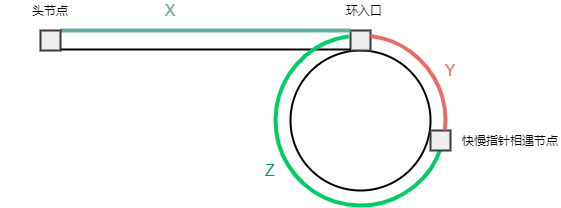
快慢指针若相遇则必在环上;再由头与相遇点同步各走一步,相遇处即入口。其正确性来自 \(x = (k-1)(y+z)+z\) 。
先让 fast 步长为 \(2\) 、slow 步长为 \(1\) 直至相遇(或 fast 为空则无环),再将 \(ans\) 从头出发与 slow 同速前进。不使用额外表。
我们先利用快慢指针判断链表是否有环,如果有环的话,快慢指针一定会相遇,且相遇的节点一定在环中。
如果没有环,快指针会先到达链表尾部,直接返回 null 即可。
如果有环,我们再定义一个答案指针 \(ans\) 指向链表头部,然后让 \(ans\) 和慢指针一起向前走,每次走一步,直到 \(ans\) 和慢指针相遇,相遇的节点即为环的入口节点。
为什么这样能找到环的入口节点呢?
我们不妨假设链表头节点到环入口的距离为 \(x\) ,环入口到相遇节点的距离为 \(y\) ,相遇节点到环入口的距离为 \(z\) ,那么慢指针走过的距离为 \(x + y\) ,快指针走过的距离为 \(x + y + k \times (y + z)\) ,其中 \(k\) 是快指针在环中绕了 \(k\) 圈。
由于快指针速度是慢指针的 \(2\) 倍,因此有 \(2 \times (x + y) = x + y + k \times (y + z)\) ,可以推出 \(x + y = k \times (y + z)\) ,即 \(x = (k - 1) \times (y + z) + z\) 。
也即是说,如果我们定义一个答案指针 \(ans\) 指向链表头部,然后 \(ans\) 和慢指针一起向前走,那么它们一定会在环入口相遇。
时间复杂度 \(O(n)\) ,其中 \(n\) 是链表中节点的数目。空间复杂度 \(O(1)\) 。
Python3 Java C++ Go TypeScript JavaScript Swift
 1
 2
 3
 4
 5
 6
 7
 8
 9
10
11
12
13
14
15
16
17
18
19
# Definition for singly-linked list.
# class ListNode:
# def __init__(self, x):
# self.val = x
# self.next = None
class Solution :
def detectCycle ( self , head : Optional [ ListNode ]) -> Optional [ ListNode ]:
fast = slow = head
while fast and fast . next :
slow = slow . next
fast = fast . next . next
if slow == fast :
ans = head
while ans != slow :
ans = ans . next
slow = slow . next
return ans
 1
 2
 3
 4
 5
 6
 7
 8
 9
10
11
12
13
14
15
16
17
18
19
20
21
22
23
24
25
26
27
28
29
/**
* Definition for singly-linked list.
* class ListNode {
* int val;
* ListNode next;
* ListNode(int x) {
* val = x;
* next = null;
* }
* }
*/
public class Solution {
public ListNode detectCycle ( ListNode head ) {
ListNode fast = head , slow = head ;
while ( fast != null && fast . next != null ) {
slow = slow . next ;
fast = fast . next . next ;
if ( slow == fast ) {
ListNode ans = head ;
while ( ans != slow ) {
ans = ans . next ;
slow = slow . next ;
}
return ans ;
}
}
return null ;
}
}
 1
 2
 3
 4
 5
 6
 7
 8
 9
10
11
12
13
14
15
16
17
18
19
20
21
22
23
24
25
26
27
28
/**
* Definition for singly-linked list.
* struct ListNode {
* int val;
* ListNode *next;
* ListNode(int x) : val(x), next(NULL) {}
* };
*/
class Solution {
public :
ListNode * detectCycle ( ListNode * head ) {
ListNode * fast = head ;
ListNode * slow = head ;
while ( fast && fast -> next ) {
slow = slow -> next ;
fast = fast -> next -> next ;
if ( slow == fast ) {
ListNode * ans = head ;
while ( ans != slow ) {
ans = ans -> next ;
slow = slow -> next ;
}
return ans ;
}
}
return nullptr ;
}
};
 1
 2
 3
 4
 5
 6
 7
 8
 9
10
11
12
13
14
15
16
17
18
19
20
21
22
23
/**
* Definition for singly-linked list.
* type ListNode struct {
* Val int
* Next *ListNode
* }
*/
func detectCycle ( head * ListNode ) * ListNode {
fast , slow := head , head
for fast != nil && fast . Next != nil {
slow = slow . Next
fast = fast . Next . Next
if slow == fast {
ans := head
for ans != slow {
ans = ans . Next
slow = slow . Next
}
return ans
}
}
return nil
}
 1
 2
 3
 4
 5
 6
 7
 8
 9
10
11
12
13
14
15
16
17
18
19
20
21
22
23
24
25
26
27
28
/**
* Definition for singly-linked list.
* class ListNode {
* val: number
* next: ListNode | null
* constructor(val?: number, next?: ListNode | null) {
* this.val = (val===undefined ? 0 : val)
* this.next = (next===undefined ? null : next)
* }
* }
*/
function detectCycle ( head : ListNode | null ) : ListNode | null {
let [ slow , fast ] = [ head , head ];
while ( fast && fast . next ) {
slow = slow . next ;
fast = fast . next . next ;
if ( slow === fast ) {
let ans = head ;
while ( ans !== slow ) {
ans = ans . next ;
slow = slow . next ;
}
return ans ;
}
}
return null ;
}
 1
 2
 3
 4
 5
 6
 7
 8
 9
10
11
12
13
14
15
16
17
18
19
20
21
22
23
24
25
26
27
28
/**
* Definition for singly-linked list.
* function ListNode(val) {
* this.val = val;
* this.next = null;
* }
*/
/**
* @param {ListNode} head
* @return {ListNode}
*/
var detectCycle = function ( head ) {
let [ slow , fast ] = [ head , head ];
while ( fast && fast . next ) {
slow = slow . next ;
fast = fast . next . next ;
if ( slow === fast ) {
let ans = head ;
while ( ans !== slow ) {
ans = ans . next ;
slow = slow . next ;
}
return ans ;
}
}
return null ;
};
 1
 2
 3
 4
 5
 6
 7
 8
 9
10
11
12
13
14
15
16
17
18
19
20
21
22
23
24
25
26
27
28
29
30
31
/*
* public class ListNode {
* var val: Int
* var next: ListNode?
* init(_ x: Int) {
* self.val = x
* self.next = nil
* }
* }
*/
class Solution {
func detectCycle ( _ head : ListNode ?) -> ListNode ? {
var slow = head
var fast = head
while fast != nil && fast ?. next != nil {
slow = slow ?. next
fast = fast ?. next ?. next
if slow === fast {
var ans = head
while ans !== slow {
ans = ans ?. next
slow = slow ?. next
}
return ans
}
}
return nil
}
}
GitHub