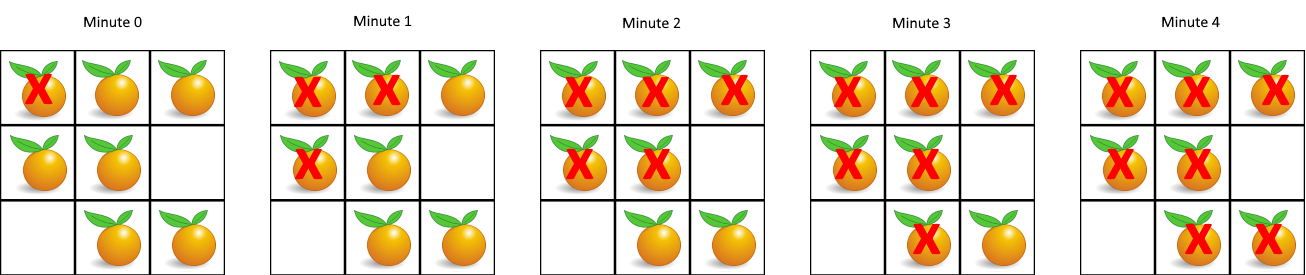
You are given an m x ngrid where each cell can have one of three values:
0 representing an empty cell,
1 representing a fresh orange, or
2 representing a rotten orange.
Every minute, any fresh orange that is 4-directionally adjacent to a rotten orange becomes rotten.
Return the minimum number of minutes that must elapse until no cell has a fresh orange. If this is impossible, return-1.
Example 1:
Input: grid = [[2,1,1],[1,1,0],[0,1,1]]
Output: 4
Example 2:
Input: grid = [[2,1,1],[0,1,1],[1,0,1]]
Output: -1
Explanation: The orange in the bottom left corner (row 2, column 0) is never rotten, because rotting only happens 4-directionally.
Example 3:
Input: grid = [[0,2]]
Output: 0
Explanation: Since there are already no fresh oranges at minute 0, the answer is just 0.
Constraints:
m == grid.length
n == grid[i].length
1 <= m, n <= 10
grid[i][j] is 0, 1, or 2.
Solutions
Solution 1: BFS
Thinking
Rot spreads to four-neighbors each minute; we want the time until every orange is rotten. Simultaneous multi-source spread is an unweighted shortest path. Enqueue every rotten orange and count the fresh ones, then BFS by layers. The layer that zeroes the fresh count is the answer; leftover fresh oranges yield \(-1\).
First, we traverse the entire grid once, count the number of fresh oranges, denoted as \(\textit{cnt}\), and add the coordinates of all rotten oranges to the queue \(q\).
Next, we perform a breadth-first search. In each round of the search, we let all the rotten oranges in the queue rot the fresh oranges in four directions, until the queue is empty or the number of fresh oranges is \(0\).
Finally, if the number of fresh oranges is \(0\), we return the current round number, otherwise, we return \(-1\).
The time complexity is \(O(m \times n)\), and the space complexity is \(O(m \times n)\). Where \(m\) and \(n\) are the number of rows and columns of the grid, respectively.