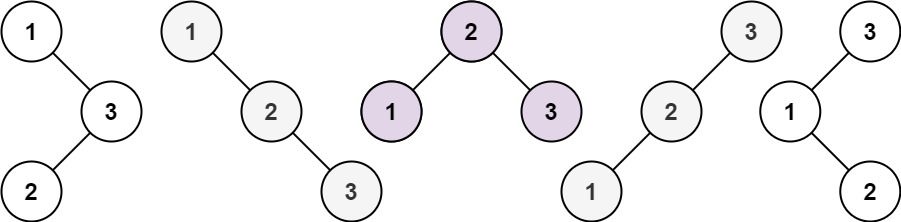
Given an integer n, return all the structurally unique BST's (binary search trees), which has exactly n nodes of unique values from1ton. Return the answer in any order.
Example 1:
Input: n = 3
Output: [[1,null,2,null,3],[1,null,3,2],[2,1,3],[3,1,null,null,2],[3,2,null,1]]
Example 2:
Input: n = 1
Output: [[1]]
Constraints:
1 <= n <= 8
Solutions
Solution 1: DFS (Depth-First Search)
Thinking
We need every BST on \(1..n\). Once the root is \(v\), the left subtree uses only \([1,v-1]\) and the right only \([v+1,n]\); the two sides are independent. Split by interval: enumerate the root, generate all left and right shapes, then take the Cartesian product. An empty interval is a null tree. \(n \le 8\), Catalan numbers stay small, so search is enough.
We design a function \(dfs(i, j)\) that returns all feasible binary search trees composed of \([i, j]\), so the answer is \(dfs(1, n)\).
The execution steps of the function \(dfs(i, j)\) are as follows:
If \(i > j\), it means that there are no numbers to form a binary search tree at this time, so return a list consisting of a null node.
If \(i \leq j\), we enumerate the numbers \(v\) in \([i, j]\) as the root node. The left subtree of the root node \(v\) is composed of \([i, v - 1]\), and the right subtree is composed of \([v + 1, j]\). Finally, we take the Cartesian product of all combinations of the left and right subtrees, i.e., \(left \times right\), add the root node \(v\), and get all binary search trees with \(v\) as the root node.
The time complexity is \(O(n \times G(n))\), and the space complexity is \(O(n \times G(n))\). Where \(G(n)\) is the Catalan number.
1 2 3 4 5 6 7 8 9101112131415161718192021
# Definition for a binary tree node.# class TreeNode:# def __init__(self, val=0, left=None, right=None):# self.val = val# self.left = left# self.right = rightclassSolution:defgenerateTrees(self,n:int)->List[Optional[TreeNode]]:defdfs(i:int,j:int)->List[Optional[TreeNode]]:ifi>j:return[None]ans=[]forvinrange(i,j+1):left=dfs(i,v-1)right=dfs(v+1,j)forlinleft:forrinright:ans.append(TreeNode(v,l,r))returnansreturndfs(1,n)
/** * Definition for a binary tree node. * type TreeNode struct { * Val int * Left *TreeNode * Right *TreeNode * } */funcgenerateTrees(nint)[]*TreeNode{vardfsfunc(int,int)[]*TreeNodedfs=func(i,jint)[]*TreeNode{ifi>j{return[]*TreeNode{nil}}ans:=[]*TreeNode{}forv:=i;v<=j;v++{left:=dfs(i,v-1)right:=dfs(v+1,j)for_,l:=rangeleft{for_,r:=rangeright{ans=append(ans,&TreeNode{v,l,r})}}}returnans}returndfs(1,n)}