941. Valid Mountain Array

Description
Given an array of integers arr, return true if and only if it is a valid mountain array.
Recall that arr is a mountain array if and only if:
arr.length >= 3- There exists some
iwith0 < i < arr.length - 1such that:arr[0] < arr[1] < ... < arr[i - 1] < arr[i]arr[i] > arr[i + 1] > ... > arr[arr.length - 1]
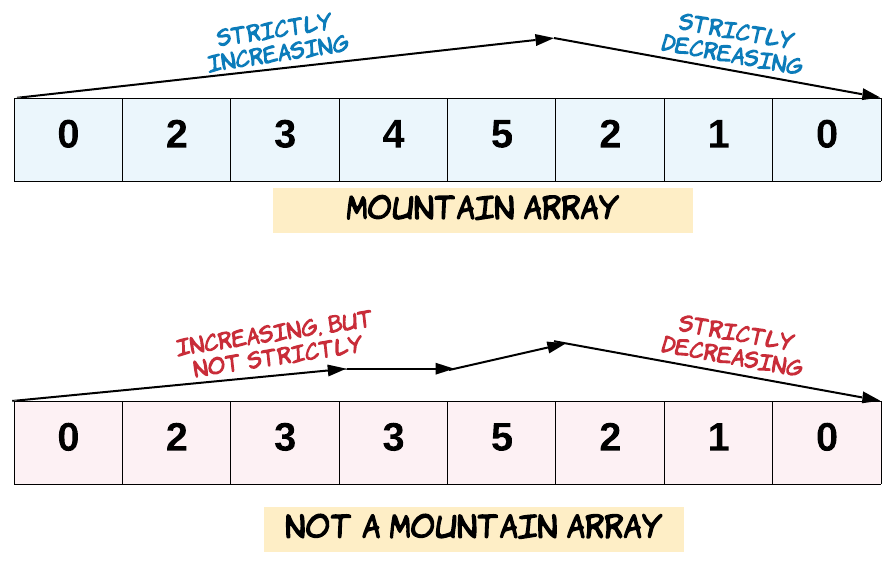
Example 1:
Input: arr = [2,1]
Output: false
Example 2:
Input: arr = [3,5,5]
Output: false
Example 3:
Input: arr = [0,3,2,1]
Output: true
Constraints:
1 <= arr.length <= 1040 <= arr[i] <= 104
Solutions
Solution 1: Two Pointers
Thinking
A mountain strictly rises then strictly falls, and needs length at least \(3\). Walk inward from both ends until the sequence stops rising or falling; the two peaks must meet and cannot sit on an endpoint. Each pointer moves once.
First, we check if the length of the array is less than \(3\). If it is, then it definitely is not a mountain array, so we return false directly.
Then, we use a pointer \(i\) to move from the left end of the array to the right, until we find a position \(i\) such that \(arr[i] > arr[i + 1]\). After that, we use a pointer \(j\) to move from the right end of the array to the left, until we find a position \(j\) such that \(arr[j] > arr[j - 1]\). If the condition \(i = j\) is satisfied, then it means that the array \(arr\) is a mountain array.
The time complexity is \(O(n)\), where \(n\) is the length of the array. The space complexity is \(O(1)\).
1 2 3 4 5 6 7 8 9 10 11 | |
1 2 3 4 5 6 7 8 9 10 11 12 13 14 15 16 | |
1 2 3 4 5 6 7 8 9 10 11 12 13 14 15 16 17 | |
1 2 3 4 5 6 7 8 9 10 11 12 13 14 | |
1 2 3 4 5 6 7 8 9 10 11 12 13 14 | |