Skip to content

938. Range Sum of BST

Description

Given the root node of a binary search tree and two integers low and high, return the sum of values of all nodes with a value in the inclusive range [low, high].


Example 1:

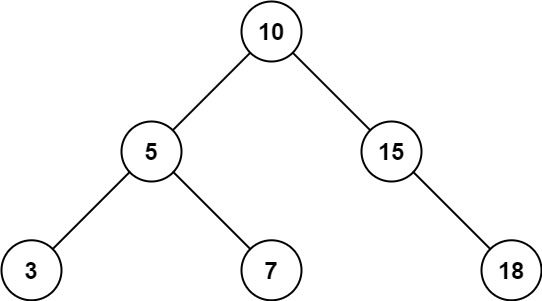
Input: root = [10,5,15,3,7,null,18], low = 7, high = 15
Output: 32
Explanation: Nodes 7, 10, and 15 are in the range [7, 15]. 7 + 10 + 15 = 32.

Example 2:

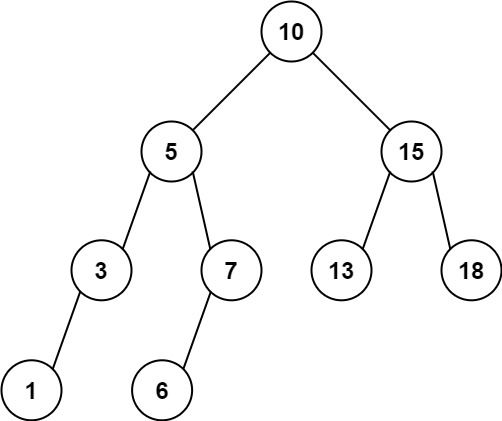
Input: root = [10,5,15,3,7,13,18,1,null,6], low = 6, high = 10
Output: 23
Explanation: Nodes 6, 7, and 10 are in the range [6, 10]. 6 + 7 + 10 = 23.


Constraints:

  • The number of nodes in the tree is in the range [1, 2 * 104].
  • 1 <= Node.val <= 105
  • 1 <= low <= high <= 105
  • All Node.val are unique.

Solutions

Solution 1: DFS

Thinking

Sum BST nodes whose values lie in \([low,high]\). A full traversal works, but the search-tree order prunes: skip the left subtree when the current value is already \(\le low\), and skip the right when it is already \(\ge high\). Recurse and add nodes that fall inside the interval.

We design a function \(dfs(root)\), which represents the sum of the values of all nodes in the subtree with \(root\) as the root, and the values are within the range \([low, high]\). The answer is \(dfs(root)\).

The execution logic of the function \(dfs(root)\) is as follows:

  • If \(root\) is null, return \(0\).
  • If the value \(x\) of \(root\) is within the range \([low, high]\), then the initial answer of the function \(dfs(root)\) is \(x\), otherwise it is \(0\).
  • If \(x > low\), it means that there may be nodes in the left subtree of \(root\) with values within the range \([low, high]\), so we need to recursively call \(dfs(root.left)\) and add the result to the answer.
  • If \(x < high\), it means that there may be nodes in the right subtree of \(root\) with values within the range \([low, high]\), so we need to recursively call \(dfs(root.right)\) and add the result to the answer.
  • Finally, return the answer.

The time complexity is \(O(n)\), and the space complexity is \(O(n)\). Where \(n\) is the number of nodes in the binary search tree.

 1
 2
 3
 4
 5
 6
 7
 8
 9
10
11
12
13
14
15
16
17
18
19
20
# Definition for a binary tree node.
# class TreeNode:
#     def __init__(self, val=0, left=None, right=None):
#         self.val = val
#         self.left = left
#         self.right = right
class Solution:
    def rangeSumBST(self, root: Optional[TreeNode], low: int, high: int) -> int:
        def dfs(root: Optional[TreeNode]) -> int:
            if root is None:
                return 0
            x = root.val
            ans = x if low <= x <= high else 0
            if x > low:
                ans += dfs(root.left)
            if x < high:
                ans += dfs(root.right)
            return ans

        return dfs(root)
 1
 2
 3
 4
 5
 6
 7
 8
 9
10
11
12
13
14
15
16
17
18
19
20
21
22
23
24
25
26
27
28
29
30
31
32
33
34
35
/**
 * Definition for a binary tree node.
 * public class TreeNode {
 *     int val;
 *     TreeNode left;
 *     TreeNode right;
 *     TreeNode() {}
 *     TreeNode(int val) { this.val = val; }
 *     TreeNode(int val, TreeNode left, TreeNode right) {
 *         this.val = val;
 *         this.left = left;
 *         this.right = right;
 *     }
 * }
 */
class Solution {
    public int rangeSumBST(TreeNode root, int low, int high) {
        return dfs(root, low, high);
    }

    private int dfs(TreeNode root, int low, int high) {
        if (root == null) {
            return 0;
        }
        int x = root.val;
        int ans = low <= x && x <= high ? x : 0;
        if (x > low) {
            ans += dfs(root.left, low, high);
        }
        if (x < high) {
            ans += dfs(root.right, low, high);
        }
        return ans;
    }
}
 1
 2
 3
 4
 5
 6
 7
 8
 9
10
11
12
13
14
15
16
17
18
19
20
21
22
23
24
25
26
27
28
29
30
31
/**
 * Definition for a binary tree node.
 * struct TreeNode {
 *     int val;
 *     TreeNode *left;
 *     TreeNode *right;
 *     TreeNode() : val(0), left(nullptr), right(nullptr) {}
 *     TreeNode(int x) : val(x), left(nullptr), right(nullptr) {}
 *     TreeNode(int x, TreeNode *left, TreeNode *right) : val(x), left(left), right(right) {}
 * };
 */
class Solution {
public:
    int rangeSumBST(TreeNode* root, int low, int high) {
        function<int(TreeNode*)> dfs = [&](TreeNode* root) {
            if (!root) {
                return 0;
            }
            int x = root->val;
            int ans = low <= x && x <= high ? x : 0;
            if (x > low) {
                ans += dfs(root->left);
            }
            if (x < high) {
                ans += dfs(root->right);
            }
            return ans;
        };
        return dfs(root);
    }
};
 1
 2
 3
 4
 5
 6
 7
 8
 9
10
11
12
13
14
15
16
17
18
19
20
21
22
23
24
25
26
27
28
/**
 * Definition for a binary tree node.
 * type TreeNode struct {
 *     Val int
 *     Left *TreeNode
 *     Right *TreeNode
 * }
 */
func rangeSumBST(root *TreeNode, low int, high int) int {
    var dfs func(*TreeNode) int
    dfs = func(root *TreeNode) (ans int) {
        if root == nil {
            return 0
        }
        x := root.Val
        if low <= x && x <= high {
            ans += x
        }
        if x > low {
            ans += dfs(root.Left)
        }
        if x < high {
            ans += dfs(root.Right)
        }
        return
    }
    return dfs(root)
}
 1
 2
 3
 4
 5
 6
 7
 8
 9
10
11
12
13
14
15
16
17
18
19
20
21
22
23
24
25
26
27
28
29
30
31
/**
 * Definition for a binary tree node.
 * class TreeNode {
 *     val: number
 *     left: TreeNode | null
 *     right: TreeNode | null
 *     constructor(val?: number, left?: TreeNode | null, right?: TreeNode | null) {
 *         this.val = (val===undefined ? 0 : val)
 *         this.left = (left===undefined ? null : left)
 *         this.right = (right===undefined ? null : right)
 *     }
 * }
 */

function rangeSumBST(root: TreeNode | null, low: number, high: number): number {
    const dfs = (root: TreeNode | null): number => {
        if (!root) {
            return 0;
        }
        const { val, left, right } = root;
        let ans = low <= val && val <= high ? val : 0;
        if (val > low) {
            ans += dfs(left);
        }
        if (val < high) {
            ans += dfs(right);
        }
        return ans;
    };
    return dfs(root);
}
 1
 2
 3
 4
 5
 6
 7
 8
 9
10
11
12
13
14
15
16
17
18
19
20
21
22
23
24
25
26
27
28
29
30
31
32
33
/**
 * Definition for a binary tree node.
 * public class TreeNode {
 *     public int val;
 *     public TreeNode left;
 *     public TreeNode right;
 *     public TreeNode(int val=0, TreeNode left=null, TreeNode right=null) {
 *         this.val = val;
 *         this.left = left;
 *         this.right = right;
 *     }
 * }
 */
public class Solution {
    public int RangeSumBST(TreeNode root, int low, int high) {
        return dfs(root, low, high);
    }

    private int dfs(TreeNode root, int low, int high) {
        if (root == null) {
            return 0;
        }
        int x = root.val;
        int ans = low <= x && x <= high ? x : 0;
        if (x > low) {
            ans += dfs(root.left, low, high);
        }
        if (x < high) {
            ans += dfs(root.right, low, high);
        }
        return ans;
    }
}

Comments