Skip to content

86. Partition List

Description

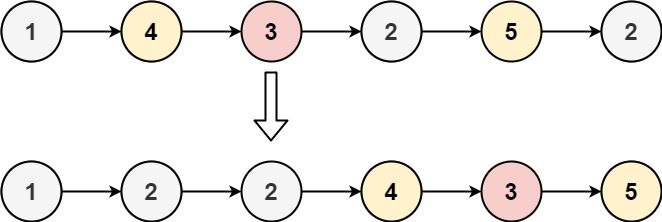
Given the head of a linked list and a value x, partition it such that all nodes less than x come before nodes greater than or equal to x.

You should preserve the original relative order of the nodes in each of the two partitions.


Example 1:

Input: head = [1,4,3,2,5,2], x = 3
Output: [1,2,2,4,3,5]

Example 2:

Input: head = [2,1], x = 2
Output: [1,2]


Constraints:

  • The number of nodes in the list is in the range [0, 200].
  • -100 <= Node.val <= 100
  • -200 <= x <= 200

Solutions

Solution 1: Simulation

Thinking

The first idea is two scans: collect nodes \(< x\), then the rest, and rebuild. Correct, and \(n \le 200\) is tiny, but that copies nodes or walks twice, and it is easy to scramble relative order.

The bottleneck is splitting and reassembling instead of one pass. The problem only asks for a stable partition: order among the small nodes and among the large nodes both stay the same.

So grow two lists in one walk and stitch the small tail to the large head. Tail pointers link original nodes — no copies; clear the large tail to avoid a cycle.

We create two linked lists \(l\) and \(r\), one to store nodes less than \(x\) and the other to store nodes greater than or equal to \(x\). Then we concatenate them.

The time complexity is \(O(n)\), where \(n\) is the length of the original linked list. The space complexity is \(O(1)\).

 1
 2
 3
 4
 5
 6
 7
 8
 9
10
11
12
13
14
15
16
17
18
19
20
21
# Definition for singly-linked list.
# class ListNode:
#     def __init__(self, val=0, next=None):
#         self.val = val
#         self.next = next
class Solution:
    def partition(self, head: Optional[ListNode], x: int) -> Optional[ListNode]:
        l = ListNode()
        r = ListNode()
        tl, tr = l, r
        while head:
            if head.val < x:
                tl.next = head
                tl = tl.next
            else:
                tr.next = head
                tr = tr.next
            head = head.next
        tr.next = None
        tl.next = r.next
        return l.next
 1
 2
 3
 4
 5
 6
 7
 8
 9
10
11
12
13
14
15
16
17
18
19
20
21
22
23
24
25
26
27
28
29
/**
 * Definition for singly-linked list.
 * public class ListNode {
 *     int val;
 *     ListNode next;
 *     ListNode() {}
 *     ListNode(int val) { this.val = val; }
 *     ListNode(int val, ListNode next) { this.val = val; this.next = next; }
 * }
 */
class Solution {
    public ListNode partition(ListNode head, int x) {
        ListNode l = new ListNode();
        ListNode r = new ListNode();
        ListNode tl = l, tr = r;
        for (; head != null; head = head.next) {
            if (head.val < x) {
                tl.next = head;
                tl = tl.next;
            } else {
                tr.next = head;
                tr = tr.next;
            }
        }
        tr.next = null;
        tl.next = r.next;
        return l.next;
    }
}
 1
 2
 3
 4
 5
 6
 7
 8
 9
10
11
12
13
14
15
16
17
18
19
20
21
22
23
24
25
26
27
28
29
30
31
/**
 * Definition for singly-linked list.
 * struct ListNode {
 *     int val;
 *     ListNode *next;
 *     ListNode() : val(0), next(nullptr) {}
 *     ListNode(int x) : val(x), next(nullptr) {}
 *     ListNode(int x, ListNode *next) : val(x), next(next) {}
 * };
 */
class Solution {
public:
    ListNode* partition(ListNode* head, int x) {
        ListNode* l = new ListNode();
        ListNode* r = new ListNode();
        ListNode* tl = l;
        ListNode* tr = r;
        for (; head; head = head->next) {
            if (head->val < x) {
                tl->next = head;
                tl = tl->next;
            } else {
                tr->next = head;
                tr = tr->next;
            }
        }
        tr->next = nullptr;
        tl->next = r->next;
        return l->next;
    }
};
 1
 2
 3
 4
 5
 6
 7
 8
 9
10
11
12
13
14
15
16
17
18
19
20
21
22
23
/**
 * Definition for singly-linked list.
 * type ListNode struct {
 *     Val int
 *     Next *ListNode
 * }
 */
func partition(head *ListNode, x int) *ListNode {
    l, r := &ListNode{}, &ListNode{}
    tl, tr := l, r
    for ; head != nil; head = head.Next {
        if head.Val < x {
            tl.Next = head
            tl = tl.Next
        } else {
            tr.Next = head
            tr = tr.Next
        }
    }
    tr.Next = nil
    tl.Next = r.Next
    return l.Next
}
 1
 2
 3
 4
 5
 6
 7
 8
 9
10
11
12
13
14
15
16
17
18
19
20
21
22
23
24
25
26
27
28
/**
 * Definition for singly-linked list.
 * class ListNode {
 *     val: number
 *     next: ListNode | null
 *     constructor(val?: number, next?: ListNode | null) {
 *         this.val = (val===undefined ? 0 : val)
 *         this.next = (next===undefined ? null : next)
 *     }
 * }
 */

function partition(head: ListNode | null, x: number): ListNode | null {
    const [l, r] = [new ListNode(), new ListNode()];
    let [tl, tr] = [l, r];
    for (; head; head = head.next) {
        if (head.val < x) {
            tl.next = head;
            tl = tl.next;
        } else {
            tr.next = head;
            tr = tr.next;
        }
    }
    tr.next = null;
    tl.next = r.next;
    return l.next;
}
 1
 2
 3
 4
 5
 6
 7
 8
 9
10
11
12
13
14
15
16
17
18
19
20
21
22
23
24
25
26
27
28
29
30
31
32
33
34
35
36
37
38
// Definition for singly-linked list.
// #[derive(PartialEq, Eq, Clone, Debug)]
// pub struct ListNode {
//   pub val: i32,
//   pub next: Option<Box<ListNode>>
// }
//
// impl ListNode {
//   #[inline]
//   fn new(val: i32) -> Self {
//     ListNode {
//       next: None,
//       val
//     }
//   }
// }
impl Solution {
    pub fn partition(head: Option<Box<ListNode>>, x: i32) -> Option<Box<ListNode>> {
        let mut l = ListNode::new(0);
        let mut r = ListNode::new(0);
        let mut tl = &mut l;
        let mut tr = &mut r;
        let mut current = head;
        while let Some(mut node) = current {
            current = node.next.take();
            if node.val < x {
                tl.next = Some(node);
                tl = tl.next.as_mut().unwrap();
            } else {
                tr.next = Some(node);
                tr = tr.next.as_mut().unwrap();
            }
        }
        tr.next = None;
        tl.next = r.next;
        l.next
    }
}
 1
 2
 3
 4
 5
 6
 7
 8
 9
10
11
12
13
14
15
16
17
18
19
20
21
22
23
24
25
26
27
28
/**
 * Definition for singly-linked list.
 * function ListNode(val, next) {
 *     this.val = (val===undefined ? 0 : val)
 *     this.next = (next===undefined ? null : next)
 * }
 */
/**
 * @param {ListNode} head
 * @param {number} x
 * @return {ListNode}
 */
var partition = function (head, x) {
    const [l, r] = [new ListNode(), new ListNode()];
    let [tl, tr] = [l, r];
    for (; head; head = head.next) {
        if (head.val < x) {
            tl.next = head;
            tl = tl.next;
        } else {
            tr.next = head;
            tr = tr.next;
        }
    }
    tr.next = null;
    tl.next = r.next;
    return l.next;
};
 1
 2
 3
 4
 5
 6
 7
 8
 9
10
11
12
13
14
15
16
17
18
19
20
21
22
23
24
25
26
27
28
29
30
/**
 * Definition for singly-linked list.
 * public class ListNode {
 *     public int val;
 *     public ListNode next;
 *     public ListNode(int val=0, ListNode next=null) {
 *         this.val = val;
 *         this.next = next;
 *     }
 * }
 */
public class Solution {
    public ListNode Partition(ListNode head, int x) {
        ListNode l = new ListNode();
        ListNode r = new ListNode();
        ListNode tl = l, tr = r;
        for (; head != null; head = head.next) {
            if (head.val < x) {
                tl.next = head;
                tl = tl.next;
            } else {
                tr.next = head;
                tr = tr.next;
            }
        }
        tr.next = null;
        tl.next = r.next;
        return l.next;
    }
}

Comments