849. Maximize Distance to Closest Person

Description
You are given an array representing a row of seats where seats[i] = 1 represents a person sitting in the ith seat, and seats[i] = 0 represents that the ith seat is empty (0-indexed).
There is at least one empty seat, and at least one person sitting.
Alex wants to sit in the seat such that the distance between him and the closest person to him is maximized.
Return that maximum distance to the closest person.
Example 1:
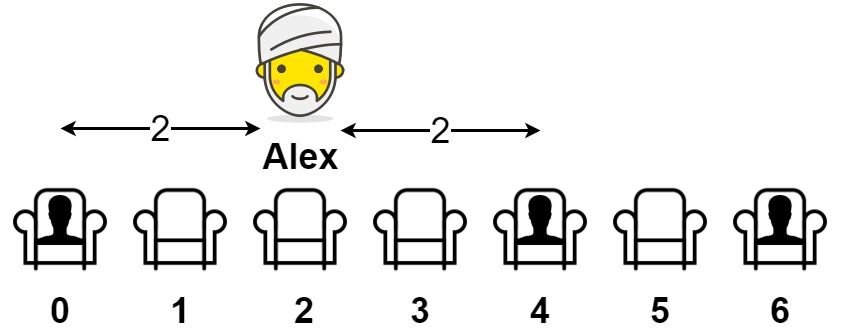
Input: seats = [1,0,0,0,1,0,1]
Output: 2
Explanation:
If Alex sits in the second open seat (i.e. seats[2]), then the closest person has distance 2.
If Alex sits in any other open seat, the closest person has distance 1.
Thus, the maximum distance to the closest person is 2.
Example 2:
Input: seats = [1,0,0,0]
Output: 3
Explanation:
If Alex sits in the last seat (i.e. seats[3]), the closest person is 3 seats away.
This is the maximum distance possible, so the answer is 3.
Example 3:
Input: seats = [0,1]
Output: 1
Constraints:
2 <= seats.length <= 2 * 104seats[i]is0or1.- At least one seat is empty.
- At least one seat is occupied.
Solutions
Solution 1: Single Traversal
Thinking
We sit in an empty seat to maximize distance to the nearest person. End gaps are the distance to the first or last occupied seat; an interior gap is best at its midpoint.
One pass records the first and last occupied indices and the widest gap between people. The answer is the max of the left gap, the right gap, and half the interior gap.
We define two variables \(\textit{first}\) and \(\textit{last}\) to represent the positions of the first and last person, respectively. We use the variable \(d\) to represent the maximum distance between two people.
Then, we traverse the array \(\textit{seats}\). If the current position is occupied, and if \(\textit{last}\) has been updated before, it means there was someone before, so we update \(d = \max(d, i - \textit{last})\). If \(\textit{first}\) has not been updated before, it means there was no one before, so we update \(\textit{first} = i\). Next, we update \(\textit{last} = i\).
Finally, we return \(\max(\textit{first}, n - \textit{last} - 1, d / 2)\).
The time complexity is \(O(n)\), where \(n\) is the length of the array \(\textit{seats}\). The space complexity is \(O(1)\).
1 2 3 4 5 6 7 8 9 10 11 12 | |
1 2 3 4 5 6 7 8 9 10 11 12 13 14 15 16 17 18 | |
1 2 3 4 5 6 7 8 9 10 11 12 13 14 15 16 17 18 19 | |
1 2 3 4 5 6 7 8 9 10 11 12 13 14 15 16 | |
1 2 3 4 5 6 7 8 9 10 11 12 13 14 15 16 17 18 | |