
Skip to content

835. Image Overlap

Description

You are given two images, img1 and img2, represented as binary, square matrices of size n x n. A binary matrix has only 0s and 1s as values.

We translate one image however we choose by sliding all the 1 bits left, right, up, and/or down any number of units. We then place it on top of the other image. We can then calculate the overlap by counting the number of positions that have a 1 in both images.

Note also that a translation does not include any kind of rotation. Any 1 bits that are translated outside of the matrix borders are erased.

Return the largest possible overlap.


Example 1:
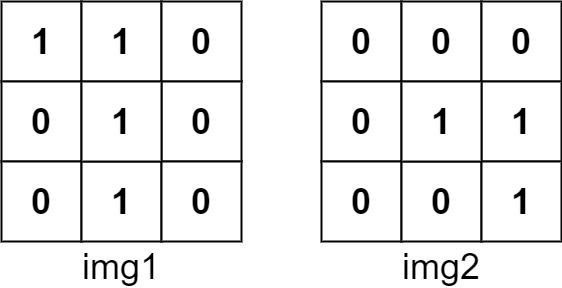
Input: img1 = [[1,1,0],[0,1,0],[0,1,0]], img2 = [[0,0,0],[0,1,1],[0,0,1]]
Output: 3
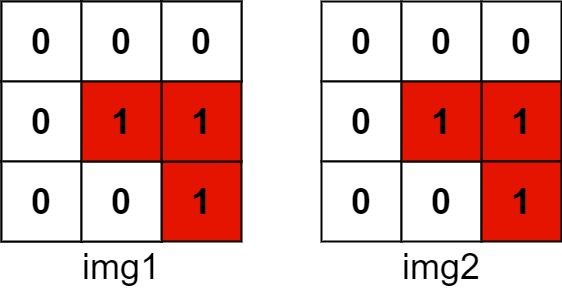
Explanation: We translate img1 to right by 1 unit and down by 1 unit.

The number of positions that have a 1 in both images is 3 (shown in red).
Example 2:

Input: img1 = [[1]], img2 = [[1]]
Output: 1

Example 3:

Input: img1 = [[0]], img2 = [[0]]
Output: 0


Constraints:

  • n == img1.length == img1[i].length
  • n == img2.length == img2[i].length
  • 1 <= n <= 30
  • img1[i][j] is either 0 or 1.
  • img2[i][j] is either 0 or 1.

Solutions

Solution 1: Enumeration

Thinking

We slide \(img1\) over \(img2\) and maximize the number of overlapping ones. \(n\le 30\) allows enumerating shifts, but it is enough to pair ones from the two images.

Each pair of ones determines a shift vector. A counter over vectors yields the largest overlap; an empty counter means the answer is \(0\).

We can enumerate each position of \(1\) in \(\textit{img1}\) and \(\textit{img2}\), denoted as \((i, j)\) and \((h, k)\) respectively. Then we calculate the offset \((i - h, j - k)\), denoted as \((dx, dy)\), and use a hash table \(\textit{cnt}\) to record the number of occurrences of each offset. Finally, we traverse the hash table \(\textit{cnt}\) to find the offset that appears the most, which is the answer.

The time complexity is \(O(n^4)\), and the space complexity is \(O(n^2)\), where \(n\) is the side length of \(\textit{img1}\).

 1
 2
 3
 4
 5
 6
 7
 8
 9
10
11
12
class Solution:
    def largestOverlap(self, img1: List[List[int]], img2: List[List[int]]) -> int:
        n = len(img1)
        cnt = Counter()
        for i in range(n):
            for j in range(n):
                if img1[i][j]:
                    for h in range(n):
                        for k in range(n):
                            if img2[h][k]:
                                cnt[(i - h, j - k)] += 1
        return max(cnt.values()) if cnt else 0
 1
 2
 3
 4
 5
 6
 7
 8
 9
10
11
12
13
14
15
16
17
18
19
20
21
22
class Solution {
    public int largestOverlap(int[][] img1, int[][] img2) {
        int n = img1.length;
        Map<List<Integer>, Integer> cnt = new HashMap<>();
        int ans = 0;
        for (int i = 0; i < n; ++i) {
            for (int j = 0; j < n; ++j) {
                if (img1[i][j] == 1) {
                    for (int h = 0; h < n; ++h) {
                        for (int k = 0; k < n; ++k) {
                            if (img2[h][k] == 1) {
                                List<Integer> t = List.of(i - h, j - k);
                                ans = Math.max(ans, cnt.merge(t, 1, Integer::sum));
                            }
                        }
                    }
                }
            }
        }
        return ans;
    }
}
 1
 2
 3
 4
 5
 6
 7
 8
 9
10
11
12
13
14
15
16
17
18
19
20
21
22
class Solution {
public:
    int largestOverlap(vector<vector<int>>& img1, vector<vector<int>>& img2) {
        int n = img1.size();
        map<pair<int, int>, int> cnt;
        int ans = 0;
        for (int i = 0; i < n; ++i) {
            for (int j = 0; j < n; ++j) {
                if (img1[i][j]) {
                    for (int h = 0; h < n; ++h) {
                        for (int k = 0; k < n; ++k) {
                            if (img2[h][k]) {
                                ans = max(ans, ++cnt[{i - h, j - k}]);
                            }
                        }
                    }
                }
            }
        }
        return ans;
    }
};
 1
 2
 3
 4
 5
 6
 7
 8
 9
10
11
12
13
14
15
16
17
18
19
20
func largestOverlap(img1 [][]int, img2 [][]int) (ans int) {
    type pair struct{ x, y int }
    cnt := map[pair]int{}
    for i, row1 := range img1 {
        for j, x1 := range row1 {
            if x1 == 1 {
                for h, row2 := range img2 {
                    for k, x2 := range row2 {
                        if x2 == 1 {
                            t := pair{i - h, j - k}
                            cnt[t]++
                            ans = max(ans, cnt[t])
                        }
                    }
                }
            }
        }
    }
    return
}
 1
 2
 3
 4
 5
 6
 7
 8
 9
10
11
12
13
14
15
16
17
18
19
20
21
function largestOverlap(img1: number[][], img2: number[][]): number {
    const n = img1.length;
    const cnt: Map<number, number> = new Map();
    let ans = 0;
    for (let i = 0; i < n; ++i) {
        for (let j = 0; j < n; ++j) {
            if (img1[i][j] === 1) {
                for (let h = 0; h < n; ++h) {
                    for (let k = 0; k < n; ++k) {
                        if (img2[h][k] === 1) {
                            const t = (i - h) * 200 + (j - k);
                            cnt.set(t, (cnt.get(t) ?? 0) + 1);
                            ans = Math.max(ans, cnt.get(t)!);
                        }
                    }
                }
            }
        }
    }
    return ans;
}

Comments