Backtracking Breadth-First Search Depth-First Search Directed Acyclic Graph Graph
Description Given a directed acyclic graph (DAG ) of n nodes labeled from 0 to n - 1, find all possible paths from node 0 to node n - 1 and return them in any order .
The graph is given as follows: graph[i] is a list of all nodes you can visit from node i (i.e., there is a directed edge from node i to node graph[i][j]).
Example 1:
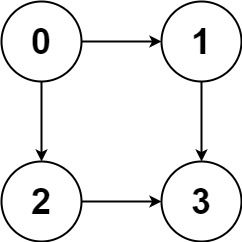
Input: graph = [[1,2],[3],[3],[]]
Output: [[0,1,3],[0,2,3]]
Explanation: There are two paths: 0 -> 1 -> 3 and 0 -> 2 -> 3.
Example 2:
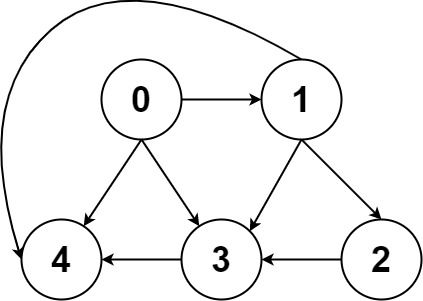
Input: graph = [[4,3,1],[3,2,4],[3],[4],[]]
Output: [[0,4],[0,3,4],[0,1,3,4],[0,1,2,3,4],[0,1,4]]
Constraints:
n == graph.length2 <= n <= 150 <= graph[i][j] < ngraph[i][j] != i (i.e., there will be no self-loops).All the elements of graph[i] are unique . The input graph is guaranteed to be a DAG . Solutions Solution 1: BFS Thinking
List every path from \(0\) to \(n-1\) in a DAG. \(n\le 15\) ; all paths must be reported.
BFS stores full paths; a finished path is recorded, otherwise each neighbor is appended and enqueued.
Start from node \(0\) , keep paths in a queue, and record a path when it reaches \(n-1\) .
Python3 Java C++ Go Rust JavaScript TypeScript
 1
 2
 3
 4
 5
 6
 7
 8
 9
10
11
12
13
14
class Solution :
def allPathsSourceTarget ( self , graph : List [ List [ int ]]) -> List [ List [ int ]]:
n = len ( graph )
q = deque ([[ 0 ]])
ans = []
while q :
path = q . popleft ()
u = path [ - 1 ]
if u == n - 1 :
ans . append ( path )
continue
for v in graph [ u ]:
q . append ( path + [ v ])
return ans
 1
 2
 3
 4
 5
 6
 7
 8
 9
10
11
12
13
14
15
16
17
18
19
20
21
22
class Solution {
public List < List < Integer >> allPathsSourceTarget ( int [][] graph ) {
int n = graph . length ;
Queue < List < Integer >> queue = new ArrayDeque <> ();
queue . offer ( Arrays . asList ( 0 ));
List < List < Integer >> ans = new ArrayList <> ();
while ( ! queue . isEmpty ()) {
List < Integer > path = queue . poll ();
int u = path . get ( path . size () - 1 );
if ( u == n - 1 ) {
ans . add ( path );
continue ;
}
for ( int v : graph [ u ] ) {
List < Integer > next = new ArrayList <> ( path );
next . add ( v );
queue . offer ( next );
}
}
return ans ;
}
}
 1
 2
 3
 4
 5
 6
 7
 8
 9
10
11
12
13
14
15
16
17
18
19
20
21
22
23
24
25
class Solution {
public :
vector < vector < int >> graph ;
vector < vector < int >> ans ;
vector < vector < int >> allPathsSourceTarget ( vector < vector < int >>& graph ) {
this -> graph = graph ;
vector < int > path ;
path . push_back ( 0 );
dfs ( 0 , path );
return ans ;
}
void dfs ( int i , vector < int > path ) {
if ( i == graph . size () - 1 ) {
ans . push_back ( path );
return ;
}
for ( int j : graph [ i ]) {
path . push_back ( j );
dfs ( j , path );
path . pop_back ();
}
}
};
 1
 2
 3
 4
 5
 6
 7
 8
 9
10
11
12
13
14
15
16
17
18
19
20
21
func allPathsSourceTarget ( graph [][] int ) [][] int {
var path [] int
path = append ( path , 0 )
var ans [][] int
var dfs func ( i int )
dfs = func ( i int ) {
if i == len ( graph ) - 1 {
ans = append ( ans , append ([] int ( nil ), path ...))
return
}
for _ , j := range graph [ i ] {
path = append ( path , j )
dfs ( j )
path = path [: len ( path ) - 1 ]
}
}
dfs ( 0 )
return ans
}
 1
 2
 3
 4
 5
 6
 7
 8
 9
10
11
12
13
14
15
16
17
18
impl Solution {
fn dfs ( i : usize , path : & mut Vec < i32 > , res : & mut Vec < Vec < i32 >> , graph : & Vec < Vec < i32 >> ) {
path . push ( i as i32 );
if i == graph . len () - 1 {
res . push ( path . clone ());
}
for j in graph [ i ]. iter () {
Self :: dfs ( * j as usize , path , res , graph );
}
path . pop ();
}
pub fn all_paths_source_target ( graph : Vec < Vec < i32 >> ) -> Vec < Vec < i32 >> {
let mut res = Vec :: new ();
Self :: dfs ( 0 , & mut vec! [], & mut res , & graph );
res
}
}
 1
 2
 3
 4
 5
 6
 7
 8
 9
10
11
12
13
14
15
16
17
18
19
20
21
22
23
24
/**
* @param {number[][]} graph
* @return {number[][]}
*/
var allPathsSourceTarget = function ( graph ) {
const ans = [];
const t = [ 0 ];
const dfs = t => {
const cur = t [ t . length - 1 ];
if ( cur == graph . length - 1 ) {
ans . push ([... t ]);
return ;
}
for ( const v of graph [ cur ]) {
t . push ( v );
dfs ( t );
t . pop ();
}
};
dfs ( t );
return ans ;
};
 1
 2
 3
 4
 5
 6
 7
 8
 9
10
11
12
13
14
15
16
17
18
19
20
21
function allPathsSourceTarget ( graph : number [][]) : number [][] {
const ans : number [][] = [];
const dfs = ( path : number []) => {
const curr = path . at ( - 1 ) ! ;
if ( curr === graph . length - 1 ) {
ans . push ([... path ]);
return ;
}
for ( const v of graph [ curr ]) {
path . push ( v );
dfs ( path );
path . pop ();
}
};
dfs ([ 0 ]);
return ans ;
}
Solution 2: DFS Thinking
BFS copies every prefix. DFS appends on one array, snapshots at the sink, and pops—fewer intermediate lists.
DFS from node \(0\) and backtrack after each path that reaches the target.