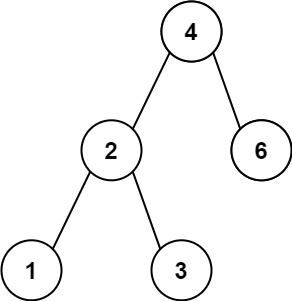
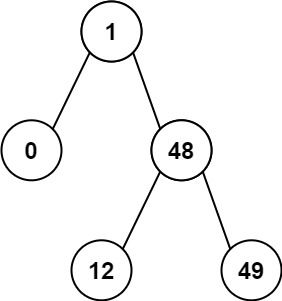
Minimum difference between any two BST values. Inorder is sorted, so the minimum lies between consecutive inorder values.
Walk inorder, keep \(\textit{pre}\), and update \(\textit{ans}\) by \(\textit{root.val}-\textit{pre}\).
The problem requires us to find the minimum difference between the values of any two nodes. Since the inorder traversal of a binary search tree is an increasing sequence, we only need to find the minimum difference between the values of two adjacent nodes in the inorder traversal.
We can use a recursive method to implement the inorder traversal. During the process, we use a variable \(\textit{pre}\) to save the value of the previous node. This way, we can calculate the minimum difference between the values of two adjacent nodes during the traversal.
The time complexity is \(O(n)\), and the space complexity is \(O(n)\). Here, \(n\) is the number of nodes in the binary search tree.
1 2 3 4 5 6 7 8 9101112131415161718192021
# Definition for a binary tree node.# class TreeNode:# def __init__(self, val=0, left=None, right=None):# self.val = val# self.left = left# self.right = rightclassSolution:defminDiffInBST(self,root:Optional[TreeNode])->int:defdfs(root:Optional[TreeNode]):ifrootisNone:returndfs(root.left)nonlocalpre,ansans=min(ans,root.val-pre)pre=root.valdfs(root.right)pre=-infans=infdfs(root)returnans
/** * Definition for a binary tree node. * type TreeNode struct { * Val int * Left *TreeNode * Right *TreeNode * } */funcminDiffInBST(root*TreeNode)int{constinfint=1<<30ans,pre:=inf,-infvardfsfunc(*TreeNode)dfs=func(root*TreeNode){ifroot==nil{return}dfs(root.Left)ans=min(ans,root.Val-pre)pre=root.Valdfs(root.Right)}dfs(root)returnans}