441. Arranging Coins

Description
You have n coins and you want to build a staircase with these coins. The staircase consists of k rows where the ith row has exactly i coins. The last row of the staircase may be incomplete.
Given the integer n, return the number of complete rows of the staircase you will build.
Example 1:
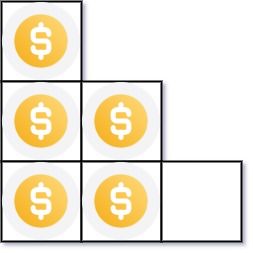
Input: n = 5
Output: 2
Explanation: Because the 3rd row is incomplete, we return 2.
Example 2:
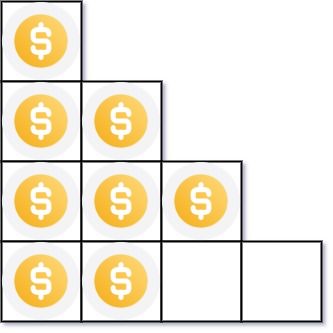
Input: n = 8
Output: 3
Explanation: Because the 4th row is incomplete, we return 3.
Constraints:
1 <= n <= 231 - 1
Solutions
Solution 1
Thinking
Row \(x\) costs \(x\) coins, so the last full row satisfies \(x(x+1)/2\le n\). Scanning \(x\) is linear and \(n\) can be \(2^{31}-1\).
The inequality solves to \(x\le \sqrt{2}\,\sqrt{n+1/8}-1/2\). Splitting \(2n\) this way avoids an overflow of \(2n\) in some languages.
A closed form evaluates in a constant number of floating-point operations.
1 2 3 | |
1 2 3 4 5 | |
1 2 3 4 5 6 7 8 9 10 11 12 13 14 15 16 17 | |
1 2 3 4 5 6 7 8 9 10 11 12 | |
Solution 2
Thinking
Solution 1 uses a square root; huge \(n\) can lose integer precision. Binary-search the row count with the integer test \(mid(mid+1)/2\le n\), rounding the mid upward when feasible.
1 2 3 4 5 6 7 8 9 10 | |
1 2 3 4 5 6 7 8 9 10 11 12 13 14 | |