Skip to content

42. Trapping Rain Water

Description

Given n non-negative integers representing an elevation map where the width of each bar is 1, compute how much water it can trap after raining.


Example 1:

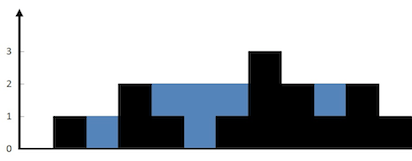
Input: height = [0,1,0,2,1,0,1,3,2,1,2,1]
Output: 6
Explanation: The above elevation map (black section) is represented by array [0,1,0,2,1,0,1,3,2,1,2,1]. In this case, 6 units of rain water (blue section) are being trapped.

Example 2:

Input: height = [4,2,0,3,2,5]
Output: 9


Constraints:

  • n == height.length
  • 1 <= n <= 2 * 104
  • 0 <= height[i] <= 105

Solutions

Solution 1: Dynamic Programming

Thinking

The first idea is, for each \(i\), scan left and right for the tallest bars; water is \(\min(\textit{leftMax}, \textit{rightMax}) - \textit{height}[i]\). Correct, but \(O(n^2)\). \(n \le 2 \times 10^4\) can time out.

The bottleneck is recomputing left/right maxima at every \(i\). Those maxima only depend on one side and can be precomputed in linear time.

Store, at each index, the highest bar to the left (inclusive) and to the right (inclusive), then sum. The water level is the shorter of the two walls — that is the DP state.

We define \(left[i]\) as the height of the highest bar to the left of and including the position at index \(i\), and \(right[i]\) as the height of the highest bar to the right of and including the position at index \(i\). Therefore, the amount of rainwater that can be trapped at index \(i\) is \(min(left[i], right[i]) - height[i]\). We traverse the array to calculate \(left[i]\) and \(right[i]\), and the final answer is \(\sum_{i=0}^{n-1} \min(left[i], right[i]) - height[i]\).

The time complexity is \(O(n)\), and the space complexity is \(O(n)\). Here, \(n\) is the length of the array.

1
2
3
4
5
6
7
8
9
class Solution:
    def trap(self, height: List[int]) -> int:
        n = len(height)
        left = [height[0]] * n
        right = [height[-1]] * n
        for i in range(1, n):
            left[i] = max(left[i - 1], height[i])
            right[n - i - 1] = max(right[n - i], height[n - i - 1])
        return sum(min(l, r) - h for l, r, h in zip(left, right, height))
 1
 2
 3
 4
 5
 6
 7
 8
 9
10
11
12
13
14
15
16
17
18
class Solution {
    public int trap(int[] height) {
        int n = height.length;
        int[] left = new int[n];
        int[] right = new int[n];
        left[0] = height[0];
        right[n - 1] = height[n - 1];
        for (int i = 1; i < n; ++i) {
            left[i] = Math.max(left[i - 1], height[i]);
            right[n - i - 1] = Math.max(right[n - i], height[n - i - 1]);
        }
        int ans = 0;
        for (int i = 0; i < n; ++i) {
            ans += Math.min(left[i], right[i]) - height[i];
        }
        return ans;
    }
}
 1
 2
 3
 4
 5
 6
 7
 8
 9
10
11
12
13
14
15
16
17
18
class Solution {
public:
    int trap(vector<int>& height) {
        int n = height.size();
        int left[n], right[n];
        left[0] = height[0];
        right[n - 1] = height[n - 1];
        for (int i = 1; i < n; ++i) {
            left[i] = max(left[i - 1], height[i]);
            right[n - i - 1] = max(right[n - i], height[n - i - 1]);
        }
        int ans = 0;
        for (int i = 0; i < n; ++i) {
            ans += min(left[i], right[i]) - height[i];
        }
        return ans;
    }
};
 1
 2
 3
 4
 5
 6
 7
 8
 9
10
11
12
13
14
func trap(height []int) (ans int) {
    n := len(height)
    left := make([]int, n)
    right := make([]int, n)
    left[0], right[n-1] = height[0], height[n-1]
    for i := 1; i < n; i++ {
        left[i] = max(left[i-1], height[i])
        right[n-i-1] = max(right[n-i], height[n-i-1])
    }
    for i, h := range height {
        ans += min(left[i], right[i]) - h
    }
    return
}
 1
 2
 3
 4
 5
 6
 7
 8
 9
10
11
12
13
14
function trap(height: number[]): number {
    const n = height.length;
    const left: number[] = new Array(n).fill(height[0]);
    const right: number[] = new Array(n).fill(height[n - 1]);
    for (let i = 1; i < n; ++i) {
        left[i] = Math.max(left[i - 1], height[i]);
        right[n - i - 1] = Math.max(right[n - i], height[n - i - 1]);
    }
    let ans = 0;
    for (let i = 0; i < n; ++i) {
        ans += Math.min(left[i], right[i]) - height[i];
    }
    return ans;
}
 1
 2
 3
 4
 5
 6
 7
 8
 9
10
11
12
13
14
15
16
17
18
19
20
21
22
23
24
25
26
impl Solution {
    #[allow(dead_code)]
    pub fn trap(height: Vec<i32>) -> i32 {
        let n = height.len();
        let mut left: Vec<i32> = vec![0; n];
        let mut right: Vec<i32> = vec![0; n];

        left[0] = height[0];
        right[n - 1] = height[n - 1];

        // Initialize the left & right vector
        for i in 1..n {
            left[i] = std::cmp::max(left[i - 1], height[i]);
            right[n - i - 1] = std::cmp::max(right[n - i], height[n - i - 1]);
        }

        let mut ans = 0;

        // Calculate the ans
        for i in 0..n {
            ans += std::cmp::min(left[i], right[i]) - height[i];
        }

        ans
    }
}
 1
 2
 3
 4
 5
 6
 7
 8
 9
10
11
12
13
14
15
16
17
18
public class Solution {
    public int Trap(int[] height) {
        int n = height.Length;
        int[] left = new int[n];
        int[] right = new int[n];
        left[0] = height[0];
        right[n - 1] = height[n - 1];
        for (int i = 1; i < n; ++i) {
            left[i] = Math.Max(left[i - 1], height[i]);
            right[n - i - 1] = Math.Max(right[n - i], height[n - i - 1]);
        }
        int ans = 0;
        for (int i = 0; i < n; ++i) {
            ans += Math.Min(left[i], right[i]) - height[i];
        }
        return ans;
    }
}
 1
 2
 3
 4
 5
 6
 7
 8
 9
10
11
12
13
14
15
16
17
18
19
20
21
22
23
24
25
26
27
28
29
30
31
32
33
34
35
36
37
38
39
class Solution {
    /**
     * @param integer[] $height
     * @return integer
     */

    function trap($height) {
        $n = count($height);

        if ($n == 0) {
            return 0;
        }

        $left = 0;
        $right = $n - 1;
        $leftMax = 0;
        $rightMax = 0;
        $ans = 0;

        while ($left < $right) {
            if ($height[$left] < $height[$right]) {
                if ($height[$left] > $leftMax) {
                    $leftMax = $height[$left];
                } else {
                    $ans += $leftMax - $height[$left];
                }
                $left++;
            } else {
                if ($height[$right] > $rightMax) {
                    $rightMax = $height[$right];
                } else {
                    $ans += $rightMax - $height[$right];
                }
                $right--;
            }
        }
        return $ans;
    }
}

Comments