3656. Determine if a Simple Graph Exists 🔒

Description
You are given an integer array degrees, where degrees[i] represents the desired degree of the ith vertex.
Your task is to determine if there exists an undirected simple graph with exactly these vertex degrees.
A simple graph has no self-loops or parallel edges between the same pair of vertices.
Return true if such a graph exists, otherwise return false.
Example 1:
Input: degrees = [3,1,2,2]
Output: true
Explanation:
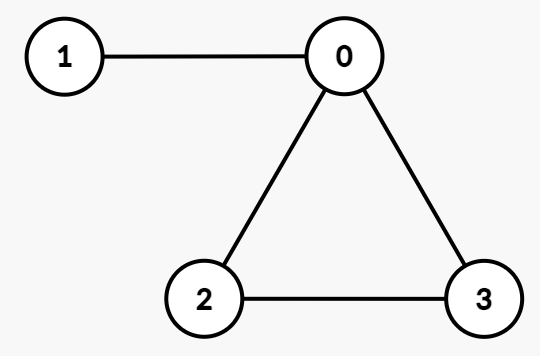
One possible undirected simple graph is:
- Edges:
(0, 1), (0, 2), (0, 3), (2, 3) - Degrees:
deg(0) = 3,deg(1) = 1,deg(2) = 2,deg(3) = 2.
Example 2:
Input: degrees = [1,3,3,1]
Output: false
Explanation:
degrees[1] = 3anddegrees[2] = 3means they must be connected to all other vertices.- This requires
degrees[0]anddegrees[3]to be at least 2, but both are equal to 1, which contradicts the requirement. - Thus, the answer is
false.
Constraints:
1 <= n == degrees.length <= 1050 <= degrees[i] <= n - 1
Solutions
Solution 1
Thinking
We are given a degree sequence and must decide whether a simple undirected graph exists. Havel–Hakimi resorts after every step and is too slow for \(n\le 10^5\).
The Erdős–Gállai theorem replaces that loop by prefix inequalities together with an even degree sum. After sorting, prefix sums verify the inequalities in linear time.
Reject an odd sum or a degree above \(n-1\), then compare the sum of the \(k\) largest degrees with the truncated right-hand side of the theorem.
1 | |
1 | |
1 | |
1 | |