3604. Minimum Time to Reach Destination in Directed Graph



Description
You are given an integer n and a directed graph with n nodes labeled from 0 to n - 1. This is represented by a 2D array edges, where edges[i] = [ui, vi, starti, endi] indicates an edge from node ui to vi that can only be used at any integer time t such that starti <= t <= endi.
You start at node 0 at time 0.
In one unit of time, you can either:
- Wait at your current node without moving, or
- Travel along an outgoing edge from your current node if the current time
tsatisfiesstarti <= t <= endi.
Return the minimum time required to reach node n - 1. If it is impossible, return -1.
Example 1:
Input: n = 3, edges = [[0,1,0,1],[1,2,2,5]]
Output: 3
Explanation:
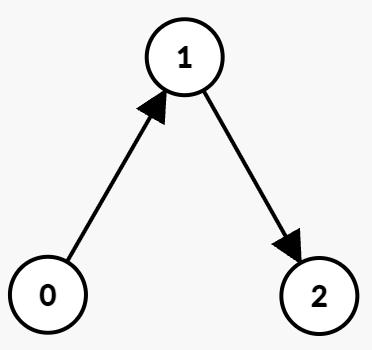
The optimal path is:
- At time
t = 0, take the edge(0 → 1)which is available from 0 to 1. You arrive at node 1 at timet = 1, then wait untilt = 2. - At time
t =, take the edge2(1 → 2)which is available from 2 to 5. You arrive at node 2 at time 3.
Hence, the minimum time to reach node 2 is 3.
Example 2:
Input: n = 4, edges = [[0,1,0,3],[1,3,7,8],[0,2,1,5],[2,3,4,7]]
Output: 5
Explanation:
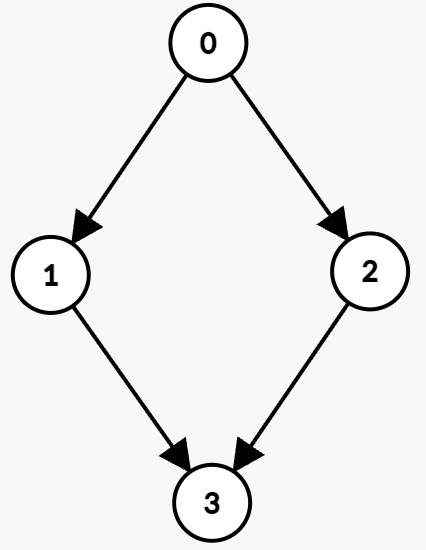
The optimal path is:
- Wait at node 0 until time
t = 1, then take the edge(0 → 2)which is available from 1 to 5. You arrive at node 2 att = 2. - Wait at node 2 until time
t = 4, then take the edge(2 → 3)which is available from 4 to 7. You arrive at node 3 att = 5.
Hence, the minimum time to reach node 3 is 5.
Example 3:
Input: n = 3, edges = [[1,0,1,3],[1,2,3,5]]
Output: -1
Explanation:
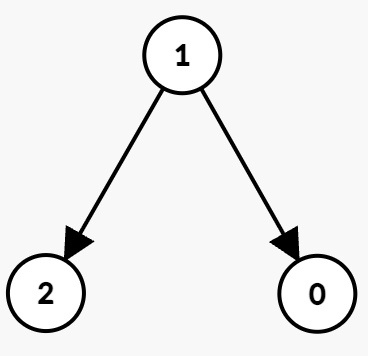
- Since there is no outgoing edge from node 0, it is impossible to reach node 2. Hence, the output is -1.
Constraints:
1 <= n <= 1050 <= edges.length <= 105edges[i] == [ui, vi, starti, endi]0 <= ui, vi <= n - 1ui != vi0 <= starti <= endi <= 109
Solutions
Solution 1
Thinking
Edges are usable only in \([\textit{start},\textit{end}]\). A BFS that ignores windows yields the wrong arrival time. We need the earliest time to each vertex.
Arriving at \(u\) at time \(t\), an edge \((u,v,s,e)\) is taken at \(\max(t,s)\) provided that instant is at most \(e\), so \(v\) is reached at \(\max(t,s)+1\). A missed window discards the edge.
This is shortest paths with time windows. A heap pops vertices by arrival time and relaxes legal outgoing edges. The first time \(n-1\) is dequeued is the answer; an empty heap means \(-1\).
1 | |
1 | |
1 | |
1 | |