Skip to content

3446. Sort Matrix by Diagonals

Description

You are given an n x n square matrix of integers grid. Return the matrix such that:

  • The diagonals in the bottom-left triangle (including the middle diagonal) are sorted in non-increasing order.
  • The diagonals in the top-right triangle are sorted in non-decreasing order.


Example 1:

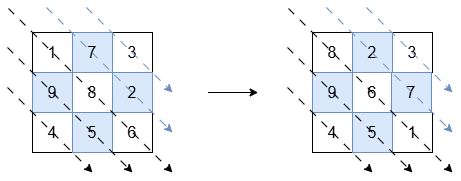
Input: grid = [[1,7,3],[9,8,2],[4,5,6]]

Output: [[8,2,3],[9,6,7],[4,5,1]]

Explanation:

The diagonals with a black arrow (bottom-left triangle) should be sorted in non-increasing order:

  • [1, 8, 6] becomes [8, 6, 1].
  • [9, 5] and [4] remain unchanged.

The diagonals with a blue arrow (top-right triangle) should be sorted in non-decreasing order:

  • [7, 2] becomes [2, 7].
  • [3] remains unchanged.

Example 2:

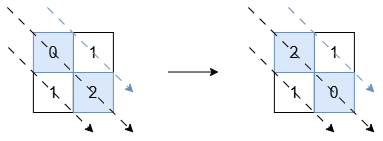
Input: grid = [[0,1],[1,2]]

Output: [[2,1],[1,0]]

Explanation:

The diagonals with a black arrow must be non-increasing, so [0, 2] is changed to [2, 0]. The other diagonals are already in the correct order.

Example 3:

Input: grid = [[1]]

Output: [[1]]

Explanation:

Diagonals with exactly one element are already in order, so no changes are needed.


Constraints:

  • grid.length == grid[i].length == n
  • 1 <= n <= 10
  • -105 <= grid[i][j] <= 105

Solutions

Solution 1: Simulation + Sorting

Thinking

\(n\le 10\) and each diagonal is independent. The lower triangle including the main diagonal is non-increasing; the upper triangle is non-decreasing.

Collect, sort, and write back; no heavier structure is required.

We extract each lower diagonal, sort, and pop largest-first; the upper diagonals are symmetric. The main diagonal is covered by the first loop.

We can simulate the diagonal sorting process as described in the problem.

First, we sort the diagonals of the lower-left triangle, including the main diagonal, in non-increasing order. Then, we sort the diagonals of the upper-right triangle in non-decreasing order. Finally, we return the sorted matrix.

The time complexity is \(O(n^2 \log n)\), and the space complexity is \(O(n)\). Here, \(n\) is the size of the matrix.


 1
 2
 3
 4
 5
 6
 7
 8
 9
10
11
12
13
14
15
16
17
18
19
20
21
22
23
24
25
26
27
28
29
30
class Solution:
    def sortMatrix(self, grid: List[List[int]]) -> List[List[int]]:
        n = len(grid)
        for k in range(n - 2, -1, -1):
            i, j = k, 0
            t = []
            while i < n and j < n:
                t.append(grid[i][j])
                i += 1
                j += 1
            t.sort()
            i, j = k, 0
            while i < n and j < n:
                grid[i][j] = t.pop()
                i += 1
                j += 1
        for k in range(n - 2, 0, -1):
            i, j = k, n - 1
            t = []
            while i >= 0 and j >= 0:
                t.append(grid[i][j])
                i -= 1
                j -= 1
            t.sort()
            i, j = k, n - 1
            while i >= 0 and j >= 0:
                grid[i][j] = t.pop()
                i -= 1
                j -= 1
        return grid
 1
 2
 3
 4
 5
 6
 7
 8
 9
10
11
12
13
14
15
16
17
18
19
20
21
22
23
24
25
26
27
28
class Solution {
    public int[][] sortMatrix(int[][] grid) {
        int n = grid.length;
        for (int k = n - 2; k >= 0; --k) {
            int i = k, j = 0;
            List<Integer> t = new ArrayList<>();
            while (i < n && j < n) {
                t.add(grid[i++][j++]);
            }
            Collections.sort(t);
            for (int x : t) {
                grid[--i][--j] = x;
            }
        }
        for (int k = n - 2; k > 0; --k) {
            int i = k, j = n - 1;
            List<Integer> t = new ArrayList<>();
            while (i >= 0 && j >= 0) {
                t.add(grid[i--][j--]);
            }
            Collections.sort(t);
            for (int x : t) {
                grid[++i][++j] = x;
            }
        }
        return grid;
    }
}
 1
 2
 3
 4
 5
 6
 7
 8
 9
10
11
12
13
14
15
16
17
18
19
20
21
22
23
24
25
26
27
28
29
class Solution {
public:
    vector<vector<int>> sortMatrix(vector<vector<int>>& grid) {
        int n = grid.size();
        for (int k = n - 2; k >= 0; --k) {
            int i = k, j = 0;
            vector<int> t;
            while (i < n && j < n) {
                t.push_back(grid[i++][j++]);
            }
            ranges::sort(t);
            for (int x : t) {
                grid[--i][--j] = x;
            }
        }
        for (int k = n - 2; k > 0; --k) {
            int i = k, j = n - 1;
            vector<int> t;
            while (i >= 0 && j >= 0) {
                t.push_back(grid[i--][j--]);
            }
            ranges::sort(t);
            for (int x : t) {
                grid[++i][++j] = x;
            }
        }
        return grid;
    }
};
 1
 2
 3
 4
 5
 6
 7
 8
 9
10
11
12
13
14
15
16
17
18
19
20
21
22
23
24
25
26
27
28
func sortMatrix(grid [][]int) [][]int {
    n := len(grid)
    for k := n - 2; k >= 0; k-- {
        i, j := k, 0
        t := []int{}
        for ; i < n && j < n; i, j = i+1, j+1 {
            t = append(t, grid[i][j])
        }
        sort.Ints(t)
        for _, x := range t {
            i, j = i-1, j-1
            grid[i][j] = x
        }
    }
    for k := n - 2; k > 0; k-- {
        i, j := k, n-1
        t := []int{}
        for ; i >= 0 && j >= 0; i, j = i-1, j-1 {
            t = append(t, grid[i][j])
        }
        sort.Ints(t)
        for _, x := range t {
            i, j = i+1, j+1
            grid[i][j] = x
        }
    }
    return grid
}
 1
 2
 3
 4
 5
 6
 7
 8
 9
10
11
12
13
14
15
16
17
18
19
20
21
22
23
24
25
26
function sortMatrix(grid: number[][]): number[][] {
    const n = grid.length;
    for (let k = n - 2; k >= 0; --k) {
        let [i, j] = [k, 0];
        const t: number[] = [];
        while (i < n && j < n) {
            t.push(grid[i++][j++]);
        }
        t.sort((a, b) => a - b);
        for (const x of t) {
            grid[--i][--j] = x;
        }
    }
    for (let k = n - 2; k > 0; --k) {
        let [i, j] = [k, n - 1];
        const t: number[] = [];
        while (i >= 0 && j >= 0) {
            t.push(grid[i--][j--]);
        }
        t.sort((a, b) => a - b);
        for (const x of t) {
            grid[++i][++j] = x;
        }
    }
    return grid;
}
 1
 2
 3
 4
 5
 6
 7
 8
 9
10
11
12
13
14
15
16
17
18
19
20
21
22
23
24
25
26
27
28
29
30
31
32
33
34
35
36
37
38
39
40
41
42
43
44
45
46
47
impl Solution {
    pub fn sort_matrix(mut grid: Vec<Vec<i32>>) -> Vec<Vec<i32>> {
        let n = grid.len();
        if n <= 1 {
            return grid;
        }
        for k in (0..=n - 2).rev() {
            let mut i = k;
            let mut j = 0;
            let mut t = Vec::new();
            while i < n && j < n {
                t.push(grid[i][j]);
                i += 1;
                j += 1;
            }
            t.sort();
            let mut i = k;
            let mut j = 0;
            while i < n && j < n {
                grid[i][j] = t.pop().unwrap();
                i += 1;
                j += 1;
            }
        }
        for k in (1..=n - 2).rev() {
            let mut i = k;
            let mut j = n - 1;
            let mut t = Vec::new();
            loop {
                t.push(grid[i][j]);
                if i == 0 { break; }
                i -= 1;
                j -= 1;
            }
            t.sort();
            let mut i = k;
            let mut j = n - 1;
            loop {
                grid[i][j] = t.pop().unwrap();
                if i == 0 { break; }
                i -= 1;
                j -= 1;
            }
        }
        grid
    }
}
 1
 2
 3
 4
 5
 6
 7
 8
 9
10
11
12
13
14
15
16
17
18
19
20
21
22
23
24
25
26
27
28
29
30
31
32
/**
 * @param {number[][]} grid
 * @return {number[][]}
 */
var sortMatrix = function (grid) {
    const n = grid.length;
    for (let k = n - 2; k >= 0; --k) {
        let i = k,
            j = 0;
        const t = [];
        while (i < n && j < n) {
            t.push(grid[i++][j++]);
        }
        t.sort((a, b) => a - b);
        for (const x of t) {
            grid[--i][--j] = x;
        }
    }
    for (let k = n - 2; k > 0; --k) {
        let i = k,
            j = n - 1;
        const t = [];
        while (i >= 0 && j >= 0) {
            t.push(grid[i--][j--]);
        }
        t.sort((a, b) => a - b);
        for (const x of t) {
            grid[++i][++j] = x;
        }
    }
    return grid;
};
 1
 2
 3
 4
 5
 6
 7
 8
 9
10
11
12
13
14
15
16
17
18
19
20
21
22
23
24
25
26
27
28
public class Solution {
    public int[][] SortMatrix(int[][] grid) {
        int n = grid.Length;
        for (int k = n - 2; k >= 0; --k) {
            int i = k, j = 0;
            List<int> t = new List<int>();
            while (i < n && j < n) {
                t.Add(grid[i++][j++]);
            }
            t.Sort();
            foreach (int x in t) {
                grid[--i][--j] = x;
            }
        }
        for (int k = n - 2; k > 0; --k) {
            int i = k, j = n - 1;
            List<int> t = new List<int>();
            while (i >= 0 && j >= 0) {
                t.Add(grid[i--][j--]);
            }
            t.Sort();
            foreach (int x in t) {
                grid[++i][++j] = x;
            }
        }
        return grid;
    }
}

Comments