3402. Minimum Operations to Make Columns Strictly Increasing



Description
You are given a m x n matrix grid consisting of non-negative integers.
In one operation, you can increment the value of any grid[i][j] by 1.
Return the minimum number of operations needed to make all columns of grid strictly increasing.
Example 1:
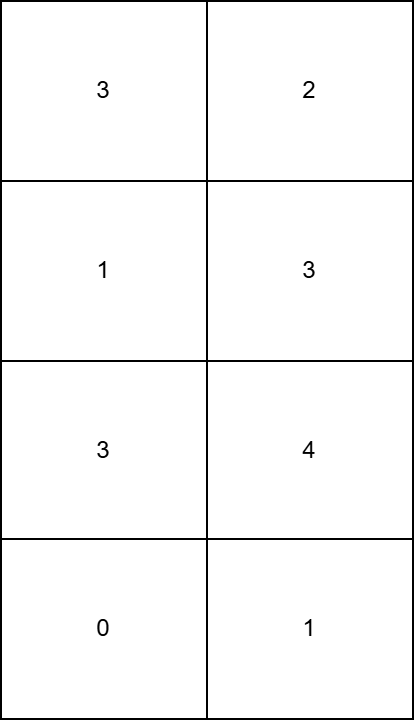
Input: grid = [[3,2],[1,3],[3,4],[0,1]]
Output: 15
Explanation:
- To make the
0thcolumn strictly increasing, we can apply 3 operations ongrid[1][0], 2 operations ongrid[2][0], and 6 operations ongrid[3][0]. - To make the
1stcolumn strictly increasing, we can apply 4 operations ongrid[3][1].
Example 2:
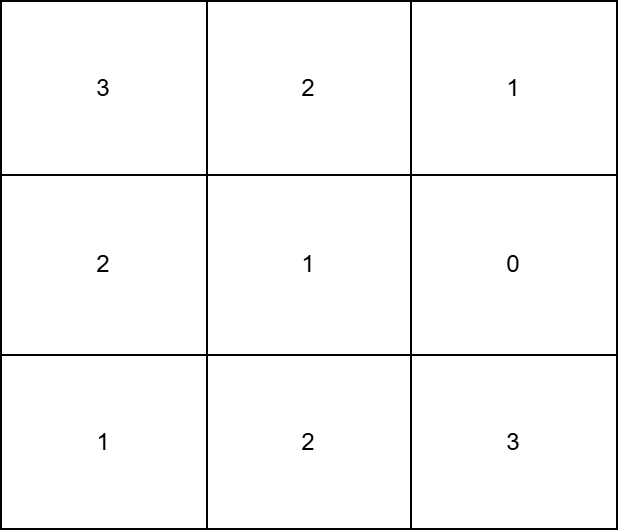
Input: grid = [[3,2,1],[2,1,0],[1,2,3]]
Output: 12
Explanation:
- To make the
0thcolumn strictly increasing, we can apply 2 operations ongrid[1][0], and 4 operations ongrid[2][0]. - To make the
1stcolumn strictly increasing, we can apply 2 operations ongrid[1][1], and 2 operations ongrid[2][1]. - To make the
2ndcolumn strictly increasing, we can apply 2 operations ongrid[1][2].
Constraints:
m == grid.lengthn == grid[i].length1 <= m, n <= 500 <= grid[i][j] < 2500
Solutions
Solution 1: Column-wise Calculation
Thinking
We may only increase cells, and columns are independent. Searching over every feasible final value in a column is unnecessary: a single pass over the grid already fits the size.
Strict increase raises the lower bound for later cells. Once a cell is forced up, every subsequent cell in that column inherits a higher floor.
We therefore scan each column from top to bottom, keeping the previous final value \(\textit{pre}\). If the current value already exceeds \(\textit{pre}\), we keep it; otherwise we raise it to \(\textit{pre}+1\) and add the gap to the answer. This assigns the minimum increment per column independently.
We can traverse the matrix column by column. For each column, we calculate the minimum number of operations required to make it strictly increasing. Specifically, for each column, we maintain a variable \(\textit{pre}\) to represent the value of the previous element in the current column. Then, we traverse the current column from top to bottom. For the current element \(\textit{cur}\), if \(\textit{pre} < \textit{cur}\), it means the current element is already greater than the previous element, so we only need to update \(\textit{pre} = \textit{cur}\). Otherwise, we need to increase the current element to \(\textit{pre} + 1\) and add the number of increases to the answer.
The time complexity is \(O(m \times n)\), where \(m\) and \(n\) are the number of rows and columns of the matrix \(\textit{grid}\), respectively. The space complexity is \(O(1)\).
1 2 3 4 5 6 7 8 9 10 11 12 | |
1 2 3 4 5 6 7 8 9 10 11 12 13 14 15 16 17 18 19 | |
1 2 3 4 5 6 7 8 9 10 11 12 13 14 15 16 17 18 19 20 | |
1 2 3 4 5 6 7 8 9 10 11 12 13 14 15 16 | |
1 2 3 4 5 6 7 8 9 10 11 12 13 14 15 16 17 | |