3382. Maximum Area Rectangle With Point Constraints II



Description
There are n points on an infinite plane. You are given two integer arrays xCoord and yCoord where (xCoord[i], yCoord[i]) represents the coordinates of the ith point.
Your task is to find the maximum area of a rectangle that:
- Can be formed using four of these points as its corners.
- Does not contain any other point inside or on its border.
- Has its edges parallel to the axes.
Return the maximum area that you can obtain or -1 if no such rectangle is possible.
Example 1:
Input: xCoord = [1,1,3,3], yCoord = [1,3,1,3]
Output: 4
Explanation:
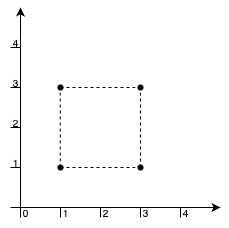
We can make a rectangle with these 4 points as corners and there is no other point that lies inside or on the border. Hence, the maximum possible area would be 4.
Example 2:
Input: xCoord = [1,1,3,3,2], yCoord = [1,3,1,3,2]
Output: -1
Explanation:
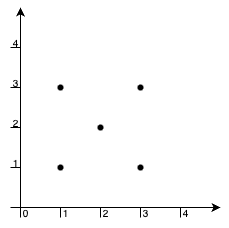
There is only one rectangle possible is with points [1,1], [1,3], [3,1] and [3,3] but [2,2] will always lie inside it. Hence, returning -1.
Example 3:
Input: xCoord = [1,1,3,3,1,3], yCoord = [1,3,1,3,2,2]
Output: 2
Explanation:
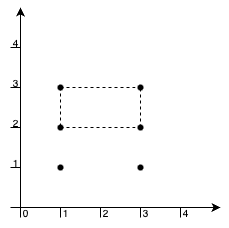
The maximum area rectangle is formed by the points [1,3], [1,2], [3,2], [3,3], which has an area of 2. Additionally, the points [1,1], [1,2], [3,1], [3,2] also form a valid rectangle with the same area.
Constraints:
1 <= xCoord.length == yCoord.length <= 2 * 1050 <= xCoord[i], yCoord[i] <= 8 * 107- All the given points are unique.
Solutions
Solution 1
Thinking
The rule matches part I, but \(n \le 2 \times 10^5\), so opposite corners cannot be enumerated. A valid rectangle has exactly one left and right point on each horizontal side and nothing inside.
Sweep by \(x\), keep the previous point of each \(y\), and query emptiness of the candidate box with a Fenwick tree or segment tree.
Each empty candidate updates the maximum area; if none exist, return \(-1\).
1 | |
1 | |
1 | |
1 | |