Array Euclidean Algorithm Greatest Common Divisor Hash Table Least Common Multiple Math Number Theory Union Find
Description You are given an array of integers nums of size n and a positive integer threshold.
There is a graph consisting of n nodes with the ith node having a value of nums[i]. Two nodes i and j in the graph are connected via an undirected edge if lcm(nums[i], nums[j]) <= threshold.
Return the number of connected components in this graph.
A connected component is a subgraph of a graph in which there exists a path between any two vertices, and no vertex of the subgraph shares an edge with a vertex outside of the subgraph.
The term lcm(a, b) denotes the least common multiple of a and b.
Example 1:
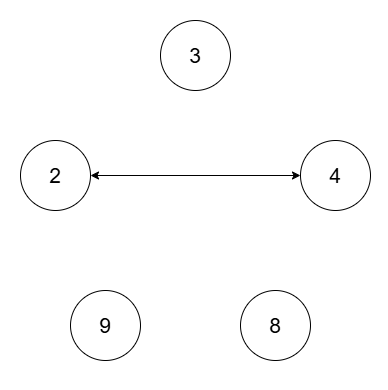
Input: nums = [2,4,8,3,9], threshold = 5
Output: 4
Explanation:
The four connected components are (2, 4), (3), (8), (9).
Example 2:
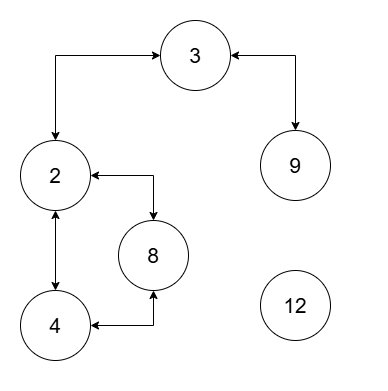
Input: nums = [2,4,8,3,9,12], threshold = 10
Output: 2
Explanation:
The two connected components are (2, 3, 4, 8, 9), and (12).
Constraints:
1 <= nums.length <= 105 1 <= nums[i] <= 109 All elements of nums are unique. 1 <= threshold <= 2 * 105 Solutions Solution 1: Union Find Thinking
Two values are joined when their LCM is at most \(\textit{threshold}\) . With \(n \le 10^5\) and \(\textit{threshold} \le 2 \times 10^5\) we cannot try every pair.
Numbers that share a multiple inside the threshold become connected through that multiple. Union each \(\textit{num}\) with every multiple up to the threshold.
Values larger than the threshold have no edge and form singleton components. The remaining answer is the number of distinct DSU roots.
Python3 Java C++ Go
 1
 2
 3
 4
 5
 6
 7
 8
 9
10
11
12
13
14
15
16
17
18
19
20
21
22
23
24
25
26
27
28
29
30
31
32
33
34
35
36
37
38
39
40
41
class DSU :
def __init__ ( self , n ):
self . parent = { i : i for i in range ( n )}
self . rank = { i : 0 for i in range ( n )}
def make_set ( self , v ):
self . parent [ v ] = v
self . rank [ v ] = 1
def find ( self , x ):
if self . parent [ x ] != x :
self . parent [ x ] = self . find ( self . parent [ x ])
return self . parent [ x ]
def union_set ( self , u , v ):
u = self . find ( u )
v = self . find ( v )
if u != v :
if self . rank [ u ] < self . rank [ v ]:
u , v = v , u
self . parent [ v ] = u
if self . rank [ u ] == self . rank [ v ]:
self . rank [ u ] += 1
class Solution :
def countComponents ( self , nums , threshold ):
dsu = DSU ( threshold + 1 )
for num in nums :
for j in range ( num , threshold + 1 , num ):
dsu . union_set ( num , j )
unique_parents = set ()
for num in nums :
if num > threshold :
unique_parents . add ( num )
else :
unique_parents . add ( dsu . find ( num ))
return len ( unique_parents )
 1
 2
 3
 4
 5
 6
 7
 8
 9
10
11
12
13
14
15
16
17
18
19
20
21
22
23
24
25
26
27
28
29
30
31
32
33
34
35
36
37
38
39
40
41
42
43
44
45
46
47
48
49
50
51
52
53
54
55
56
57
58
59
60
61
62
63
64
class DSU {
private Map < Integer , Integer > parent ;
private Map < Integer , Integer > rank ;
public DSU ( int n ) {
parent = new HashMap <> ();
rank = new HashMap <> ();
for ( int i = 0 ; i <= n ; i ++ ) {
parent . put ( i , i );
rank . put ( i , 0 );
}
}
public void makeSet ( int v ) {
parent . put ( v , v );
rank . put ( v , 1 );
}
public int find ( int x ) {
if ( parent . get ( x ) != x ) {
parent . put ( x , find ( parent . get ( x )));
}
return parent . get ( x );
}
public void unionSet ( int u , int v ) {
u = find ( u );
v = find ( v );
if ( u != v ) {
if ( rank . get ( u ) < rank . get ( v )) {
int temp = u ;
u = v ;
v = temp ;
}
parent . put ( v , u );
if ( rank . get ( u ). equals ( rank . get ( v ))) {
rank . put ( u , rank . get ( u ) + 1 );
}
}
}
}
class Solution {
public int countComponents ( int [] nums , int threshold ) {
DSU dsu = new DSU ( threshold );
for ( int num : nums ) {
for ( int j = num ; j <= threshold ; j += num ) {
dsu . unionSet ( num , j );
}
}
Set < Integer > uniqueParents = new HashSet <> ();
for ( int num : nums ) {
if ( num > threshold ) {
uniqueParents . add ( num );
} else {
uniqueParents . add ( dsu . find ( num ));
}
}
return uniqueParents . size ();
}
}
 1
 2
 3
 4
 5
 6
 7
 8
 9
10
11
12
13
14
15
16
17
18
19
20
21
22
23
24
25
26
27
28
29
30
31
32
33
34
35
36
37
38
39
40
41
42
43
44
45
46
47
48
49
50
51
52
typedef struct DSU {
unordered_map < int , int > par , rank ;
DSU ( int n ) {
for ( int i = 0 ; i < n ; ++ i ) {
par [ i ] = i ;
rank [ i ] = 0 ;
}
}
void makeSet ( int v ) {
par [ v ] = v ;
rank [ v ] = 1 ;
}
int find ( int x ) {
if ( par [ x ] == x ) {
return x ;
}
return par [ x ] = find ( par [ x ]);
}
void unionSet ( int u , int v ) {
u = find ( u );
v = find ( v );
if ( u != v ) {
if ( rank [ u ] < rank [ v ]) swap ( u , v );
par [ v ] = u ;
if ( rank [ u ] == rank [ v ]) rank [ u ] ++ ;
}
}
} DSU ;
class Solution {
public :
int countComponents ( vector < int > & nums , int threshold ) {
DSU dsu ( threshold );
for ( auto & num : nums ) {
for ( int j = num ; j <= threshold ; j += num ) {
dsu . unionSet ( num , j );
}
}
unordered_set < int > par ;
for ( auto & num : nums ) {
if ( num > threshold ) {
par . insert ( num );
} else {
par . insert ( dsu . find ( num ));
}
}
return par . size ();
}
};
 1
 2
 3
 4
 5
 6
 7
 8
 9
10
11
12
13
14
15
16
17
18
19
20
21
22
23
24
25
26
27
28
29
30
31
32
33
34
35
36
37
38
39
40
41
42
43
44
45
46
47
48
49
50
51
52
53
54
55
56
57
58
type DSU struct {
parent map [ int ] int
rank map [ int ] int
}
func NewDSU ( n int ) * DSU {
dsu := & DSU {
parent : make ( map [ int ] int ),
rank : make ( map [ int ] int ),
}
for i := 0 ; i <= n ; i ++ {
dsu . parent [ i ] = i
dsu . rank [ i ] = 0
}
return dsu
}
func ( dsu * DSU ) Find ( x int ) int {
if dsu . parent [ x ] != x {
dsu . parent [ x ] = dsu . Find ( dsu . parent [ x ])
}
return dsu . parent [ x ]
}
func ( dsu * DSU ) Union ( u , v int ) {
uRoot := dsu . Find ( u )
vRoot := dsu . Find ( v )
if uRoot != vRoot {
if dsu . rank [ uRoot ] < dsu . rank [ vRoot ] {
uRoot , vRoot = vRoot , uRoot
}
dsu . parent [ vRoot ] = uRoot
if dsu . rank [ uRoot ] == dsu . rank [ vRoot ] {
dsu . rank [ uRoot ] ++
}
}
}
func countComponents ( nums [] int , threshold int ) int {
dsu := NewDSU ( threshold )
for _ , num := range nums {
for j := num ; j <= threshold ; j += num {
dsu . Union ( num , j )
}
}
uniqueParents := make ( map [ int ] struct {})
for _ , num := range nums {
if num > threshold {
uniqueParents [ num ] = struct {}{}
} else {
uniqueParents [ dsu . Find ( num )] = struct {}{}
}
}
return len ( uniqueParents )
}
Solution 2: DFS Thinking
Union-find needs ranks and compression. If we only count components, an explicit graph plus DFS is enough.
Each \(\textit{num}\) is joined to \(2\textit{num},3\textit{num},\ldots\) ; values above the threshold add one component and are skipped.
DFS from every unvisited \(\textit{num}\) inside the threshold counts one component per tree. Connectivity matches method one with a simpler implementation.
Python3 Java C++ Go
 1
 2
 3
 4
 5
 6
 7
 8
 9
10
11
12
13
14
15
16
17
18
19
20
21
22
23
24
25
26
27
class Solution :
def dfs ( self , node , adj , vis ):
if vis [ node ]:
return
vis [ node ] = True
for neighbor in adj [ node ]:
self . dfs ( neighbor , adj , vis )
def countComponents ( self , nums , threshold ):
adj = [[] for _ in range ( threshold + 1 )]
vis = [ False ] * ( threshold + 1 )
ans = 0
for num in nums :
if num > threshold :
ans += 1
continue
for j in range ( 2 * num , threshold + 1 , num ):
adj [ num ] . append ( j )
adj [ j ] . append ( num )
for num in nums :
if num <= threshold and not vis [ num ]:
self . dfs ( num , adj , vis )
ans += 1
return ans
 1
 2
 3
 4
 5
 6
 7
 8
 9
10
11
12
13
14
15
16
17
18
19
20
21
22
23
24
25
26
27
28
29
30
31
32
33
34
35
36
37
38
class Solution {
private void dfs ( int node , List < List < Integer >> adj , boolean [] visited ) {
if ( visited [ node ] ) return ;
visited [ node ] = true ;
for ( int neighbor : adj . get ( node )) {
dfs ( neighbor , adj , visited );
}
}
public int countComponents ( int [] nums , int threshold ) {
List < List < Integer >> adj = new ArrayList <> ();
for ( int i = 0 ; i <= threshold ; i ++ ) {
adj . add ( new ArrayList <> ());
}
boolean [] visited = new boolean [ threshold + 1 ] ;
int ans = 0 ;
for ( int num : nums ) {
if ( num > threshold ) {
ans ++ ;
continue ;
}
for ( int j = 2 * num ; j <= threshold ; j += num ) {
adj . get ( num ). add ( j );
adj . get ( j ). add ( num );
}
}
for ( int num : nums ) {
if ( num <= threshold && ! visited [ num ] ) {
dfs ( num , adj , visited );
ans ++ ;
}
}
return ans ;
}
}
 1
 2
 3
 4
 5
 6
 7
 8
 9
10
11
12
13
14
15
16
17
18
19
20
21
22
23
24
25
26
27
28
29
30
31
32
33
34
class Solution {
private :
void dfs ( int node , vector < vector < int >> & adj , vector < bool > & vis ) {
if ( vis [ node ]) return ;
vis [ node ] = true ;
for ( auto & u : adj [ node ]) {
dfs ( u , adj , vis );
}
}
public :
int countComponents ( vector < int > & nums , int threshold ) {
vector < vector < int >> adj ( threshold + 1 );
vector < bool > vis ( threshold + 1 , false );
int ans = 0 ;
for ( auto & num : nums ) {
if ( num > threshold ) {
++ ans ;
continue ;
}
for ( int j = 2 * num ; j <= threshold ; j += num ) {
adj [ num ]. push_back ( j );
adj [ j ]. push_back ( num );
}
}
for ( auto & num : nums ) {
if ( num <= threshold && ! vis [ num ]) {
dfs ( num , adj , vis );
++ ans ;
}
}
return ans ;
}
};
 1
 2
 3
 4
 5
 6
 7
 8
 9
10
11
12
13
14
15
16
17
18
19
20
21
22
23
24
25
26
27
28
29
30
31
32
33
34
35
36
37
38
39
func dfs ( node int , adj [][] int , visited [] bool ) {
if visited [ node ] {
return
}
visited [ node ] = true
for _ , neighbor := range adj [ node ] {
dfs ( neighbor , adj , visited )
}
}
func countComponents ( nums [] int , threshold int ) int {
adj := make ([][] int , threshold + 1 )
for i := range adj {
adj [ i ] = [] int {}
}
visited := make ([] bool , threshold + 1 )
components := 0
for _ , num := range nums {
if num > threshold {
components ++
continue
}
for j := 2 * num ; j <= threshold ; j += num {
adj [ num ] = append ( adj [ num ], j )
adj [ j ] = append ( adj [ j ], num )
}
}
for _ , num := range nums {
if num <= threshold && ! visited [ num ] {
dfs ( num , adj , visited )
components ++
}
}
return components
}
GitHub