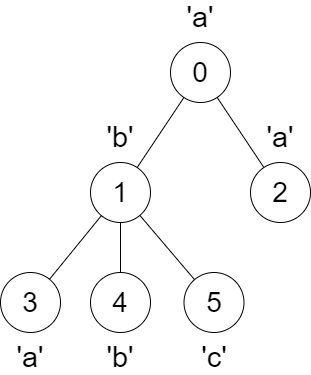
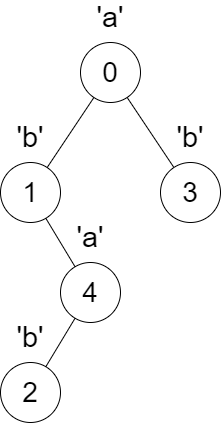
You are given a tree rooted at node 0 that consists of n nodes numbered from 0 to n - 1. The tree is represented by an array parent of size n, where parent[i] is the parent of node i. Since node 0 is the root, parent[0] == -1.
You are also given a string s of length n, where s[i] is the character assigned to node i.
We make the following changes on the tree one time simultaneously for all nodes x from 1 to n - 1:
Find the closest node y to node x such that y is an ancestor of x, and s[x] == s[y].
If node y does not exist, do nothing.
Otherwise, remove the edge between x and its current parent and make node y the new parent of x by adding an edge between them.
Return an array answer of size n where answer[i] is the size of the subtree rooted at node i in the final tree.
Example 1:
Input:parent = [-1,0,0,1,1,1], s = "abaabc"
Output:[6,3,1,1,1,1]
Explanation:
The parent of node 3 will change from node 1 to node 0.
Example 2:
Input:parent = [-1,0,4,0,1], s = "abbba"
Output:[5,2,1,1,1]
Explanation:
The following changes will happen at the same time:
The parent of node 4 will change from node 1 to node 0.
The parent of node 2 will change from node 4 to node 1.
Constraints:
n == parent.length == s.length
1 <= n <= 105
0 <= parent[i] <= n - 1 for all i >= 1.
parent[0] == -1
parent represents a valid tree.
s consists only of lowercase English letters.
Solutions
Solution 1
Thinking
A node may be reattached under its nearest ancestor with the same letter. With \(n \le 10^5\) we should not rebuild the edge list and then recount subtrees.
One DFS is enough: stacks \(\textit{d}[c]\) store ancestors of letter \(c\). Before returning, we add the current subtree size to the previous same-letter ancestor if it exists, otherwise to the parent.
Post-order ensures \(\textit{ans}[i]\) already includes every descendant; popping the stack restores the ancestor chain.