3244. Shortest Distance After Road Addition Queries II



Description
You are given an integer n and a 2D integer array queries.
There are n cities numbered from 0 to n - 1. Initially, there is a unidirectional road from city i to city i + 1 for all 0 <= i < n - 1.
queries[i] = [ui, vi] represents the addition of a new unidirectional road from city ui to city vi. After each query, you need to find the length of the shortest path from city 0 to city n - 1.
There are no two queries such that queries[i][0] < queries[j][0] < queries[i][1] < queries[j][1].
Return an array answer where for each i in the range [0, queries.length - 1], answer[i] is the length of the shortest path from city 0 to city n - 1 after processing the first i + 1 queries.
Example 1:
Input: n = 5, queries = [[2,4],[0,2],[0,4]]
Output: [3,2,1]
Explanation:

After the addition of the road from 2 to 4, the length of the shortest path from 0 to 4 is 3.

After the addition of the road from 0 to 2, the length of the shortest path from 0 to 4 is 2.
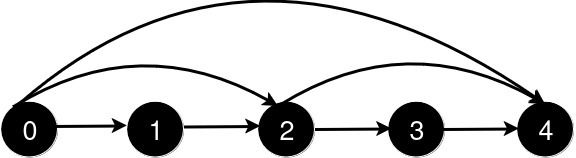
After the addition of the road from 0 to 4, the length of the shortest path from 0 to 4 is 1.
Example 2:
Input: n = 4, queries = [[0,3],[0,2]]
Output: [1,1]
Explanation:
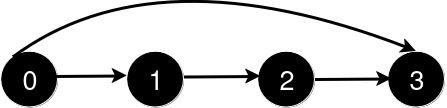
After the addition of the road from 0 to 3, the length of the shortest path from 0 to 3 is 1.
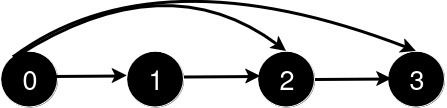
After the addition of the road from 0 to 2, the length of the shortest path remains 1.
Constraints:
3 <= n <= 1051 <= queries.length <= 105queries[i].length == 20 <= queries[i][0] < queries[i][1] < n1 < queries[i][1] - queries[i][0]- There are no repeated roads among the queries.
- There are no two queries such that
i != jandqueries[i][0] < queries[j][0] < queries[i][1] < queries[j][1].
Solutions
Solution 1: Greedy + Recording Jump Positions
Thinking
Same setting as the previous problem, but new edges do not nest across one another and the limits rule out BFS per query. An edge \(u\to v\) swallows the cities that had to be visited in between, so the distance drops by the number of covered nodes.
\(\textit{nxt}[i]\) is the city currently reached from \(i\). If the new edge actually shortens, walk \(\textit{nxt}\) through \([u,v)\), clear those jumps, and decrease \(\textit{cnt}\). Each index is deleted at most once, so the total time is linear.
We define an array \(\textit{nxt}\) of length \(n - 1\), where \(\textit{nxt}[i]\) represents the next city that can be reached from city \(i\). Initially, \(\textit{nxt}[i] = i + 1\).
For each query \([u, v]\), if \(u'\) and \(v'\) have already been connected before, and \(u' \leq u < v \leq v'\), then we can skip this query. Otherwise, we need to set the next city number for cities from \(\textit{nxt}[u]\) to \(\textit{nxt}[v - 1]\) to \(0\), and set \(\textit{nxt}[u]\) to \(v\).
During this process, we maintain a variable \(\textit{cnt}\), which represents the length of the shortest path from city \(0\) to city \(n - 1\). Initially, \(\textit{cnt} = n - 1\). Each time we set the next city number for cities in \([\textit{nxt}[u], \textit{v})\) to \(0\), \(\textit{cnt}\) decreases by \(1\).
Time complexity is \(O(n + q)\), and space complexity is \(O(n)\). Here, \(n\) and \(q\) are the number of cities and the number of queries, respectively.
1 2 3 4 5 6 7 8 9 10 11 12 13 14 15 16 | |
1 2 3 4 5 6 7 8 9 10 11 12 13 14 15 16 17 18 19 20 21 22 23 24 25 26 | |
1 2 3 4 5 6 7 8 9 10 11 12 13 14 15 16 17 18 19 20 21 22 23 24 | |
1 2 3 4 5 6 7 8 9 10 11 12 13 14 15 16 17 18 19 20 | |
1 2 3 4 5 6 7 8 9 10 11 12 13 14 15 16 17 | |