3243. Shortest Distance After Road Addition Queries I



Description
You are given an integer n and a 2D integer array queries.
There are n cities numbered from 0 to n - 1. Initially, there is a unidirectional road from city i to city i + 1 for all 0 <= i < n - 1.
queries[i] = [ui, vi] represents the addition of a new unidirectional road from city ui to city vi. After each query, you need to find the length of the shortest path from city 0 to city n - 1.
Return an array answer where for each i in the range [0, queries.length - 1], answer[i] is the length of the shortest path from city 0 to city n - 1 after processing the first i + 1 queries.
Example 1:
Input: n = 5, queries = [[2,4],[0,2],[0,4]]
Output: [3,2,1]
Explanation:

After the addition of the road from 2 to 4, the length of the shortest path from 0 to 4 is 3.

After the addition of the road from 0 to 2, the length of the shortest path from 0 to 4 is 2.
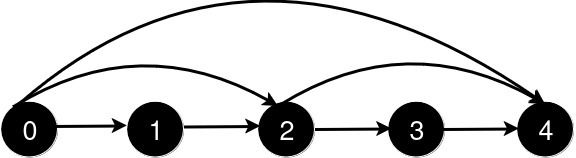
After the addition of the road from 0 to 4, the length of the shortest path from 0 to 4 is 1.
Example 2:
Input: n = 4, queries = [[0,3],[0,2]]
Output: [1,1]
Explanation:
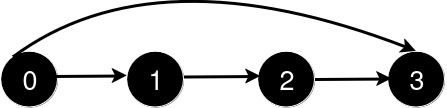
After the addition of the road from 0 to 3, the length of the shortest path from 0 to 3 is 1.
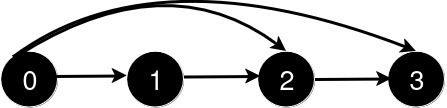
After the addition of the road from 0 to 2, the length of the shortest path remains 1.
Constraints:
3 <= n <= 5001 <= queries.length <= 500queries[i].length == 20 <= queries[i][0] < queries[i][1] < n1 < queries[i][1] - queries[i][0]- There are no repeated roads among the queries.
Solutions
Solution 1: BFS
Thinking
The graph starts as the path \(0\to 1\to\cdots\to n-1\); after each forward edge we want the distance from \(0\) to \(n-1\). \(n,q\le 500\), so a fresh shortest path per query is acceptable.
Edges have weight \(1\), so BFS from \(0\) after each insertion records the distance. The total time is \(O(q(n+q))\).
We first build a directed graph \(\textit{g}\), where \(\textit{g}[i]\) represents the list of cities that can be reached from city \(i\). Initially, each city \(i\) has a one-way road to city \(i + 1\).
Then, for each query \([u, v]\), we add \(v\) to the list of reachable cities from \(u\), and then use BFS to find the shortest path length from city \(0\) to city \(n - 1\), adding the result to the answer array.
Finally, we return the answer array.
The time complexity is \(O(q \times (n + q))\), and the space complexity is \(O(n + q)\). Here, \(n\) and \(q\) are the number of cities and the number of queries, respectively.
1 2 3 4 5 6 7 8 9 10 11 12 13 14 15 16 17 18 19 20 21 22 23 24 25 26 | |
1 2 3 4 5 6 7 8 9 10 11 12 13 14 15 16 17 18 19 20 21 22 23 24 25 26 27 28 29 30 31 32 33 34 35 36 37 38 39 40 41 42 | |
1 2 3 4 5 6 7 8 9 10 11 12 13 14 15 16 17 18 19 20 21 22 23 24 25 26 27 28 29 30 31 32 33 34 35 | |
1 2 3 4 5 6 7 8 9 10 11 12 13 14 15 16 17 18 19 20 21 22 23 24 25 26 27 28 29 30 31 32 | |
1 2 3 4 5 6 7 8 9 10 11 12 13 14 15 16 17 18 19 20 21 22 23 24 25 26 27 28 29 30 31 32 | |