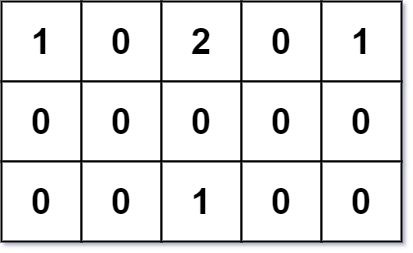
You are given an m x n grid grid of values 0, 1, or 2, where:
each 0 marks an empty land that you can pass by freely,
each 1 marks a building that you cannot pass through, and
each 2 marks an obstacle that you cannot pass through.
You want to build a house on an empty land that reaches all buildings in the shortest total travel distance. You can only move up, down, left, and right.
Return the shortest travel distance for such a house. If it is not possible to build such a house according to the above rules, return -1.
The total travel distance is the sum of the distances between the houses of the friends and the meeting point.
Example 1:
Input: grid = [[1,0,2,0,1],[0,0,0,0,0],[0,0,1,0,0]]
Output: 7
Explanation: Given three buildings at (0,0), (0,4), (2,2), and an obstacle at (0,2).
The point (1,2) is an ideal empty land to build a house, as the total travel distance of 3+3+1=7 is minimal.
So return 7.
Example 2:
Input: grid = [[1,0]]
Output: 1
Example 3:
Input: grid = [[1]]
Output: -1
Constraints:
m == grid.length
n == grid[i].length
1 <= m, n <= 50
grid[i][j] is either 0, 1, or 2.
There will be at least one building in the grid.
Solutions
Solution 1
Thinking
Find an empty cell minimizing the sum of distances to every building, without crossing buildings or obstacles. BFS from every empty cell repeats work when buildings are few and empties are many.
BFS from each building instead, adding the distance into \(dist\) and incrementing \(cnt\). Among empties with \(cnt\) equal to the building total, take the smallest \(dist\); if none is reached by every building, return \(-1\).