3033. Modify the Matrix



Description
Given a 0-indexed m x n integer matrix matrix, create a new 0-indexed matrix called answer. Make answer equal to matrix, then replace each element with the value -1 with the maximum element in its respective column.
Return the matrix answer.
Example 1:
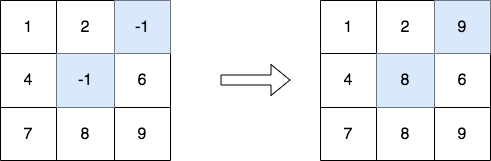
Input: matrix = [[1,2,-1],[4,-1,6],[7,8,9]]
Output: [[1,2,9],[4,8,6],[7,8,9]]
Explanation: The diagram above shows the elements that are changed (in blue).
- We replace the value in the cell [1][1] with the maximum value in the column 1, that is 8.
- We replace the value in the cell [0][2] with the maximum value in the column 2, that is 9.
Example 2:
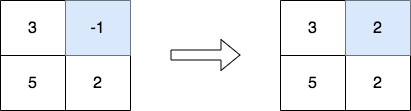
Input: matrix = [[3,-1],[5,2]]
Output: [[3,2],[5,2]]
Explanation: The diagram above shows the elements that are changed (in blue).
Constraints:
m == matrix.lengthn == matrix[i].length2 <= m, n <= 50-1 <= matrix[i][j] <= 100- The input is generated such that each column contains at least one non-negative integer.
Solutions
Solution 1: Simulation
Thinking
Each \(-1\) is replaced by the maximum of its column. Dimensions are at most \(50\), so two passes per column suffice.
A column’s maximum is independent of the replacements, so we compute it first and then write it into every \(-1\).
We can follow the problem description, traverse each column, find the maximum value of each column, and then traverse each column again, replacing the elements with a value of -1 with the maximum value of that column.
The time complexity is \(O(m \times n)\), where \(m\) and \(n\) are the number of rows and columns of the matrix, respectively. The space complexity is \(O(1)\).
1 2 3 4 5 6 7 8 9 | |
1 2 3 4 5 6 7 8 9 10 11 12 13 14 15 16 17 | |
1 2 3 4 5 6 7 8 9 10 11 12 13 14 15 16 17 18 | |
1 2 3 4 5 6 7 8 9 10 11 12 13 14 15 | |
1 2 3 4 5 6 7 8 9 10 11 12 13 14 15 | |
1 2 3 4 5 6 7 8 9 10 11 12 13 14 15 16 17 | |