Skip to content

3017. Count the Number of Houses at a Certain Distance II

Description

You are given three positive integers n, x, and y.

In a city, there exist houses numbered 1 to n connected by n streets. There is a street connecting the house numbered i with the house numbered i + 1 for all 1 <= i <= n - 1 . An additional street connects the house numbered x with the house numbered y.

For each k, such that 1 <= k <= n, you need to find the number of pairs of houses (house1, house2) such that the minimum number of streets that need to be traveled to reach house2 from house1 is k.

Return a 1-indexed array result of length n where result[k] represents the total number of pairs of houses such that the minimum streets required to reach one house from the other is k.

Note that x and y can be equal.


Example 1:
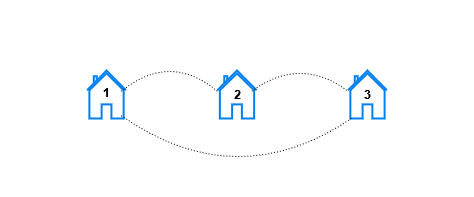
Input: n = 3, x = 1, y = 3
Output: [6,0,0]
Explanation: Let's look at each pair of houses:
- For the pair (1, 2), we can go from house 1 to house 2 directly.
- For the pair (2, 1), we can go from house 2 to house 1 directly.
- For the pair (1, 3), we can go from house 1 to house 3 directly.
- For the pair (3, 1), we can go from house 3 to house 1 directly.
- For the pair (2, 3), we can go from house 2 to house 3 directly.
- For the pair (3, 2), we can go from house 3 to house 2 directly.

Example 2:
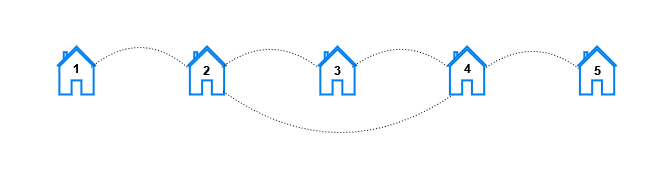
Input: n = 5, x = 2, y = 4
Output: [10,8,2,0,0]
Explanation: For each distance k the pairs are:
- For k == 1, the pairs are (1, 2), (2, 1), (2, 3), (3, 2), (2, 4), (4, 2), (3, 4), (4, 3), (4, 5), and (5, 4).
- For k == 2, the pairs are (1, 3), (3, 1), (1, 4), (4, 1), (2, 5), (5, 2), (3, 5), and (5, 3).
- For k == 3, the pairs are (1, 5), and (5, 1).
- For k == 4 and k == 5, there are no pairs.

Example 3:
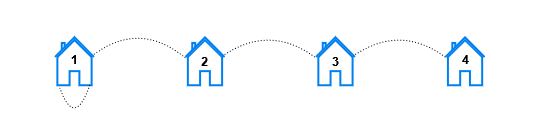
Input: n = 4, x = 1, y = 1
Output: [6,4,2,0]
Explanation: For each distance k the pairs are:
- For k == 1, the pairs are (1, 2), (2, 1), (2, 3), (3, 2), (3, 4), and (4, 3).
- For k == 2, the pairs are (1, 3), (3, 1), (2, 4), and (4, 2).
- For k == 3, the pairs are (1, 4), and (4, 1).
- For k == 4, there are no pairs.


Constraints:

  • 2 <= n <= 105
  • 1 <= x, y <= n

Solutions

Solution 1

Thinking

\(n\) is now \(10^5\), so the \(O(n^2)\) enumeration of part I is gone. The graph is still a path plus one edge, and the distance histogram has a closed form.

If \(|x-y| \le 1\) the extra edge is useless and we count distances on a path. Otherwise a cycle of length \(|x-y|+1\) appears, with a tail on each side.

We add the histograms of path pairs, cycle pairs, and tail-to-cycle pairs, treating even/odd cycle length so the diameter is not double-counted.

 1
 2
 3
 4
 5
 6
 7
 8
 9
10
11
12
13
14
15
16
17
18
19
20
21
22
23
24
25
26
27
28
29
30
31
32
33
34
35
36
37
38
39
40
41
42
class Solution:
    def countOfPairs(self, n: int, x: int, y: int) -> List[int]:
        if abs(x - y) <= 1:
            return [2 * x for x in reversed(range(n))]
        cycle_len = abs(x - y) + 1
        n2 = n - cycle_len + 2
        res = [2 * x for x in reversed(range(n2))]
        while len(res) < n:
            res.append(0)
        res2 = [cycle_len * 2] * (cycle_len >> 1)
        if not cycle_len & 1:
            res2[-1] = cycle_len
        res2[0] -= 2
        for i in range(len(res2)):
            res[i] += res2[i]
        if x > y:
            x, y = y, x
        tail1 = x - 1
        tail2 = n - y
        for tail in (tail1, tail2):
            if not tail:
                continue
            i_mx = tail + (cycle_len >> 1)
            val_mx = 4 * min((cycle_len - 3) >> 1, tail)
            i_mx2 = i_mx - (1 - (cycle_len & 1))
            res3 = [val_mx] * i_mx
            res3[0] = 0
            res3[1] = 0
            if not cycle_len & 1:
                res3[-1] = 0
            for i, j in enumerate(range(4, val_mx, 4)):
                res3[i + 2] = j
                res3[i_mx2 - i - 1] = j
            for i in range(1, tail + 1):
                res3[i] += 2
            if not cycle_len & 1:
                mn = cycle_len >> 1
                for i in range(mn, mn + tail):
                    res3[i] += 2
            for i in range(len(res3)):
                res[i] += res3[i]
        return res
 1
 2
 3
 4
 5
 6
 7
 8
 9
10
11
12
13
14
15
16
17
18
19
20
21
22
23
24
25
26
class Solution {
    public long[] countOfPairs(int n, int x, int y) {
        --x;
        --y;
        if (x > y) {
        int temp = x;
        x = y;
        y = temp;
        }
        long[] diff = new long[n];
        for (int i = 0; i < n; ++i) {
        diff[0] += 1 + 1;
        ++diff[Math.min(Math.abs(i - x), Math.abs(i - y) + 1)];
        ++diff[Math.min(Math.abs(i - y), Math.abs(i - x) + 1)];
        --diff[Math.min(Math.abs(i - 0), Math.abs(i - y) + 1 + Math.abs(x - 0))];
        --diff[Math.min(Math.abs(i - (n - 1)),
                        Math.abs(i - x) + 1 + Math.abs(y - (n - 1)))];
        --diff[Math.max(x - i, 0) + Math.max(i - y, 0) + ((y - x) + 0) / 2];
        --diff[Math.max(x - i, 0) + Math.max(i - y, 0) + ((y - x) + 1) / 2];
        }
        for (int i = 0; i + 1 < n; ++i) {
        diff[i + 1] += diff[i];
        }
        return diff;
    }
}
 1
 2
 3
 4
 5
 6
 7
 8
 9
10
11
12
13
14
15
16
17
18
19
20
21
22
23
class Solution {
public:
  vector<long long> countOfPairs(int n, int x, int y) {
    --x, --y;
    if (x > y) {
      swap(x, y);
    }
    vector<long long> diff(n);
    for (int i = 0; i < n; ++i) {
      diff[0] += 1 + 1;
      ++diff[min(abs(i - x), abs(i - y) + 1)];
      ++diff[min(abs(i - y), abs(i - x) + 1)];
      --diff[min(abs(i - 0), abs(i - y) + 1 + abs(x - 0))];
      --diff[min(abs(i - (n - 1)), abs(i - x) + 1 + abs(y - (n - 1)))];
      --diff[max(x - i, 0) + max(i - y, 0) + ((y - x) + 0) / 2];
      --diff[max(x - i, 0) + max(i - y, 0) + ((y - x) + 1) / 2];
    }
    for (int i = 0; i + 1 < n; ++i) {
      diff[i + 1] += diff[i];
    }
    return diff;
  }
};
 1
 2
 3
 4
 5
 6
 7
 8
 9
10
11
12
13
14
15
16
17
18
19
20
21
func countOfPairs(n int, x int, y int) []int64 {
    if x > y {
        x, y = y, x
    }
    A := make([]int64, n)
    for i := 1; i <= n; i++ {
        A[0] += 2
        A[min(int64(i-1), int64(math.Abs(float64(i-y)))+int64(x))] -= 1
        A[min(int64(n-i), int64(math.Abs(float64(i-x)))+1+int64(n-y))] -= 1
        A[min(int64(math.Abs(float64(i-x))), int64(math.Abs(float64(y-i)))+1)] += 1
        A[min(int64(math.Abs(float64(i-x)))+1, int64(math.Abs(float64(y-i))))] += 1
        r := max(int64(x-i), 0) + max(int64(i-y), 0)
        A[r+int64((y-x+0)/2)] -= 1
        A[r+int64((y-x+1)/2)] -= 1
    }
    for i := 1; i < n; i++ {
        A[i] += A[i-1]
    }

    return A
}

Comments