2737. Find the Closest Marked Node 🔒

Description
You are given a positive integer n which is the number of nodes of a 0-indexed directed weighted graph and a 0-indexed 2D array edges where edges[i] = [ui, vi, wi] indicates that there is an edge from node ui to node vi with weight wi.
You are also given a node s and a node array marked; your task is to find the minimum distance from s to any of the nodes in marked.
Return an integer denoting the minimum distance from s to any node in marked or -1 if there are no paths from s to any of the marked nodes.
Example 1:
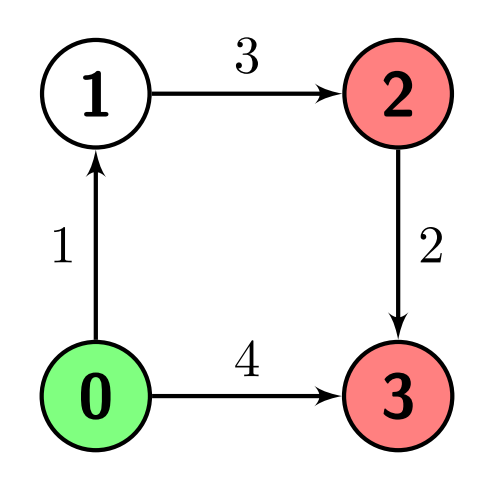
Input: n = 4, edges = [[0,1,1],[1,2,3],[2,3,2],[0,3,4]], s = 0, marked = [2,3]
Output: 4
Explanation: There is one path from node 0 (the green node) to node 2 (a red node), which is 0->1->2, and has a distance of 1 + 3 = 4.
There are two paths from node 0 to node 3 (a red node), which are 0->1->2->3 and 0->3, the first one has a distance of 1 + 3 + 2 = 6 and the second one has a distance of 4.
The minimum of them is 4.
Example 2:
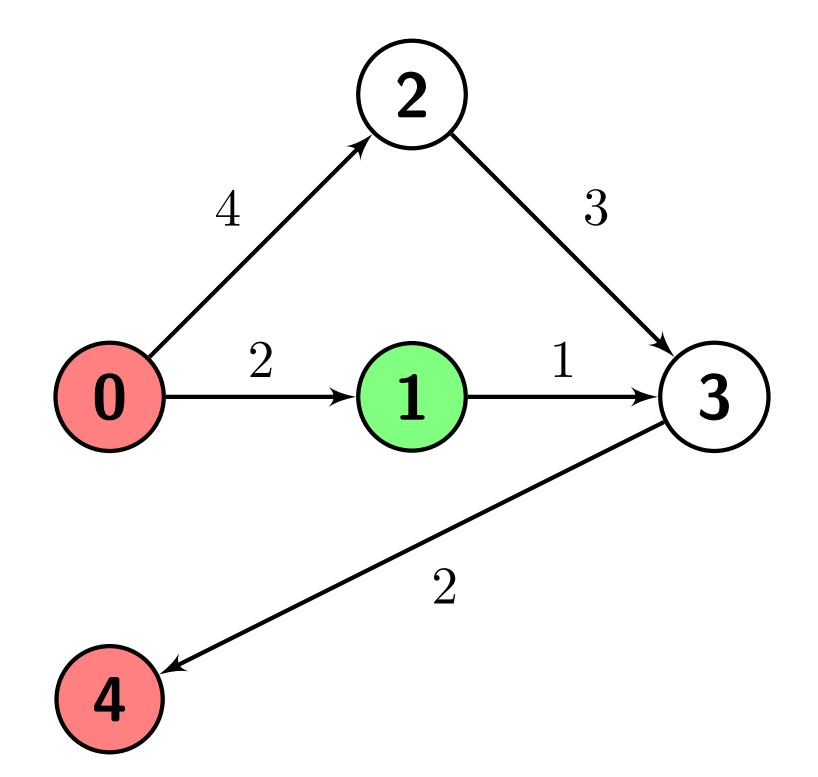
Input: n = 5, edges = [[0,1,2],[0,2,4],[1,3,1],[2,3,3],[3,4,2]], s = 1, marked = [0,4]
Output: 3
Explanation: There are no paths from node 1 (the green node) to node 0 (a red node).
There is one path from node 1 to node 4 (a red node), which is 1->3->4, and has a distance of 1 + 2 = 3.
So the answer is 3.
Example 3:
Input: n = 4, edges = [[0,1,1],[1,2,3],[2,3,2]], s = 3, marked = [0,1]
Output: -1
Explanation: There are no paths from node 3 (the green node) to any of the marked nodes (the red nodes), so the answer is -1.

Constraints:
2 <= n <= 5001 <= edges.length <= 104edges[i].length = 30 <= edges[i][0], edges[i][1] <= n - 11 <= edges[i][2] <= 1061 <= marked.length <= n - 10 <= s, marked[i] <= n - 1s != marked[i]marked[i] != marked[j]for everyi != j- The graph might have repeated edges.
- The graph is generated such that it has no self-loops.
Solutions
Solution 1: Dijkstra's Algorithm
Thinking
Find the shortest path from \(s\) to any marked vertex in a directed weighted graph. \(n\) is small enough for Dijkstra on an adjacency matrix without a heap.
Repeatedly pick the closest unused vertex and relax its outgoing edges, then take the minimum \(dist\) among marked vertices, or \(-1\) if it stays infinite.
First, we construct an adjacency matrix \(g\) based on the edge information provided in the problem, where \(g[i][j]\) represents the distance from node \(i\) to node \(j\). If such an edge does not exist, then \(g[i][j]\) is positive infinity.
Then, we can use Dijkstra's algorithm to find the shortest distance from the starting point \(s\) to all nodes, denoted as \(dist\).
Finally, we traverse all the marked nodes and find the marked node with the smallest distance. If the distance is positive infinity, we return \(-1\).
The time complexity is \(O(n^2)\), and the space complexity is \(O(n^2)\). Here, \(n\) is the number of nodes.
1 2 3 4 5 6 7 8 9 10 11 12 13 14 15 16 17 18 19 20 | |
1 2 3 4 5 6 7 8 9 10 11 12 13 14 15 16 17 18 19 20 21 22 23 24 25 26 27 28 29 30 31 32 33 34 | |
1 2 3 4 5 6 7 8 9 10 11 12 13 14 15 16 17 18 19 20 21 22 23 24 25 26 27 28 29 30 31 | |
1 2 3 4 5 6 7 8 9 10 11 12 13 14 15 16 17 18 19 20 21 22 23 24 25 26 27 28 29 30 31 32 33 34 35 36 37 38 | |
1 2 3 4 5 6 7 8 9 10 11 12 13 14 15 16 17 18 19 20 21 22 23 24 25 26 27 28 29 | |