You are given a directed graph of n nodes numbered from 0 to n - 1, where each node has at most one outgoing edge.
The graph is represented with a given 0-indexed array edges of size n, indicating that there is a directed edge from node i to node edges[i]. If there is no outgoing edge from i, then edges[i] == -1.
You are also given two integers node1 and node2.
Return the index of the node that can be reached from both node1 and node2, such that the maximum between the distance from node1 to that node, and from node2 to that node is minimized. If there are multiple answers, return the node with the smallest index, and if no possible answer exists, return -1.
Note that edges may contain cycles.
Example 1:
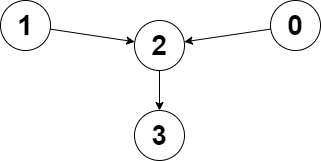
Input: edges = [2,2,3,-1], node1 = 0, node2 = 1
Output: 2
Explanation: The distance from node 0 to node 2 is 1, and the distance from node 1 to node 2 is 1.
The maximum of those two distances is 1. It can be proven that we cannot get a node with a smaller maximum distance than 1, so we return node 2.
Example 2:
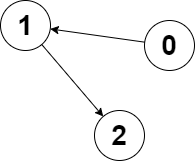
Input: edges = [1,2,-1], node1 = 0, node2 = 2
Output: 2
Explanation: The distance from node 0 to node 2 is 2, and the distance from node 2 to itself is 0.
The maximum of those two distances is 2. It can be proven that we cannot get a node with a smaller maximum distance than 2, so we return node 2.
Constraints:
n == edges.length
2 <= n <= 105
-1 <= edges[i] < n
edges[i] != i
0 <= node1, node2 < n
Solutions
Solution 1: BFS + Enumerate Common Nodes
Thinking
Out-degree is at most one, so each start reaches a path (or a cycle prefix). \(n \le 10^5\) allows one BFS from each node.
After both distance arrays, scan every index and minimize \(\max(d_1[i],d_2[i])\), breaking ties by the smaller index. Unreachable stays infinity.
We can first use BFS to calculate the distance from \(node1\) and \(node2\) to every node, denoted as \(d_1\) and \(d_2\) respectively. Then, enumerate all common nodes \(i\), and for each, compute \(\max(d_1[i], d_2[i])\). The answer is the node with the minimal such value.
The complexity is \(O(n)\), and the space complexity is \(O(n)\), where \(n\) is the number of nodes.