You are given a positive integer n representing the number of nodes of a Directed Acyclic Graph (DAG). The nodes are numbered from 0 to n - 1 (inclusive).
You are also given a 2D integer array edges, where edges[i] = [fromi, toi] denotes that there is a unidirectional edge from fromi to toi in the graph.
Return a listanswer, where answer[i] is the list of ancestors of theithnode, sorted in ascending order.
A node u is an ancestor of another node v if u can reach v via a set of edges.
Example 1:
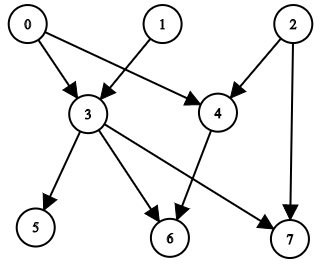
Input: n = 8, edgeList = [[0,3],[0,4],[1,3],[2,4],[2,7],[3,5],[3,6],[3,7],[4,6]]
Output: [[],[],[],[0,1],[0,2],[0,1,3],[0,1,2,3,4],[0,1,2,3]]
Explanation:
The above diagram represents the input graph.
- Nodes 0, 1, and 2 do not have any ancestors.
- Node 3 has two ancestors 0 and 1.
- Node 4 has two ancestors 0 and 2.
- Node 5 has three ancestors 0, 1, and 3.
- Node 6 has five ancestors 0, 1, 2, 3, and 4.
- Node 7 has four ancestors 0, 1, 2, and 3.
Example 2:
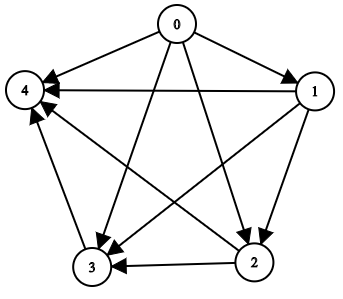
Input: n = 5, edgeList = [[0,1],[0,2],[0,3],[0,4],[1,2],[1,3],[1,4],[2,3],[2,4],[3,4]]
Output: [[],[0],[0,1],[0,1,2],[0,1,2,3]]
Explanation:
The above diagram represents the input graph.
- Node 0 does not have any ancestor.
- Node 1 has one ancestor 0.
- Node 2 has two ancestors 0 and 1.
- Node 3 has three ancestors 0, 1, and 2.
- Node 4 has four ancestors 0, 1, 2, and 3.
Constraints:
1 <= n <= 1000
0 <= edges.length <= min(2000, n * (n - 1) / 2)
edges[i].length == 2
0 <= fromi, toi <= n - 1
fromi != toi
There are no duplicate edges.
The graph is directed and acyclic.
Solutions
Solution 1: BFS
Thinking
List every ancestor of each node in a DAG, sorted by id. Reverse DFS from every node repeats shared in-edges and still needs sorting. With \(n\le 1000\) we can walk descendants of each \(i\) and append \(i\) to those lists, which is already sorted by \(i\).
Build the adjacency list, BFS from every \(i\), and record \(i\) on every reachable node. A visited set prevents re-enqueue.
Each answer row is increasing because sources are enumerated in order.
First, we construct the adjacency list \(g\) based on the two-dimensional array \(edges\), where \(g[i]\) represents all successor nodes of node \(i\).
Then, we enumerate node \(i\) as the ancestor node from small to large, use BFS to search all successor nodes of node \(i\), and add node \(i\) to the ancestor list of these successor nodes.
The time complexity is \(O(n^2)\), and the space complexity is \(O(n^2)\). Where \(n\) is the number of nodes.