In one operation, you can choose any i and j that meet the following conditions:
0 <= i < m
0 <= j < n
grid[i][j] == 1
and change the values of all cells in row i and column j to zero.
Return the minimum number of operations needed to remove all 1's from grid.
Example 1:
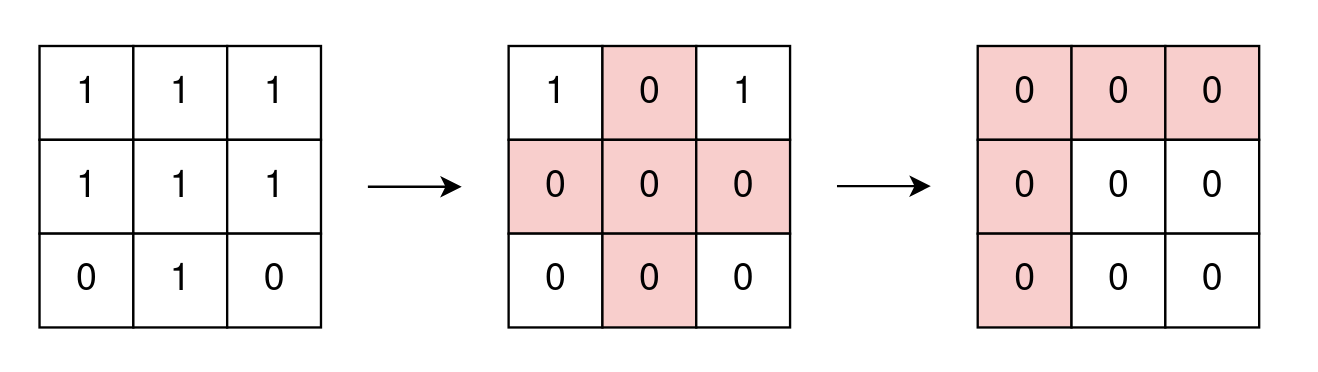
Input: grid = [[1,1,1],[1,1,1],[0,1,0]]
Output: 2
Explanation:
In the first operation, change all cell values of row 1 and column 1 to zero.
In the second operation, change all cell values of row 0 and column 0 to zero.
Example 2:
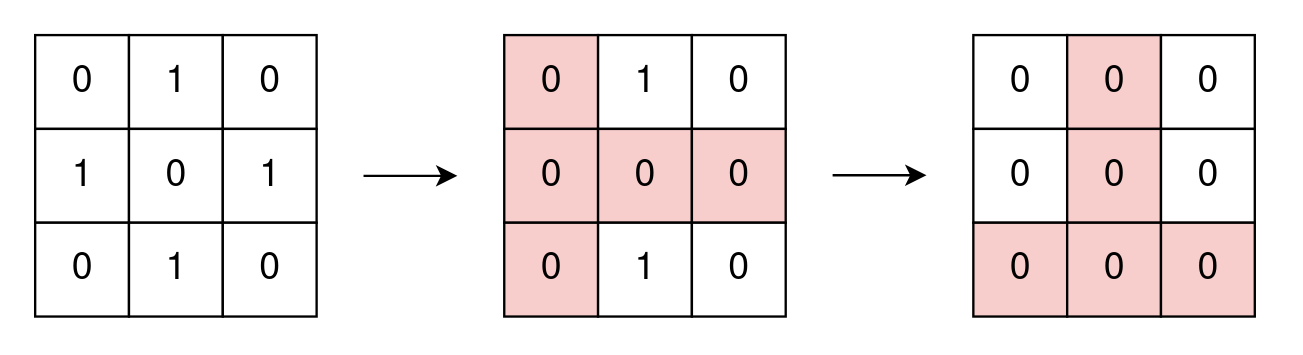
Input: grid = [[0,1,0],[1,0,1],[0,1,0]]
Output: 2
Explanation:
In the first operation, change all cell values of row 1 and column 0 to zero.
In the second operation, change all cell values of row 2 and column 1 to zero.
Note that we cannot perform an operation using row 1 and column 1 because grid[1][1] != 1.
Example 3:
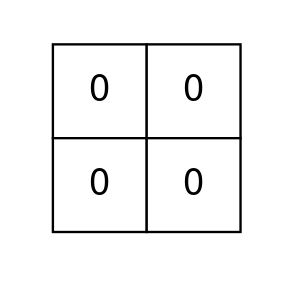
Input: grid = [[0,0],[0,0]]
Output: 0
Explanation:
There are no 1's to remove so return 0.
Constraints:
m == grid.length
n == grid[i].length
1 <= m, n <= 15
1 <= m * n <= 15
grid[i][j] is either 0 or 1.
Solutions
Solution 1
Thinking
An operation picks a \(1\) and clears its whole row and column. The grid is at most \(8\times 8\), so configurations fit in an integer. Order among a set of moves does not matter; BFS finds the shortest sequence.
Pack the matrix into \(\textit{state}\). From a \(1\) cell, clear every bit on its row and column. Distance in this graph is the number of operations.