You are given an array points where points[i] = [xi, yi] represents a point on an X-Y plane.
Straight lines are going to be added to the X-Y plane, such that every point is covered by at least one line.
Return the minimum number of straight lines needed to cover all the points.
Example 1:
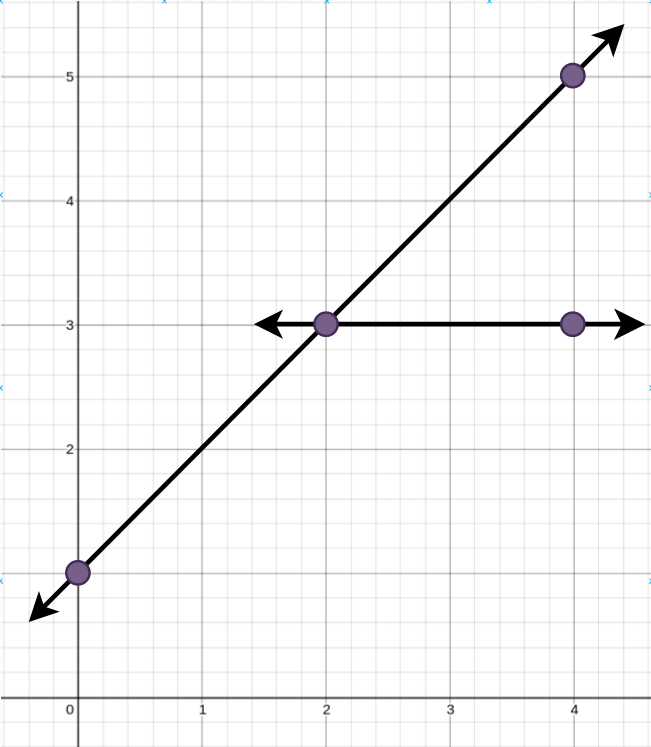
Input: points = [[0,1],[2,3],[4,5],[4,3]]
Output: 2
Explanation: The minimum number of straight lines needed is two. One possible solution is to add:
- One line connecting the point at (0, 1) to the point at (4, 5).
- Another line connecting the point at (2, 3) to the point at (4, 3).
Example 2:
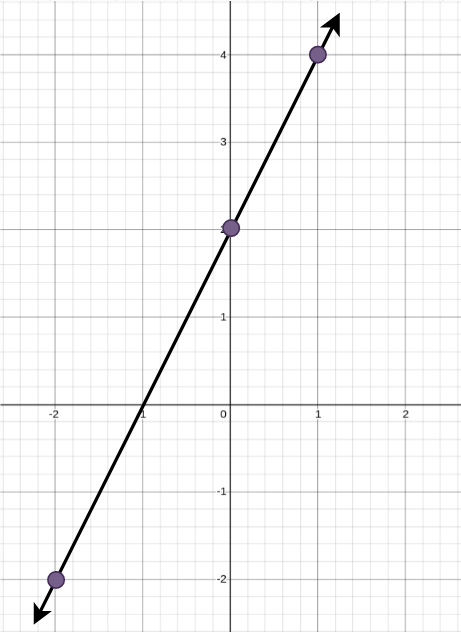
Input: points = [[0,2],[-2,-2],[1,4]]
Output: 1
Explanation: The minimum number of straight lines needed is one. The only solution is to add:
- One line connecting the point at (-2, -2) to the point at (1, 4).
Constraints:
1 <= points.length <= 10
points[i].length == 2
-100 <= xi, yi <= 100
All the points are unique.
Solutions
Solution 1
Thinking
Cover at most \(10\) points with as few lines as possible. Partition search is exponential, but the point count is tiny enough for a subset DP.
\(\textit{state}\) is the set of covered points. From an uncovered \(i\), pair it with \(j\), include every other colinear point, and recurse. A leftover singleton uses a line by itself.
Memoized \(dfs(\textit{state})\) adds one line per transition; colinearity is a cross-product test.