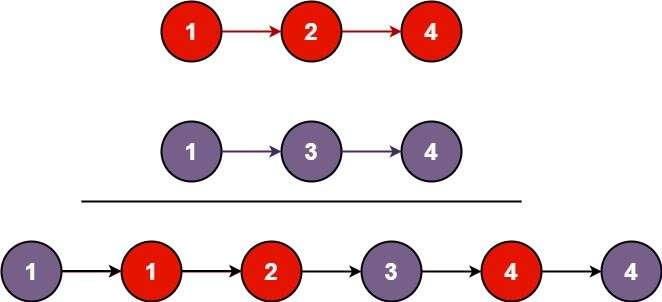
The number of nodes in both lists is in the range [0, 50].
-100 <= Node.val <= 100
Both list1 and list2 are sorted in non-decreasing order.
Solutions
Solution 1: Recursion
Thinking
The first idea is to dump both lists into an array, sort, and rebuild. Total length is at most \(100\), so it would pass, but it throws away the fact that both lists are already sorted.
The bottleneck is unnecessary reordering: each step only needs the smaller of the two heads. After taking it, what remains is still two sorted lists — the same problem, one node smaller.
Compare the heads of \(l_1\) and \(l_2\); keep the smaller one and hang the merge of the rest on its \(\textit{next}\). When one list is empty, the other is the answer as-is.
Recursion depth equals the number of nodes. Lengths here are tiny, so \(O(m+n)\) stack space is fine.
First, we judge whether the linked lists \(l_1\) and \(l_2\) are empty. If one of them is empty, we return the other linked list. Otherwise, we compare the head nodes of \(l_1\) and \(l_2\):
If the value of the head node of \(l_1\) is less than or equal to the value of the head node of \(l_2\), we recursively call the function \(mergeTwoLists(l_1.next, l_2)\), and connect the head node of \(l_1\) with the returned linked list head node, and return the head node of \(l_1\).
Otherwise, we recursively call the function \(mergeTwoLists(l_1, l_2.next)\), and connect the head node of \(l_2\) with the returned linked list head node, and return the head node of \(l_2\).
The time complexity is \(O(m + n)\), and the space complexity is \(O(m + n)\). Here, \(m\) and \(n\) are the lengths of the two linked lists respectively.
1 2 3 4 5 6 7 8 91011121314151617
# Definition for singly-linked list.# class ListNode:# def __init__(self, val=0, next=None):# self.val = val# self.next = nextclassSolution:defmergeTwoLists(self,list1:Optional[ListNode],list2:Optional[ListNode])->Optional[ListNode]:iflist1isNoneorlist2isNone:returnlist1orlist2iflist1.val<=list2.val:list1.next=self.mergeTwoLists(list1.next,list2)returnlist1else:list2.next=self.mergeTwoLists(list1,list2.next)returnlist2
/** * Definition for singly-linked list. * type ListNode struct { * Val int * Next *ListNode * } */funcmergeTwoLists(list1*ListNode,list2*ListNode)*ListNode{iflist1==nil{returnlist2}iflist2==nil{returnlist1}iflist1.Val<=list2.Val{list1.Next=mergeTwoLists(list1.Next,list2)returnlist1}else{list2.Next=mergeTwoLists(list1,list2.Next)returnlist2}}
/** * Definition for a singly-linked list. * class ListNode { * public $val = 0; * public $next = null; * function __construct($val = 0, $next = null) { * $this->val = $val; * $this->next = $next; * } * } */classSolution{/** * @param ListNode $list1 * @param ListNode $list2 * @return ListNode */functionmergeTwoLists($list1,$list2){if(is_null($list1)){return$list2;}if(is_null($list2)){return$list1;}if($list1->val<=$list2->val){$list1->next=$this->mergeTwoLists($list1->next,$list2);return$list1;}else{$list2->next=$this->mergeTwoLists($list1,$list2->next);return$list2;}}}
Solution 2: Iteration
Thinking
Solution 1 is correct, but the recursion stack is linear in the number of nodes. The lists here are short, yet the same choice can be made with constant extra space.
The observation is unchanged: each step still compares the two heads and appends the smaller. A dummy \(dummy\) plus a tail pointer \(curr\) do that in a loop; when one list runs out, splice the other on.
Time matches the recursive version; extra space drops to \(O(1)\).
We can also use iteration to implement the merging of two sorted linked lists.
First, we define a dummy head node \(dummy\), then loop through the two linked lists, compare the head nodes of the two linked lists, add the smaller node to the end of \(dummy\), until one of the linked lists is empty, then add the remaining part of the other linked list to the end of \(dummy\).
Finally, return \(dummy.next\).
The time complexity is \(O(m + n)\), where \(m\) and \(n\) are the lengths of the two linked lists respectively. Ignoring the space consumption of the answer linked list, the space complexity is \(O(1)\).
1 2 3 4 5 6 7 8 9101112131415161718192021
# Definition for singly-linked list.# class ListNode:# def __init__(self, val=0, next=None):# self.val = val# self.next = nextclassSolution:defmergeTwoLists(self,list1:Optional[ListNode],list2:Optional[ListNode])->Optional[ListNode]:dummy=ListNode()curr=dummywhilelist1andlist2:iflist1.val<=list2.val:curr.next=list1list1=list1.nextelse:curr.next=list2list2=list2.nextcurr=curr.nextcurr.next=list1orlist2returndummy.next
/** * Definition for singly-linked list. * type ListNode struct { * Val int * Next *ListNode * } */funcmergeTwoLists(list1*ListNode,list2*ListNode)*ListNode{dummy:=&ListNode{}curr:=dummyforlist1!=nil&&list2!=nil{iflist1.Val<=list2.Val{curr.Next=list1list1=list1.Next}else{curr.Next=list2list2=list2.Next}curr=curr.Next}iflist1!=nil{curr.Next=list1}else{curr.Next=list2}returndummy.Next}