You are given an integer array nums of 2 * n integers. You need to partition nums into two arrays of length n to minimize the absolute difference of the sums of the arrays. To partition nums, put each element of nums into one of the two arrays.
Return the minimum possible absolute difference.
Example 1:
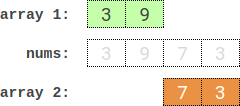
Input: nums = [3,9,7,3]
Output: 2
Explanation: One optimal partition is: [3,9] and [7,3].
The absolute difference between the sums of the arrays is abs((3 + 9) - (7 + 3)) = 2.
Example 2:
Input: nums = [-36,36]
Output: 72
Explanation: One optimal partition is: [-36] and [36].
The absolute difference between the sums of the arrays is abs((-36) - (36)) = 72.
Example 3:
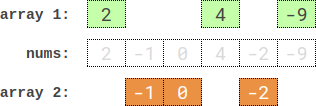
Input: nums = [2,-1,0,4,-2,-9]
Output: 0
Explanation: One optimal partition is: [2,4,-9] and [-1,0,-2].
The absolute difference between the sums of the arrays is abs((2 + 4 + -9) - (-1 + 0 + -2)) = 0.
Constraints:
1 <= n <= 15
nums.length == 2 * n
-107 <= nums[i] <= 107
Solutions
Solution 1
Thinking
We split \(2n \le 30\) elements into equal halves minimizing the sum gap. Full \(C(30,15)\) is tight; meet-in-the-middle leaves \(n \le 15\) per half.
For each half, group by chosen count the signed sums (chosen minus unchosen). Left count \(i\) pairs with right count \(n-i\), aiming for opposite sums.
Sort both groups and binary-search partners to minimize \(|a+b|\). The \(2^{15}\) enumeration fits.