2014. Longest Subsequence Repeated k Times



Description
You are given a string s of length n, and an integer k. You are tasked to find the longest subsequence repeated k times in string s.
A subsequence is a string that can be derived from another string by deleting some or no characters without changing the order of the remaining characters.
A subsequence seq is repeated k times in the string s if seq * k is a subsequence of s, where seq * k represents a string constructed by concatenating seq k times.
- For example,
"bba"is repeated2times in the string"bababcba", because the string"bbabba", constructed by concatenating"bba"2times, is a subsequence of the string"bababcba".
Return the longest subsequence repeated k times in string s. If multiple such subsequences are found, return the lexicographically largest one. If there is no such subsequence, return an empty string.
Example 1:
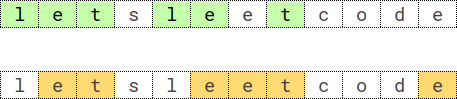
Input: s = "letsleetcode", k = 2
Output: "let"
Explanation: There are two longest subsequences repeated 2 times: "let" and "ete".
"let" is the lexicographically largest one.
Example 2:
Input: s = "bb", k = 2
Output: "b"
Explanation: The longest subsequence repeated 2 times is "b".
Example 3:
Input: s = "ab", k = 2
Output: ""
Explanation: There is no subsequence repeated 2 times. Empty string is returned.
Constraints:
n == s.length2 <= k <= 20002 <= n < min(2001, k * 8)sconsists of lowercase English letters.
Solutions
Solution 1: BFS
Thinking
Since \(n < \min(2001, k \cdot 8)\), a \(k\)-repeated subsequence has length at most \(\lfloor n/k \rfloor \le 7\). A letter must occur at least \(k\) times to appear in the answer.
With short candidates, BFS from short to long makes the last success the longest, and appending letters in order makes it lexicographically largest among that length.
The queue starts from "" and appends letters with count \(\ge k\); check matches \(t\) in \(s\) for \(k\) rounds.
We can first count the occurrences of each character in the string, and then store the characters that appear at least \(k\) times in a list \(\textit{cs}\) in ascending order. Next, we can use BFS to enumerate all possible subsequences.
We define a queue \(\textit{q}\), initially putting the empty string into the queue. Then, we take out a string \(\textit{cur}\) from the queue and try to append each character \(c \in \textit{cs}\) to the end of \(\textit{cur}\) to form a new string \(\textit{nxt}\). If \(\textit{nxt}\) is a subsequence that can be repeated \(k\) times, we add it to the answer and put \(\textit{nxt}\) back into the queue for further processing.
We need an auxiliary function \(\textit{check(t, k)}\) to determine whether the string \(\textit{t}\) is a repeated \(k\) times subsequence of string \(s\). Specifically, we can use two pointers to traverse \(s\) and \(\textit{t}\). If we can find all characters of \(\textit{t}\) in \(s\) and repeat this process \(k\) times, then return \(\textit{true}\); otherwise, return \(\textit{false}\).
1 2 3 4 5 6 7 8 9 10 11 12 13 14 15 16 17 18 19 20 21 22 23 24 25 26 | |
1 2 3 4 5 6 7 8 9 10 11 12 13 14 15 16 17 18 19 20 21 22 23 24 25 26 27 28 29 30 31 32 33 34 35 36 37 38 39 40 41 42 43 44 45 46 47 48 | |
1 2 3 4 5 6 7 8 9 10 11 12 13 14 15 16 17 18 19 20 21 22 23 24 25 26 27 28 29 30 31 32 33 34 35 36 37 38 39 40 41 42 43 44 45 46 47 | |
1 2 3 4 5 6 7 8 9 10 11 12 13 14 15 16 17 18 19 20 21 22 23 24 25 26 27 28 29 30 31 32 33 34 35 36 37 38 39 40 41 42 43 44 45 | |
1 2 3 4 5 6 7 8 9 10 11 12 13 14 15 16 17 18 19 20 21 22 23 24 25 26 27 28 29 30 31 32 33 34 35 36 37 38 39 40 41 42 43 44 45 | |