You are given an m x n integer matrix points (0-indexed). Starting with 0 points, you want to maximize the number of points you can get from the matrix.
To gain points, you must pick one cell in each row. Picking the cell at coordinates (r, c) will addpoints[r][c] to your score.
However, you will lose points if you pick a cell too far from the cell that you picked in the previous row. For every two adjacent rows r and r + 1 (where 0 <= r < m - 1), picking cells at coordinates (r, c1) and (r + 1, c2) will subtractabs(c1 - c2) from your score.
Return the maximum number of points you can achieve.
abs(x) is defined as:
x for x >= 0.
-x for x < 0.
Example 1:
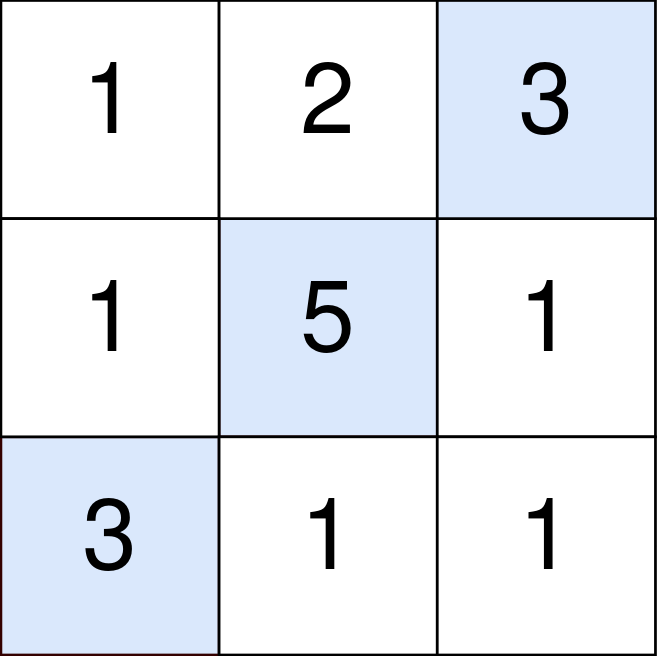
Input: points = [[1,2,3],[1,5,1],[3,1,1]]
Output: 9
Explanation:
The blue cells denote the optimal cells to pick, which have coordinates (0, 2), (1, 1), and (2, 0).
You add 3 + 5 + 3 = 11 to your score.
However, you must subtract abs(2 - 1) + abs(1 - 0) = 2 from your score.
Your final score is 11 - 2 = 9.
Example 2:
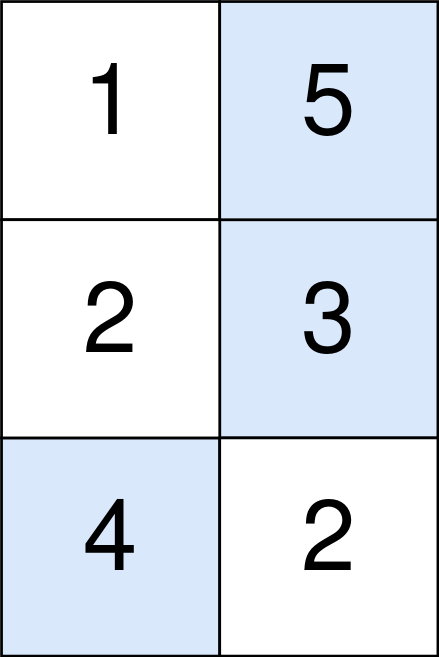
Input: points = [[1,5],[2,3],[4,2]]
Output: 11
Explanation:
The blue cells denote the optimal cells to pick, which have coordinates (0, 1), (1, 1), and (2, 0).
You add 5 + 3 + 4 = 12 to your score.
However, you must subtract abs(1 - 1) + abs(1 - 0) = 1 from your score.
Your final score is 12 - 1 = 11.
Constraints:
m == points.length
n == points[r].length
1 <= m, n <= 105
1 <= m * n <= 105
0 <= points[r][c] <= 105
Solutions
Solution 1
Thinking
One cell per row with an absolute-column penalty. Trying every previous column is \(O(n^2)\) per row and fails when \(mn\le 10^5\).
The \(k\le j\) part depends on \(\max(f[k]+k)\) and the \(k\ge j\) part on \(\max(f[k]-k)\). A left-to-right prefix max and a right-to-left suffix max evaluate each cell in \(O(1)\).
Rolling one row of DP uses \(O(n)\) extra space and linear time in the number of cells.