1924. Erect the Fence II 🔒

Description
You are given a 2D integer array trees where trees[i] = [xi, yi] represents the location of the ith tree in the garden.
You are asked to fence the entire garden using the minimum length of rope possible. The garden is well-fenced only if all the trees are enclosed and the rope used forms a perfect circle. A tree is considered enclosed if it is inside or on the border of the circle.
More formally, you must form a circle using the rope with a center (x, y) and radius r where all trees lie inside or on the circle and r is minimum.
Return the center and radius of the circle as a length 3 array [x, y, r]. Answers within 10-5 of the actual answer will be accepted.
Example 1:
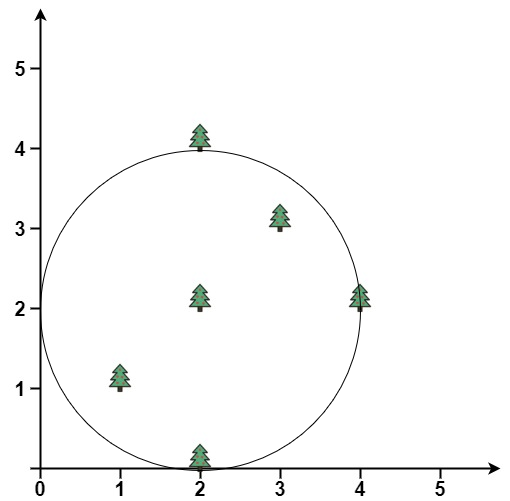
Input: trees = [[1,1],[2,2],[2,0],[2,4],[3,3],[4,2]]
Output: [2.00000,2.00000,2.00000]
Explanation: The fence will have center = (2, 2) and radius = 2
Example 2:
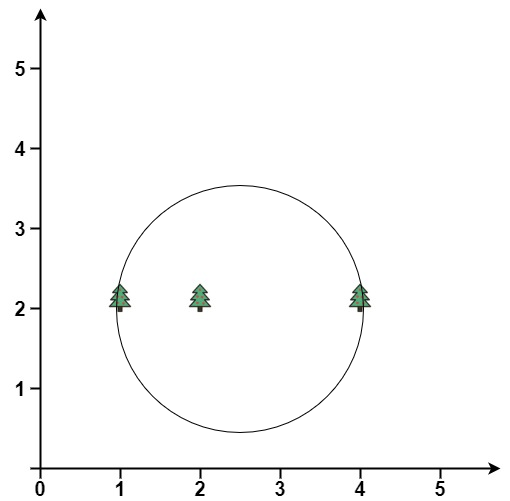
Input: trees = [[1,2],[2,2],[4,2]]
Output: [2.50000,2.00000,1.50000]
Explanation: The fence will have center = (2.5, 2) and radius = 1.5
Constraints:
1 <= trees.length <= 3000trees[i].length == 20 <= xi, yi <= 3000
Solutions
Solution 1
Thinking
The fence is the minimum enclosing circle of the points. Trying every pair or triple is \(O(n^3)\) and tight for \(n\le 3000\).
The circle is defined by two diametral points or three boundary points. Welzl's randomized incremental construction is expected linear: a new point inside the current circle changes nothing, otherwise it must lie on the next boundary and the instance shrinks.
Shuffle the points, maintain the current center and radius, and keep the error within the allowed \(10^{-5}\).
1 | |
1 | |
1 | |
1 | |