1916. Count Ways to Build Rooms in an Ant Colony



Description
You are an ant tasked with adding n new rooms numbered 0 to n-1 to your colony. You are given the expansion plan as a 0-indexed integer array of length n, prevRoom, where prevRoom[i] indicates that you must build room prevRoom[i] before building room i, and these two rooms must be connected directly. Room 0 is already built, so prevRoom[0] = -1. The expansion plan is given such that once all the rooms are built, every room will be reachable from room 0.
You can only build one room at a time, and you can travel freely between rooms you have already built only if they are connected. You can choose to build any room as long as its previous room is already built.
Return the number of different orders you can build all the rooms in. Since the answer may be large, return it modulo 109 + 7.
Example 1:
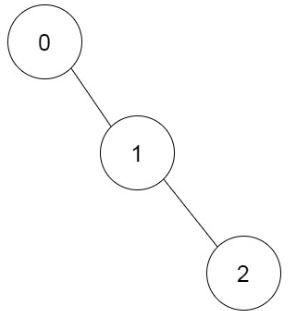
Input: prevRoom = [-1,0,1]
Output: 1
Explanation: There is only one way to build the additional rooms: 0 → 1 → 2
Example 2:
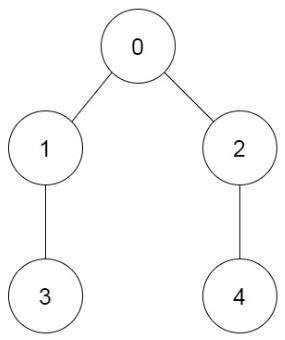
Input: prevRoom = [-1,0,0,1,2]
Output: 6
Explanation:
The 6 ways are:
0 → 1 → 3 → 2 → 4
0 → 2 → 4 → 1 → 3
0 → 1 → 2 → 3 → 4
0 → 1 → 2 → 4 → 3
0 → 2 → 1 → 3 → 4
0 → 2 → 1 → 4 → 3
Constraints:
n == prevRoom.length2 <= n <= 105prevRoom[0] == -10 <= prevRoom[i] < nfor all1 <= i < n- Every room is reachable from room
0once all the rooms are built.
Solutions
Solution 1
Thinking
Valid build orders are the topological orders of the given tree. Testing permutations is impossible for \(n\le 10^5\).
Orders inside disjoint subtrees are independent; merging two subtrees is the binomial choice of positions for one of them. Several children are merged left to right.
A DFS returns subtree sizes and multiplies \(\binom{s+t}{t}\) when folding a child of size \(t\) into an already merged size \(s\), taken modulo \(10^9+7\).
1 2 3 4 5 6 7 8 9 10 11 12 13 14 15 16 17 18 19 20 21 22 23 24 25 26 | |
1 | |
1 | |
1 | |