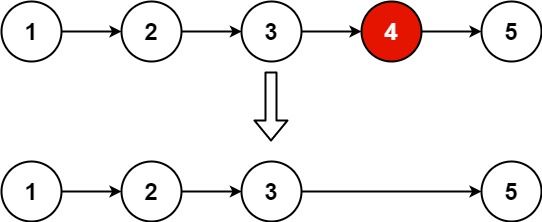
Given the head of a linked list, remove the nth node from the end of the list and return its head.
Example 1:
Input: head = [1,2,3,4,5], n = 2
Output: [1,2,3,5]
Example 2:
Input: head = [1], n = 1
Output: []
Example 3:
Input: head = [1,2], n = 1
Output: [1]
Constraints:
The number of nodes in the list is sz.
1 <= sz <= 30
0 <= Node.val <= 100
1 <= n <= sz
Follow up: Could you do this in one pass?
Solutions
Solution 1: Fast and Slow Pointers
Thinking
The first idea is to count the length \(L\), then walk \(L-n\) steps and delete. \(sz\le 30\) would pass, but the follow-up asks for one pass.
Until we reach the end we do not know where the \(n\)-th node from the end is, and deletion still needs its predecessor. Give the fast pointer a head start of \(n\) steps, then move both; when fast hits the tail, slow sits on the predecessor. A dummy node makes deleting the head the same as deleting a middle node.
So one walk with fast and slow locates and removes the node.
We define two pointers fast and slow, both initially pointing to the dummy head node of the linked list.
Next, the fast pointer moves forward \(n\) steps first, then fast and slow pointers move forward together until the fast pointer reaches the end of the linked list. At this point, the node pointed to by slow.next is the predecessor of the \(n\)-th node from the end, and we can delete it.
The time complexity is \(O(n)\), where \(n\) is the length of the linked list. The space complexity is \(O(1)\).
1 2 3 4 5 6 7 8 9101112131415
# Definition for singly-linked list.# class ListNode:# def __init__(self, val=0, next=None):# self.val = val# self.next = nextclassSolution:defremoveNthFromEnd(self,head:Optional[ListNode],n:int)->Optional[ListNode]:dummy=ListNode(next=head)fast=slow=dummyfor_inrange(n):fast=fast.nextwhilefast.next:slow,fast=slow.next,fast.nextslow.next=slow.next.nextreturndummy.next
/** * Definition for singly-linked list. * type ListNode struct { * Val int * Next *ListNode * } */funcremoveNthFromEnd(head*ListNode,nint)*ListNode{dummy:=&ListNode{0,head}fast,slow:=dummy,dummyfor;n>0;n--{fast=fast.Next}forfast.Next!=nil{slow,fast=slow.Next,fast.Next}slow.Next=slow.Next.Nextreturndummy.Next}