1823. Find the Winner of the Circular Game



Description
There are n friends that are playing a game. The friends are sitting in a circle and are numbered from 1 to n in clockwise order. More formally, moving clockwise from the ith friend brings you to the (i+1)th friend for 1 <= i < n, and moving clockwise from the nth friend brings you to the 1st friend.
The rules of the game are as follows:
- Start at the
1stfriend. - Count the next
kfriends in the clockwise direction including the friend you started at. The counting wraps around the circle and may count some friends more than once. - The last friend you counted leaves the circle and loses the game.
- If there is still more than one friend in the circle, go back to step
2starting from the friend immediately clockwise of the friend who just lost and repeat. - Else, the last friend in the circle wins the game.
Given the number of friends, n, and an integer k, return the winner of the game.
Example 1:
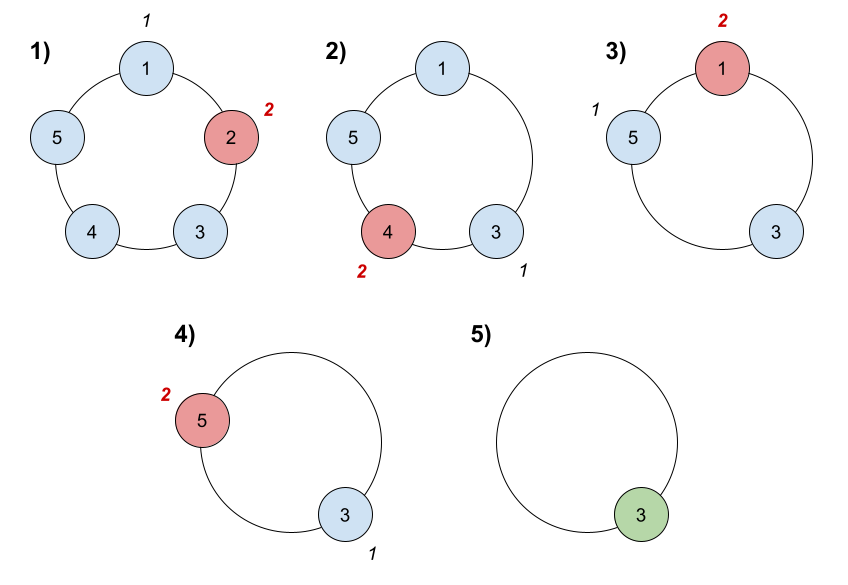
Input: n = 5, k = 2
Output: 3
Explanation: Here are the steps of the game:
1) Start at friend 1.
2) Count 2 friends clockwise, which are friends 1 and 2.
3) Friend 2 leaves the circle. Next start is friend 3.
4) Count 2 friends clockwise, which are friends 3 and 4.
5) Friend 4 leaves the circle. Next start is friend 5.
6) Count 2 friends clockwise, which are friends 5 and 1.
7) Friend 1 leaves the circle. Next start is friend 3.
8) Count 2 friends clockwise, which are friends 3 and 5.
9) Friend 5 leaves the circle. Only friend 3 is left, so they are the winner.
Example 2:
Input: n = 6, k = 5
Output: 1
Explanation: The friends leave in this order: 5, 4, 6, 2, 3. The winner is friend 1.
Constraints:
1 <= k <= n <= 500
Follow up:
Could you solve this problem in linear time with constant space?
Solutions
Solution 1
Thinking
\(n\) people stand in a circle and every \(k\)-th person is eliminated. \(n\le 500\), so a list simulation would pass, but counting \(k\) steps naively does not use the recurrence.
The winner among \(n\) people is the winner among \(n-1\) people shifted by \(k\) modulo \(n\) (treating \(0\) as \(n\)). The base case \(n=1\) is person \(1\). The recurrence solves the game in \(O(n)\).
1 2 3 4 5 6 | |
1 2 3 4 5 6 7 8 9 | |
1 2 3 4 5 6 7 8 | |
1 2 3 4 5 6 7 8 9 10 | |
1 2 3 4 5 6 7 | |
1 2 3 4 5 6 7 8 9 | |
1 2 3 4 5 6 7 8 9 10 11 12 | |
Solution 2: Simulation
Thinking
Solution 1 is a compact index recurrence. We can instead keep the remaining people in a list or deque and repeatedly count to \(k\) and delete until one remains. With small \(n\) the simulation stays faithful to the statement and the \(1\)-based labels.
1 2 3 4 5 6 7 8 9 10 11 | |
1 2 3 4 5 6 7 8 9 10 11 | |