1761. Minimum Degree of a Connected Trio in a Graph



Description
You are given an undirected graph. You are given an integer n which is the number of nodes in the graph and an array edges, where each edges[i] = [ui, vi] indicates that there is an undirected edge between ui and vi.
A connected trio is a set of three nodes where there is an edge between every pair of them.
The degree of a connected trio is the number of edges where one endpoint is in the trio, and the other is not.
Return the minimum degree of a connected trio in the graph, or -1 if the graph has no connected trios.
Example 1:
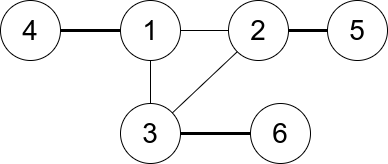
Input: n = 6, edges = [[1,2],[1,3],[3,2],[4,1],[5,2],[3,6]]
Output: 3
Explanation: There is exactly one trio, which is [1,2,3]. The edges that form its degree are bolded in the figure above.
Example 2:
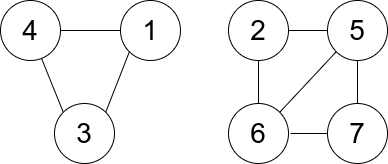
Input: n = 7, edges = [[1,3],[4,1],[4,3],[2,5],[5,6],[6,7],[7,5],[2,6]]
Output: 0
Explanation: There are exactly three trios:
1) [1,4,3] with degree 0.
2) [2,5,6] with degree 2.
3) [5,6,7] with degree 2.
Constraints:
2 <= n <= 400edges[i].length == 21 <= edges.length <= n * (n-1) / 21 <= ui, vi <= nui != vi- There are no repeated edges.
Solutions
Solution 1: Brute Force Enumeration
Thinking
The degree of a trio is the sum of the three vertex degrees minus \(6\). The graph is small enough to enumerate triangles in \(O(n^3)\).
An adjacency matrix tests edges and \(\textit{deg}\) stores degrees. For \(i<j<k\) with all three edges, update \(\textit{deg}[i]+\textit{deg}[j]+\textit{deg}[k]-6\). Return \(-1\) if none exist.
We first store all edges in the adjacency matrix \(\textit{g}\), and then store the degree of each node in the array \(\textit{deg}\). Initialize the answer \(\textit{ans} = +\infty\).
Then enumerate all triplets \((i, j, k)\), where \(i \lt j \lt k\). If \(\textit{g}[i][j] = \textit{g}[j][k] = \textit{g}[i][k] = 1\), it means these three nodes form a connected trio. In this case, update the answer to \(\textit{ans} = \min(\textit{ans}, \textit{deg}[i] + \textit{deg}[j] + \textit{deg}[k] - 6)\).
After enumerating all triplets, if the answer is still \(+\infty\), it means there is no connected trio in the graph, return \(-1\). Otherwise, return the answer.
The time complexity is \(O(n^3)\), and the space complexity is \(O(n^2)\). Here, \(n\) is the number of nodes.
1 2 3 4 5 6 7 8 9 10 11 12 13 14 15 16 17 18 19 20 21 | |
1 2 3 4 5 6 7 8 9 10 11 12 13 14 15 16 17 18 19 20 21 22 23 24 25 26 | |
1 2 3 4 5 6 7 8 9 10 11 12 13 14 15 16 17 18 19 20 21 22 23 24 25 26 27 | |
1 2 3 4 5 6 7 8 9 10 11 12 13 14 15 16 17 18 19 20 21 22 23 24 25 26 27 28 29 | |
1 2 3 4 5 6 7 8 9 10 11 12 13 14 15 16 17 18 19 20 21 22 23 24 | |