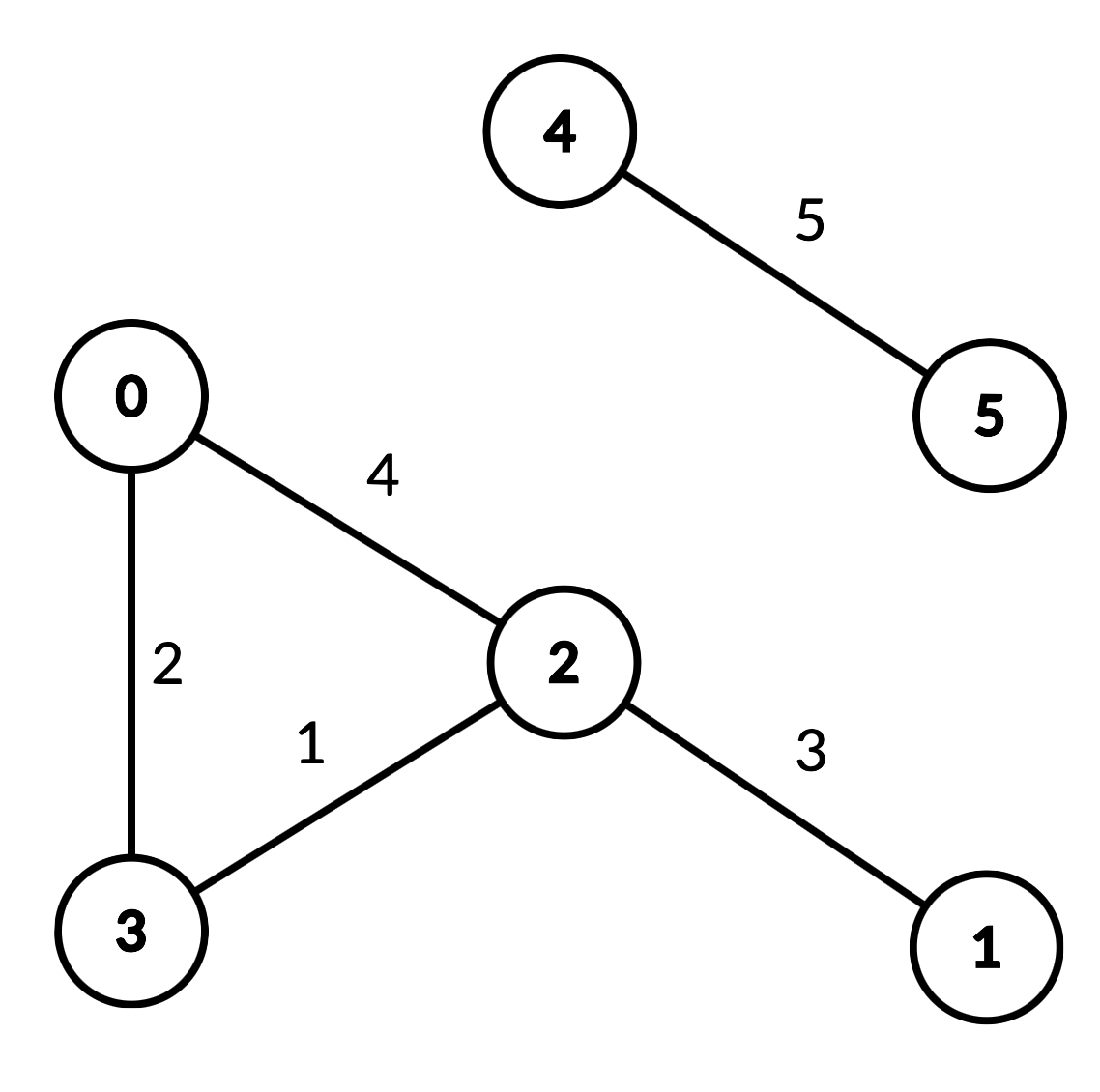
An undirected graph of n nodes is defined by edgeList, where edgeList[i] = [ui, vi, disi] denotes an edge between nodes ui and vi with distance disi. Note that there may be multiple edges between two nodes, and the graph may not be connected.
Implement the DistanceLimitedPathsExist class:
DistanceLimitedPathsExist(int n, int[][] edgeList) Initializes the class with an undirected graph.
boolean query(int p, int q, int limit) Returns true if there exists a path from p to q such that each edge on the path has a distance strictly less thanlimit, and otherwise false.
Example 1:
Input
["DistanceLimitedPathsExist", "query", "query", "query", "query"]
[[6, [[0, 2, 4], [0, 3, 2], [1, 2, 3], [2, 3, 1], [4, 5, 5]]], [2, 3, 2], [1, 3, 3], [2, 0, 3], [0, 5, 6]]
Output
[null, true, false, true, false]

Explanation
DistanceLimitedPathsExist distanceLimitedPathsExist = new DistanceLimitedPathsExist(6, [[0, 2, 4], [0, 3, 2], [1, 2, 3], [2, 3, 1], [4, 5, 5]]);
distanceLimitedPathsExist.query(2, 3, 2); // return true. There is an edge from 2 to 3 of distance 1, which is less than 2.
distanceLimitedPathsExist.query(1, 3, 3); // return false. There is no way to go from 1 to 3 with distances strictly less than 3.
distanceLimitedPathsExist.query(2, 0, 3); // return true. There is a way to go from 2 to 0 with distance < 3: travel from 2 to 3 to 0.
distanceLimitedPathsExist.query(0, 5, 6); // return false. There are no paths from 0 to 5.
Constraints:
2 <= n <= 104
0 <= edgeList.length <= 104
edgeList[i].length == 3
0 <= ui, vi, p, q <= n-1
ui != vi
p != q
1 <= disi, limit <= 109
At most 104 calls will be made to query.
Solutions
Solution 1
Thinking
Online queries ask whether \(p\) and \(q\) are connected using only edges of weight strictly less than \(\textit{limit}\). Offline Kruskal works for a batch, but queries arrive later and repeat.
Union edges in increasing weight and timestamp each union by that weight. A query should follow parent links only when the union time is \(<\textit{limit}\).
The persistent DSU stores in \(\textit{version}[x]\) the weight at which \(x\) was attached. \(\textit{find}(x,t)\) stops before time \(t\); equal roots mean connected.
classPersistentUnionFind{privatefinalintinf=1<<30;privateint[]rank;privateint[]parent;privateint[]version;publicPersistentUnionFind(intn){rank=newint[n];parent=newint[n];version=newint[n];for(inti=0;i<n;i++){parent[i]=i;version[i]=inf;}}publicintfind(intx,intt){if(parent[x]==x||version[x]>=t){returnx;}returnfind(parent[x],t);}publicbooleanunion(inta,intb,intt){intpa=find(a,inf);intpb=find(b,inf);if(pa==pb){returnfalse;}if(rank[pa]>rank[pb]){version[pb]=t;parent[pb]=pa;}else{version[pa]=t;parent[pa]=pb;if(rank[pa]==rank[pb]){rank[pb]++;}}returntrue;}}publicclassDistanceLimitedPathsExist{privatePersistentUnionFindpuf;publicDistanceLimitedPathsExist(intn,int[][]edgeList){puf=newPersistentUnionFind(n);Arrays.sort(edgeList,(a,b)->a[2]-b[2]);for(vare:edgeList){puf.union(e[0],e[1],e[2]);}}publicbooleanquery(intp,intq,intlimit){returnpuf.find(p,limit)==puf.find(q,limit);}}/** * Your DistanceLimitedPathsExist object will be instantiated and called as such: * DistanceLimitedPathsExist obj = new DistanceLimitedPathsExist(n, edgeList); * boolean param_1 = obj.query(p,q,limit); */
classPersistentUnionFind{private:vector<int>rank;vector<int>parent;vector<int>version;public:PersistentUnionFind(intn):rank(n,0),parent(n),version(n,INT_MAX){for(inti=0;i<n;i++){parent[i]=i;}}intfind(intx,intt){if(parent[x]==x||version[x]>=t){returnx;}returnfind(parent[x],t);}boolunionSet(inta,intb,intt){intpa=find(a,INT_MAX);intpb=find(b,INT_MAX);if(pa==pb){returnfalse;}if(rank[pa]>rank[pb]){version[pb]=t;parent[pb]=pa;}else{version[pa]=t;parent[pa]=pb;if(rank[pa]==rank[pb]){rank[pb]++;}}returntrue;}};classDistanceLimitedPathsExist{private:PersistentUnionFindpuf;public:DistanceLimitedPathsExist(intn,vector<vector<int>>&edgeList):puf(n){sort(edgeList.begin(),edgeList.end(),[](constvector<int>&a,constvector<int>&b){returna[2]<b[2];});for(constauto&edge:edgeList){puf.unionSet(edge[0],edge[1],edge[2]);}}boolquery(intp,intq,intlimit){returnpuf.find(p,limit)==puf.find(q,limit);}};/** * Your DistanceLimitedPathsExist object will be instantiated and called as such: * DistanceLimitedPathsExist* obj = new DistanceLimitedPathsExist(n, edgeList); * bool param_1 = obj->query(p,q,limit); */
typePersistentUnionFindstruct{rank[]intparent[]intversion[]int}funcNewPersistentUnionFind(nint)*PersistentUnionFind{rank:=make([]int,n)parent:=make([]int,n)version:=make([]int,n)fori:=0;i<n;i++{parent[i]=i}return&PersistentUnionFind{rank:rank,parent:parent,version:version,}}func(uf*PersistentUnionFind)find(xint,tint)int{ifuf.parent[x]==x||uf.version[x]>=t{returnx}returnuf.find(uf.parent[x],t)}func(uf*PersistentUnionFind)union(a,b,tint)bool{pa:=uf.find(a,int(^uint(0)>>1))pb:=uf.find(b,int(^uint(0)>>1))ifpa==pb{returnfalse}ifuf.rank[pa]>uf.rank[pb]{uf.version[pb]=tuf.parent[pb]=pa}else{uf.version[pa]=tuf.parent[pa]=pbifuf.rank[pa]==uf.rank[pb]{uf.rank[pb]++}}returntrue}typeDistanceLimitedPathsExiststruct{puf*PersistentUnionFind}funcConstructor(nint,edgeList[][]int)DistanceLimitedPathsExist{sort.Slice(edgeList,func(i,jint)bool{returnedgeList[i][2]<edgeList[j][2]})puf:=NewPersistentUnionFind(n)for_,edge:=rangeedgeList{puf.union(edge[0],edge[1],edge[2])}returnDistanceLimitedPathsExist{puf:puf,}}func(dle*DistanceLimitedPathsExist)Query(p,q,limitint)bool{returndle.puf.find(p,limit)==dle.puf.find(q,limit)}/** * Your DistanceLimitedPathsExist object will be instantiated and called as such: * obj := Constructor(n, edgeList); * param_1 := obj.Query(p,q,limit); */
classPersistentUnionFind{privaterank:number[];privateparent:number[];privateversion:number[];constructor(n:number){this.rank=Array(n).fill(0);this.parent=Array.from({length:n},(_,i)=>i);this.version=Array(n).fill(Infinity);}find(x:number,t:number):number{if(this.parent[x]===x||this.version[x]>=t){returnx;}returnthis.find(this.parent[x],t);}union(a:number,b:number,t:number):boolean{constpa=this.find(a,Infinity);constpb=this.find(b,Infinity);if(pa===pb){returnfalse;}if(this.rank[pa]>this.rank[pb]){this.version[pb]=t;this.parent[pb]=pa;}else{this.version[pa]=t;this.parent[pa]=pb;if(this.rank[pa]===this.rank[pb]){this.rank[pb]++;}}returntrue;}}classDistanceLimitedPathsExist{privatepuf:PersistentUnionFind;constructor(n:number,edgeList:number[][]){this.puf=newPersistentUnionFind(n);edgeList.sort((a,b)=>a[2]-b[2]);for(const[u,v,dis]ofedgeList){this.puf.union(u,v,dis);}}query(p:number,q:number,limit:number):boolean{returnthis.puf.find(p,limit)===this.puf.find(q,limit);}}/** * Your DistanceLimitedPathsExist object will be instantiated and called as such: * var obj = new DistanceLimitedPathsExist(n, edgeList) * var param_1 = obj.query(p,q,limit) */