Skip to content

1621. Number of Sets of K Non-Overlapping Line Segments

Description

Given n points on a 1-D plane, where the ith point (from 0 to n-1) is at x = i, find the number of ways we can draw exactly k non-overlapping line segments such that each segment covers two or more points. The endpoints of each segment must have integral coordinates. The k line segments do not have to cover all n points, and they are allowed to share endpoints.

Return the number of ways we can draw k non-overlapping line segments. Since this number can be huge, return it modulo 109 + 7.


Example 1:

Input: n = 4, k = 2
Output: 5
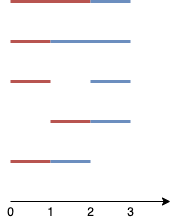
Explanation: The two line segments are shown in red and blue.
The image above shows the 5 different ways {(0,2),(2,3)}, {(0,1),(1,3)}, {(0,1),(2,3)}, {(1,2),(2,3)}, {(0,1),(1,2)}.

Example 2:

Input: n = 3, k = 1
Output: 3
Explanation: The 3 ways are {(0,1)}, {(0,2)}, {(1,2)}.

Example 3:

Input: n = 30, k = 7
Output: 796297179
Explanation: The total number of possible ways to draw 7 line segments is 3796297200. Taking this number modulo 109 + 7 gives us 796297179.


Constraints:

  • 2 <= n <= 1000
  • 1 <= k <= n-1

Solutions

Solution 1

Thinking

Drawing \(k\) non-overlapping (but possibly touching) segments on \(n\) points is awkward to enumerate by endpoints. Process points left to right and split states by whether the last segment ends at the current point.

Let \(f[i][j]\) be ways to place \(j\) segments on the first \(i\) points with the last segment not ending at \(i\), and \(g[i][j]\) the ways where it does. Transitions use only the two kinds of state at \(i-1\): inherit \(j\) segments, or extend / start a new length-\(1\) segment.

Start from \(f[1][0]=1\) and return \(f[n][k]+g[n][k]\) modulo \(10^9+7\).

 1
 2
 3
 4
 5
 6
 7
 8
 9
10
11
12
13
14
15
16
class Solution:
    def numberOfSets(self, n: int, k: int) -> int:
        mod = 10**9 + 7
        f = [[0] * (k + 1) for _ in range(n + 1)]
        g = [[0] * (k + 1) for _ in range(n + 1)]
        f[1][0] = 1
        for i in range(2, n + 1):
            for j in range(k + 1):
                f[i][j] = (f[i - 1][j] + g[i - 1][j]) % mod
                g[i][j] = g[i - 1][j]
                if j:
                    g[i][j] += f[i - 1][j - 1]
                    g[i][j] %= mod
                    g[i][j] += g[i - 1][j - 1]
                    g[i][j] %= mod
        return (f[-1][-1] + g[-1][-1]) % mod
 1
 2
 3
 4
 5
 6
 7
 8
 9
10
11
12
13
14
15
16
17
18
19
20
21
22
class Solution {
    private static final int MOD = (int) 1e9 + 7;

    public int numberOfSets(int n, int k) {
        int[][] f = new int[n + 1][k + 1];
        int[][] g = new int[n + 1][k + 1];
        f[1][0] = 1;
        for (int i = 2; i <= n; ++i) {
            for (int j = 0; j <= k; ++j) {
                f[i][j] = (f[i - 1][j] + g[i - 1][j]) % MOD;
                g[i][j] = g[i - 1][j];
                if (j > 0) {
                    g[i][j] += f[i - 1][j - 1];
                    g[i][j] %= MOD;
                    g[i][j] += g[i - 1][j - 1];
                    g[i][j] %= MOD;
                }
            }
        }
        return (f[n][k] + g[n][k]) % MOD;
    }
}
 1
 2
 3
 4
 5
 6
 7
 8
 9
10
11
12
13
14
15
16
17
18
19
20
21
22
23
24
25
class Solution {
public:
    int f[1010][1010];
    int g[1010][1010];
    const int mod = 1e9 + 7;

    int numberOfSets(int n, int k) {
        memset(f, 0, sizeof(f));
        memset(g, 0, sizeof(g));
        f[1][0] = 1;
        for (int i = 2; i <= n; ++i) {
            for (int j = 0; j <= k; ++j) {
                f[i][j] = (f[i - 1][j] + g[i - 1][j]) % mod;
                g[i][j] = g[i - 1][j];
                if (j > 0) {
                    g[i][j] += f[i - 1][j - 1];
                    g[i][j] %= mod;
                    g[i][j] += g[i - 1][j - 1];
                    g[i][j] %= mod;
                }
            }
        }
        return (f[n][k] + g[n][k]) % mod;
    }
};
 1
 2
 3
 4
 5
 6
 7
 8
 9
10
11
12
13
14
15
16
17
18
19
20
21
22
23
func numberOfSets(n int, k int) int {
    f := make([][]int, n+1)
    g := make([][]int, n+1)
    for i := range f {
        f[i] = make([]int, k+1)
        g[i] = make([]int, k+1)
    }
    f[1][0] = 1
    var mod int = 1e9 + 7
    for i := 2; i <= n; i++ {
        for j := 0; j <= k; j++ {
            f[i][j] = (f[i-1][j] + g[i-1][j]) % mod
            g[i][j] = g[i-1][j]
            if j > 0 {
                g[i][j] += f[i-1][j-1]
                g[i][j] %= mod
                g[i][j] += g[i-1][j-1]
                g[i][j] %= mod
            }
        }
    }
    return (f[n][k] + g[n][k]) % mod
}
 1
 2
 3
 4
 5
 6
 7
 8
 9
10
11
12
13
14
15
16
17
18
19
function numberOfSets(n: number, k: number): number {
    const f = Array.from({ length: n + 1 }, _ => new Array(k + 1).fill(0));
    const g = Array.from({ length: n + 1 }, _ => new Array(k + 1).fill(0));
    f[1][0] = 1;
    const mod = 10 ** 9 + 7;
    for (let i = 2; i <= n; ++i) {
        for (let j = 0; j <= k; ++j) {
            f[i][j] = (f[i - 1][j] + g[i - 1][j]) % mod;
            g[i][j] = g[i - 1][j];
            if (j) {
                g[i][j] += f[i - 1][j - 1];
                g[i][j] %= mod;
                g[i][j] += g[i - 1][j - 1];
                g[i][j] %= mod;
            }
        }
    }
    return (f[n][k] + g[n][k]) % mod;
}

Comments