Array Borůvka Graph Kruskal Minimum Spanning Tree Prim Union Find
Description You are given an array points representing integer coordinates of some points on a 2D-plane, where points[i] = [xi , yi ].
The cost of connecting two points [xi , yi ] and [xj , yj ] is the manhattan distance between them: |xi - xj | + |yi - yj |, where |val| denotes the absolute value of val.
Return the minimum cost to make all points connected. All points are connected if there is exactly one simple path between any two points.
Example 1:
Input: points = [[0,0],[2,2],[3,10],[5,2],[7,0]]
Output: 20
Explanation:
Example 2:
Input: points = [[3,12],[-2,5],[-4,1]]
Output: 18
Constraints:
1 <= points.length <= 1000-106 <= xi , yi <= 106 All pairs (xi , yi ) are distinct. Solutions Solution 1 Thinking
Connect all points by Manhattan distance and take a minimum spanning tree. \(n\le 1000\) yields a dense complete graph, which suits a dense MST algorithm.
Plain Prim keeps each vertex's distance to the current tree, repeatedly adds the closest unused vertex, and relaxes the others. \(n\) rounds of an \(n\) -scan cost \(O(n^2)\) .
Python3 Java C++ Go TypeScript
 1
 2
 3
 4
 5
 6
 7
 8
 9
10
11
12
13
14
15
16
17
18
19
20
21
22
23
24
class Solution :
def minCostConnectPoints ( self , points : List [ List [ int ]]) -> int :
n = len ( points )
g = [[ 0 ] * n for _ in range ( n )]
dist = [ inf ] * n
vis = [ False ] * n
for i , ( x1 , y1 ) in enumerate ( points ):
for j in range ( i + 1 , n ):
x2 , y2 = points [ j ]
t = abs ( x1 - x2 ) + abs ( y1 - y2 )
g [ i ][ j ] = g [ j ][ i ] = t
dist [ 0 ] = 0
ans = 0
for _ in range ( n ):
i = - 1
for j in range ( n ):
if not vis [ j ] and ( i == - 1 or dist [ j ] < dist [ i ]):
i = j
vis [ i ] = True
ans += dist [ i ]
for j in range ( n ):
if not vis [ j ]:
dist [ j ] = min ( dist [ j ], g [ i ][ j ])
return ans
 1
 2
 3
 4
 5
 6
 7
 8
 9
10
11
12
13
14
15
16
17
18
19
20
21
22
23
24
25
26
27
28
29
30
31
32
33
34
35
36
37
class Solution {
public int minCostConnectPoints ( int [][] points ) {
final int inf = 1 << 30 ;
int n = points . length ;
int [][] g = new int [ n ][ n ] ;
for ( int i = 0 ; i < n ; ++ i ) {
int x1 = points [ i ][ 0 ] , y1 = points [ i ][ 1 ] ;
for ( int j = i + 1 ; j < n ; ++ j ) {
int x2 = points [ j ][ 0 ] , y2 = points [ j ][ 1 ] ;
int t = Math . abs ( x1 - x2 ) + Math . abs ( y1 - y2 );
g [ i ][ j ] = t ;
g [ j ][ i ] = t ;
}
}
int [] dist = new int [ n ] ;
boolean [] vis = new boolean [ n ] ;
Arrays . fill ( dist , inf );
dist [ 0 ] = 0 ;
int ans = 0 ;
for ( int i = 0 ; i < n ; ++ i ) {
int j = - 1 ;
for ( int k = 0 ; k < n ; ++ k ) {
if ( ! vis [ k ] && ( j == - 1 || dist [ k ] < dist [ j ] )) {
j = k ;
}
}
vis [ j ] = true ;
ans += dist [ j ] ;
for ( int k = 0 ; k < n ; ++ k ) {
if ( ! vis [ k ] ) {
dist [ k ] = Math . min ( dist [ k ] , g [ j ][ k ] );
}
}
}
return ans ;
}
}
 1
 2
 3
 4
 5
 6
 7
 8
 9
10
11
12
13
14
15
16
17
18
19
20
21
22
23
24
25
26
27
28
29
30
31
32
33
34
35
36
37
38
class Solution {
public :
int minCostConnectPoints ( vector < vector < int >>& points ) {
int n = points . size ();
int g [ n ][ n ];
for ( int i = 0 ; i < n ; ++ i ) {
int x1 = points [ i ][ 0 ], y1 = points [ i ][ 1 ];
for ( int j = i + 1 ; j < n ; ++ j ) {
int x2 = points [ j ][ 0 ], y2 = points [ j ][ 1 ];
int t = abs ( x1 - x2 ) + abs ( y1 - y2 );
g [ i ][ j ] = t ;
g [ j ][ i ] = t ;
}
}
int dist [ n ];
bool vis [ n ];
memset ( dist , 0x3f , sizeof ( dist ));
memset ( vis , false , sizeof ( vis ));
dist [ 0 ] = 0 ;
int ans = 0 ;
for ( int i = 0 ; i < n ; ++ i ) {
int j = -1 ;
for ( int k = 0 ; k < n ; ++ k ) {
if ( ! vis [ k ] && ( j == -1 || dist [ k ] < dist [ j ])) {
j = k ;
}
}
vis [ j ] = true ;
ans += dist [ j ];
for ( int k = 0 ; k < n ; ++ k ) {
if ( ! vis [ k ]) {
dist [ k ] = min ( dist [ k ], g [ j ][ k ]);
}
}
}
return ans ;
}
};
 1
 2
 3
 4
 5
 6
 7
 8
 9
10
11
12
13
14
15
16
17
18
19
20
21
22
23
24
25
26
27
28
29
30
31
32
33
34
35
36
37
38
39
40
41
42
43
func minCostConnectPoints ( points [][] int ) ( ans int ) {
n := len ( points )
g := make ([][] int , n )
vis := make ([] bool , n )
dist := make ([] int , n )
for i := range g {
g [ i ] = make ([] int , n )
dist [ i ] = 1 << 30
}
for i := range g {
x1 , y1 := points [ i ][ 0 ], points [ i ][ 1 ]
for j := i + 1 ; j < n ; j ++ {
x2 , y2 := points [ j ][ 0 ], points [ j ][ 1 ]
t := abs ( x1 - x2 ) + abs ( y1 - y2 )
g [ i ][ j ] = t
g [ j ][ i ] = t
}
}
dist [ 0 ] = 0
for i := 0 ; i < n ; i ++ {
j := - 1
for k := 0 ; k < n ; k ++ {
if ! vis [ k ] && ( j == - 1 || dist [ k ] < dist [ j ]) {
j = k
}
}
vis [ j ] = true
ans += dist [ j ]
for k := 0 ; k < n ; k ++ {
if ! vis [ k ] {
dist [ k ] = min ( dist [ k ], g [ j ][ k ])
}
}
}
return
}
func abs ( x int ) int {
if x < 0 {
return - x
}
return x
}
 1
 2
 3
 4
 5
 6
 7
 8
 9
10
11
12
13
14
15
16
17
18
19
20
21
22
23
24
25
26
27
28
29
30
31
32
33
34
35
function minCostConnectPoints ( points : number [][]) : number {
const n = points . length ;
const g : number [][] = Array ( n )
. fill ( 0 )
. map (() => Array ( n ). fill ( 0 ));
const dist : number [] = Array ( n ). fill ( 1 << 30 );
const vis : boolean [] = Array ( n ). fill ( false );
for ( let i = 0 ; i < n ; ++ i ) {
const [ x1 , y1 ] = points [ i ];
for ( let j = i + 1 ; j < n ; ++ j ) {
const [ x2 , y2 ] = points [ j ];
const t = Math . abs ( x1 - x2 ) + Math . abs ( y1 - y2 );
g [ i ][ j ] = t ;
g [ j ][ i ] = t ;
}
}
let ans = 0 ;
dist [ 0 ] = 0 ;
for ( let i = 0 ; i < n ; ++ i ) {
let j = - 1 ;
for ( let k = 0 ; k < n ; ++ k ) {
if ( ! vis [ k ] && ( j === - 1 || dist [ k ] < dist [ j ])) {
j = k ;
}
}
vis [ j ] = true ;
ans += dist [ j ];
for ( let k = 0 ; k < n ; ++ k ) {
if ( ! vis [ k ]) {
dist [ k ] = Math . min ( dist [ k ], g [ j ][ k ]);
}
}
}
return ans ;
}
Solution 2 Thinking
Prim is organized around a cut and an adjacency matrix. Kruskal sorts every edge and unions endpoints until the graph is connected. With \(O(n^2)\) edges the sort dominates; the style is convenient when we prefer to iterate edges.
Python3 Java C++ Go
 1
 2
 3
 4
 5
 6
 7
 8
 9
10
11
12
13
14
15
16
17
18
19
20
21
22
23
24
25
26
class Solution :
def minCostConnectPoints ( self , points : List [ List [ int ]]) -> int :
def find ( x : int ) -> int :
if p [ x ] != x :
p [ x ] = find ( p [ x ])
return p [ x ]
n = len ( points )
g = []
for i , ( x1 , y1 ) in enumerate ( points ):
for j in range ( i + 1 , n ):
x2 , y2 = points [ j ]
t = abs ( x1 - x2 ) + abs ( y1 - y2 )
g . append (( t , i , j ))
p = list ( range ( n ))
ans = 0
for cost , i , j in sorted ( g ):
pa , pb = find ( i ), find ( j )
if pa == pb :
continue
p [ pa ] = pb
ans += cost
n -= 1
if n == 1 :
break
return ans
 1
 2
 3
 4
 5
 6
 7
 8
 9
10
11
12
13
14
15
16
17
18
19
20
21
22
23
24
25
26
27
28
29
30
31
32
33
34
35
36
37
38
39
40
class Solution {
private int [] p ;
public int minCostConnectPoints ( int [][] points ) {
int n = points . length ;
List < int []> g = new ArrayList <> ();
for ( int i = 0 ; i < n ; ++ i ) {
int x1 = points [ i ][ 0 ] , y1 = points [ i ][ 1 ] ;
for ( int j = i + 1 ; j < n ; ++ j ) {
int x2 = points [ j ][ 0 ] , y2 = points [ j ][ 1 ] ;
g . add ( new int [] { Math . abs ( x1 - x2 ) + Math . abs ( y1 - y2 ), i , j });
}
}
g . sort ( Comparator . comparingInt ( a -> a [ 0 ] ));
p = new int [ n ] ;
for ( int i = 0 ; i < n ; ++ i ) {
p [ i ] = i ;
}
int ans = 0 ;
for ( int [] e : g ) {
int cost = e [ 0 ] , i = e [ 1 ] , j = e [ 2 ] ;
if ( find ( i ) == find ( j )) {
continue ;
}
p [ find ( i ) ] = find ( j );
ans += cost ;
if ( -- n == 1 ) {
return ans ;
}
}
return 0 ;
}
private int find ( int x ) {
if ( p [ x ] != x ) {
p [ x ] = find ( p [ x ] );
}
return p [ x ] ;
}
}
 1
 2
 3
 4
 5
 6
 7
 8
 9
10
11
12
13
14
15
16
17
18
19
20
21
22
23
24
25
26
27
28
29
30
31
32
33
class Solution {
public :
vector < int > p ;
int minCostConnectPoints ( vector < vector < int >>& points ) {
int n = points . size ();
vector < vector < int >> g ;
for ( int i = 0 ; i < n ; ++ i ) {
int x1 = points [ i ][ 0 ], y1 = points [ i ][ 1 ];
for ( int j = i + 1 ; j < n ; ++ j ) {
int x2 = points [ j ][ 0 ], y2 = points [ j ][ 1 ];
g . push_back ({ abs ( x1 - x2 ) + abs ( y1 - y2 ), i , j });
}
}
sort ( g . begin (), g . end ());
p . resize ( n );
for ( int i = 0 ; i < n ; ++ i ) p [ i ] = i ;
int ans = 0 ;
for ( auto & e : g ) {
int cost = e [ 0 ], i = e [ 1 ], j = e [ 2 ];
if ( find ( i ) == find ( j )) continue ;
p [ find ( i )] = find ( j );
ans += cost ;
if ( -- n == 1 ) return ans ;
}
return 0 ;
}
int find ( int x ) {
if ( p [ x ] != x ) p [ x ] = find ( p [ x ]);
return p [ x ];
}
};
 1
 2
 3
 4
 5
 6
 7
 8
 9
10
11
12
13
14
15
16
17
18
19
20
21
22
23
24
25
26
27
28
29
30
31
32
33
34
35
36
37
38
39
40
41
42
43
44
45
46
func minCostConnectPoints ( points [][] int ) int {
n := len ( points )
var g [][] int
for i , p := range points {
x1 , y1 := p [ 0 ], p [ 1 ]
for j := i + 1 ; j < n ; j ++ {
x2 , y2 := points [ j ][ 0 ], points [ j ][ 1 ]
g = append ( g , [] int { abs ( x1 - x2 ) + abs ( y1 - y2 ), i , j })
}
}
sort . Slice ( g , func ( i , j int ) bool {
return g [ i ][ 0 ] < g [ j ][ 0 ]
})
ans := 0
p := make ([] int , n )
for i := range p {
p [ i ] = i
}
var find func ( x int ) int
find = func ( x int ) int {
if p [ x ] != x {
p [ x ] = find ( p [ x ])
}
return p [ x ]
}
for _ , e := range g {
cost , i , j := e [ 0 ], e [ 1 ], e [ 2 ]
if find ( i ) == find ( j ) {
continue
}
p [ find ( i )] = find ( j )
ans += cost
n --
if n == 1 {
return ans
}
}
return 0
}
func abs ( x int ) int {
if x < 0 {
return - x
}
return x
}
GitHub 



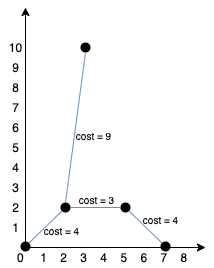 We can connect the points as shown above to get the minimum cost of 20.
Notice that there is a unique path between every pair of points.
We can connect the points as shown above to get the minimum cost of 20.
Notice that there is a unique path between every pair of points.