1572. Matrix Diagonal Sum



Description
Given a square matrix mat, return the sum of the matrix diagonals.
Only include the sum of all the elements on the primary diagonal and all the elements on the secondary diagonal that are not part of the primary diagonal.
Example 1:
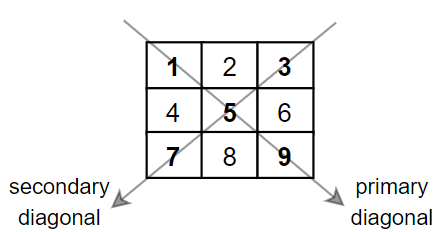
Input: mat = [[1,2,3],
              [4,5,6],
              [7,8,9]]
Output: 25
Explanation: Diagonals sum: 1 + 5 + 9 + 3 + 7 = 25
Notice that element mat[1][1] = 5 is counted only once.
Example 2:
Input: mat = [[1,1,1,1],
              [1,1,1,1],
              [1,1,1,1],
              [1,1,1,1]]
Output: 8
Example 3:
Input: mat = [[5]]
Output: 5
Constraints:
n == mat.length == mat[i].length1 <= n <= 1001 <= mat[i][j] <= 100
Solutions
Solution 1: Row-by-Row Traversal
Thinking
Sum both diagonals of a square matrix; the center of an odd order would be counted twice. \(n\) is small: take the two diagonal entries per row and skip the duplicate center.
Row \(i\) contributes \(row[i]\) and \(row[n-i-1]\). When those indices coincide, add once; otherwise add both. A single row scan finishes the sum.
We can traverse each row \(\textit{row}[i]\) of the matrix. For each row, we calculate the elements on the two diagonals, i.e., \(\textit{row}[i][i]\) and \(\textit{row}[i][n - i - 1]\), where \(n\) is the number of rows in the matrix. If \(i = n - i - 1\), it means there is only one element on the diagonals of the current row; otherwise, there are two elements. We add these elements to the answer.
After traversing all rows, we get the answer.
The time complexity is \(O(n)\), where \(n\) is the number of rows in the matrix. The space complexity is \(O(1)\).
1 2 3 4 5 6 7 8 | |
1 2 3 4 5 6 7 8 9 10 11 | |
1 2 3 4 5 6 7 8 9 10 11 12 | |
1 2 3 4 5 6 7 8 9 10 | |
1 2 3 4 5 6 7 8 9 | |
1 2 3 4 5 6 7 8 9 10 11 12 13 14 15 16 | |
1 2 3 4 5 6 7 8 9 10 11 | |