Skip to content

1522. Diameter of N-Ary Tree πŸ”’

Description

Given a root of an N-ary tree, you need to compute the length of the diameter of the tree.

The diameter of an N-ary tree is the length of the longest path between any two nodes in the tree. This path may or may not pass through the root.

(Nary-Tree input serialization is represented in their level order traversal, each group of children is separated by the null value.)


Example 1:

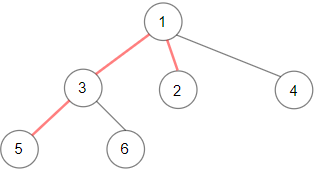
Input: root = [1,null,3,2,4,null,5,6]
Output: 3
Explanation: Diameter is shown in red color.

Example 2:

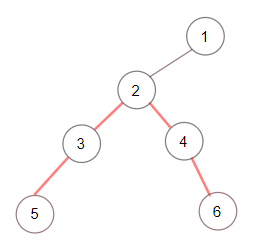
Input: root = [1,null,2,null,3,4,null,5,null,6]
Output: 4

Example 3:

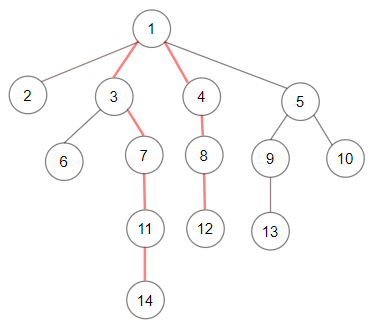
Input: root = [1,null,2,3,4,5,null,null,6,7,null,8,null,9,10,null,null,11,null,12,null,13,null,null,14]
Output: 7


Constraints:

  • The depth of the n-ary tree is less than or equal to 1000.
  • The total number of nodes is between [1, 104].

Solutions

Solution 1: DFS (Post-order Diameter)

Thinking

The diameter of an \(N\)-ary tree is the longest distance between two nodes. The tree can have thousands of nodes, so careless double walks waste work. The diameter through a node is the sum of its two deepest child heights.

A post-order DFS gathers child heights, updates a global answer with the sum of the two largest, and returns the node's own height. One traversal examines every candidate without building another graph.

Traverse each node in post-order, record the two deepest child heights \(m_1\) and \(m_2\), and update the diameter with \(m_1+m_2\). The height of a subtree is one plus the deepest child height.

The time complexity is \(O(n)\), and the space complexity is \(O(n)\), where \(n\) is the number of nodes.

 1
 2
 3
 4
 5
 6
 7
 8
 9
10
11
12
13
14
15
16
17
18
19
20
21
22
23
24
25
26
27
28
29
30
31
32
33
"""
# Definition for a Node.
class Node:
    def __init__(self, val=None, children=None):
        self.val = val
        self.children = children if children is not None else []
"""


class Solution:
    def diameter(self, root: 'Node') -> int:
        """
        :type root: 'Node'
        :rtype: int
        """

        def dfs(root):
            if root is None:
                return 0
            nonlocal ans
            m1 = m2 = 0
            for child in root.children:
                t = dfs(child)
                if t > m1:
                    m2, m1 = m1, t
                elif t > m2:
                    m2 = t
            ans = max(ans, m1 + m2)
            return 1 + m1

        ans = 0
        dfs(root)
        return ans
 1
 2
 3
 4
 5
 6
 7
 8
 9
10
11
12
13
14
15
16
17
18
19
20
21
22
23
24
25
26
27
28
29
30
31
32
33
34
35
36
37
38
39
40
41
42
43
44
45
46
47
48
49
50
/*
// Definition for a Node.
class Node {
    public int val;
    public List<Node> children;


    public Node() {
        children = new ArrayList<Node>();
    }

    public Node(int _val) {
        val = _val;
        children = new ArrayList<Node>();
    }

    public Node(int _val,ArrayList<Node> _children) {
        val = _val;
        children = _children;
    }
};
*/

class Solution {
    private int ans;

    public int diameter(Node root) {
        ans = 0;
        dfs(root);
        return ans;
    }

    private int dfs(Node root) {
        if (root == null) {
            return 0;
        }
        int m1 = 0, m2 = 0;
        for (Node child : root.children) {
            int t = dfs(child);
            if (t > m1) {
                m2 = m1;
                m1 = t;
            } else if (t > m2) {
                m2 = t;
            }
        }
        ans = Math.max(ans, m1 + m2);
        return 1 + m1;
    }
}
 1
 2
 3
 4
 5
 6
 7
 8
 9
10
11
12
13
14
15
16
17
18
19
20
21
22
23
24
25
26
27
28
29
30
31
32
33
34
35
36
37
38
39
40
41
42
43
44
45
/*
// Definition for a Node.
class Node {
public:
    int val;
    vector<Node*> children;

    Node() {}

    Node(int _val) {
        val = _val;
    }

    Node(int _val, vector<Node*> _children) {
        val = _val;
        children = _children;
    }
};
*/

class Solution {
public:
    int ans;

    int diameter(Node* root) {
        ans = 0;
        dfs(root);
        return ans;
    }

    int dfs(Node* root) {
        if (!root) return 0;
        int m1 = 0, m2 = 0;
        for (Node* child : root->children) {
            int t = dfs(child);
            if (t > m1) {
                m2 = m1;
                m1 = t;
            } else if (t > m2)
                m2 = t;
        }
        ans = max(ans, m1 + m2);
        return 1 + m1;
    }
};
 1
 2
 3
 4
 5
 6
 7
 8
 9
10
11
12
13
14
15
16
17
18
19
20
21
22
23
24
25
26
27
28
29
30
/**
 * Definition for a Node.
 * type Node struct {
 *     Val int
 *     Children []*Node
 * }
 */

func diameter(root *Node) int {
    ans := 0
    var dfs func(root *Node) int
    dfs = func(root *Node) int {
        if root == nil {
            return 0
        }
        m1, m2 := 0, 0
        for _, child := range root.Children {
            t := dfs(child)
            if t > m1 {
                m2, m1 = m1, t
            } else if t > m2 {
                m2 = t
            }
        }
        ans = max(ans, m1+m2)
        return 1 + m1
    }
    dfs(root)
    return ans
}

Solution 2: Build Graph + Two DFS

Thinking

Solution 1 folds the diameter into a tree DP. If we only have adjacency, or want the classic graph algorithm, that coupling is inconvenient. Build an undirected graph, walk from an arbitrary node to a farthest node, then walk again from there; the second distance is the diameter. The two DFS passes match the tree DP asymptotically and differ only in implementation.

Convert the \(N\)-ary tree into an undirected graph. DFS from an arbitrary node to find the farthest node, then DFS again from that node. The farthest distance of the second search is the diameter of the tree.

The time complexity is \(O(n)\), and the space complexity is \(O(n)\), where \(n\) is the number of nodes.

 1
 2
 3
 4
 5
 6
 7
 8
 9
10
11
12
13
14
15
16
17
18
19
20
21
22
23
24
25
26
27
28
29
30
31
32
33
34
35
36
37
38
39
40
41
42
43
44
45
"""
# Definition for a Node.
class Node:
    def __init__(self, val=None, children=None):
        self.val = val
        self.children = children if children is not None else []
"""


class Solution:
    def diameter(self, root: 'Node') -> int:
        """
        :type root: 'Node'
        :rtype: int
        """

        def build(root):
            nonlocal d
            if root is None:
                return
            for child in root.children:
                d[root].add(child)
                d[child].add(root)
                build(child)

        def dfs(u, t):
            nonlocal ans, vis, d, next
            if u in vis:
                return
            vis.add(u)
            for v in d[u]:
                dfs(v, t + 1)
            if ans < t:
                ans = t
                next = u

        d = defaultdict(set)
        vis = set()
        build(root)
        ans = 0
        next = None
        dfs(root, 0)
        vis.clear()
        dfs(next, 0)
        return ans
 1
 2
 3
 4
 5
 6
 7
 8
 9
10
11
12
13
14
15
16
17
18
19
20
21
22
23
24
25
26
27
28
29
30
31
32
33
34
35
36
37
38
39
40
41
42
43
44
45
46
47
48
49
50
51
52
53
54
55
56
57
58
59
60
61
62
63
64
65
66
67
68
/*
// Definition for a Node.
class Node {
    public int val;
    public List<Node> children;


    public Node() {
        children = new ArrayList<Node>();
    }

    public Node(int _val) {
        val = _val;
        children = new ArrayList<Node>();
    }

    public Node(int _val,ArrayList<Node> _children) {
        val = _val;
        children = _children;
    }
};
*/

class Solution {
    private Map<Node, Set<Node>> g;
    private Set<Node> vis;
    private Node next;
    private int ans;

    public int diameter(Node root) {
        g = new HashMap<>();
        build(root);
        vis = new HashSet<>();
        next = root;
        ans = 0;
        dfs(next, 0);
        vis.clear();
        dfs(next, 0);
        return ans;
    }

    private void dfs(Node u, int t) {
        if (vis.contains(u)) {
            return;
        }
        vis.add(u);
        if (t > ans) {
            ans = t;
            next = u;
        }
        if (g.containsKey(u)) {
            for (Node v : g.get(u)) {
                dfs(v, t + 1);
            }
        }
    }

    private void build(Node root) {
        if (root == null) {
            return;
        }
        for (Node child : root.children) {
            g.computeIfAbsent(root, k -> new HashSet<>()).add(child);
            g.computeIfAbsent(child, k -> new HashSet<>()).add(root);
            build(child);
        }
    }
}
 1
 2
 3
 4
 5
 6
 7
 8
 9
10
11
12
13
14
15
16
17
18
19
20
21
22
23
24
25
26
27
28
29
30
31
32
33
34
35
36
37
38
39
40
41
42
43
44
45
46
47
48
49
50
51
52
53
54
55
56
57
58
/*
// Definition for a Node.
class Node {
public:
    int val;
    vector<Node*> children;

    Node() {}

    Node(int _val) {
        val = _val;
    }

    Node(int _val, vector<Node*> _children) {
        val = _val;
        children = _children;
    }
};
*/

class Solution {
public:
    unordered_map<Node*, unordered_set<Node*>> g;
    unordered_set<Node*> vis;
    Node* next;
    int ans;

    int diameter(Node* root) {
        build(root);
        next = root;
        ans = 0;
        dfs(next, 0);
        vis.clear();
        dfs(next, 0);
        return ans;
    }

    void dfs(Node* u, int t) {
        if (vis.count(u)) return;
        vis.insert(u);
        if (ans < t) {
            ans = t;
            next = u;
        }
        if (g.count(u))
            for (Node* v : g[u])
                dfs(v, t + 1);
    }

    void build(Node* root) {
        if (!root) return;
        for (Node* child : root->children) {
            g[root].insert(child);
            g[child].insert(root);
            build(child);
        }
    }
};
 1
 2
 3
 4
 5
 6
 7
 8
 9
10
11
12
13
14
15
16
17
18
19
20
21
22
23
24
25
26
27
28
29
30
31
32
33
34
35
36
37
38
39
40
41
42
43
44
45
46
/**
 * Definition for a Node.
 * type Node struct {
 *     Val int
 *     Children []*Node
 * }
 */

func diameter(root *Node) int {
    g := make(map[*Node][]*Node)
    vis := make(map[*Node]bool)
    next := root
    ans := 0
    var build func(root *Node)
    build = func(root *Node) {
        if root == nil {
            return
        }
        for _, child := range root.Children {
            g[root] = append(g[root], child)
            g[child] = append(g[child], root)
            build(child)
        }
    }
    build(root)
    var dfs func(u *Node, t int)
    dfs = func(u *Node, t int) {
        if vis[u] {
            return
        }
        vis[u] = true
        if t > ans {
            ans = t
            next = u
        }
        if vs, ok := g[u]; ok {
            for _, v := range vs {
                dfs(v, t+1)
            }
        }
    }
    dfs(next, 0)
    vis = make(map[*Node]bool)
    dfs(next, 0)
    return ans
}

Comments