1516. Move Sub-Tree of N-Ary Tree 🔒

Description
Given the root of an N-ary tree of unique values, and two nodes of the tree p and q.
You should move the subtree of the node p to become a direct child of node q. If p is already a direct child of q, do not change anything. Node p must be the last child in the children list of node q.
Return the root of the tree after adjusting it.
There are 3 cases for nodes p and q:
- Node
qis in the sub-tree of nodep. - Node
pis in the sub-tree of nodeq. - Neither node
pis in the sub-tree of nodeqnor nodeqis in the sub-tree of nodep.
In cases 2 and 3, you just need to move p (with its sub-tree) to be a child of q, but in case 1 the tree may be disconnected, thus you need to reconnect the tree again. Please read the examples carefully before solving this problem.
Nary-Tree input serialization is represented in their level order traversal, each group of children is separated by the null value (See examples).
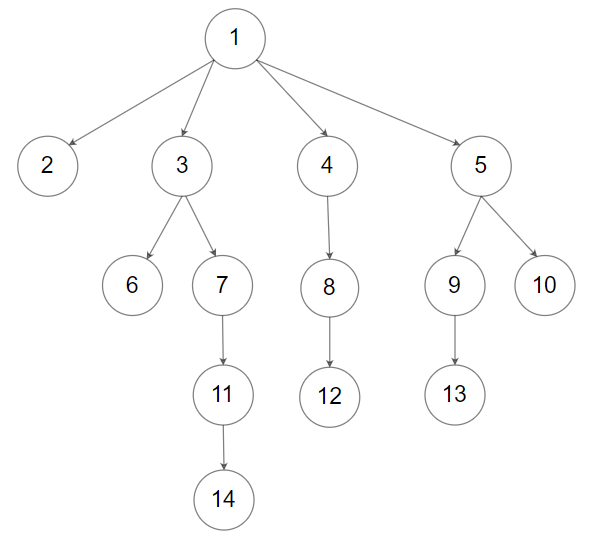
For example, the above tree is serialized as [1,null,2,3,4,5,null,null,6,7,null,8,null,9,10,null,null,11,null,12,null,13,null,null,14].
Example 1:
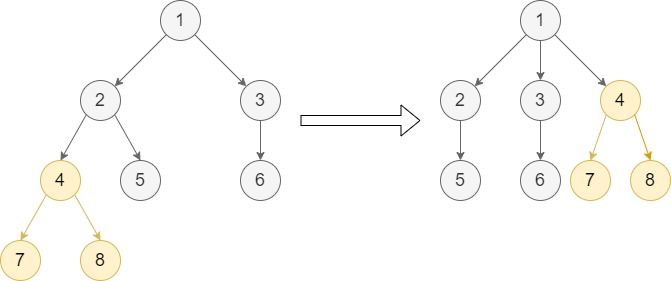
Input: root = [1,null,2,3,null,4,5,null,6,null,7,8], p = 4, q = 1
Output: [1,null,2,3,4,null,5,null,6,null,7,8]
Explanation: This example follows the second case as node p is in the sub-tree of node q. We move node p with its sub-tree to be a direct child of node q.
Notice that node 4 is the last child of node 1.
Example 2:
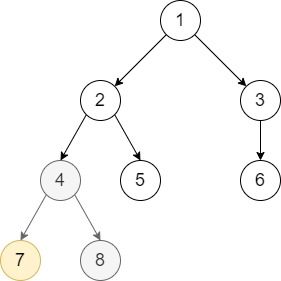
Input: root = [1,null,2,3,null,4,5,null,6,null,7,8], p = 7, q = 4
Output: [1,null,2,3,null,4,5,null,6,null,7,8]
Explanation: Node 7 is already a direct child of node 4. We don't change anything.
Example 3:
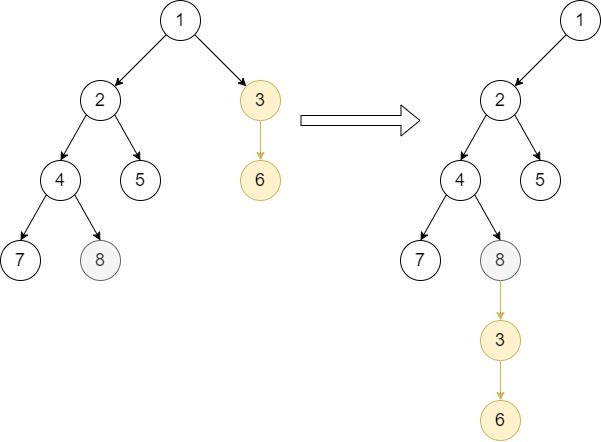
Input: root = [1,null,2,3,null,4,5,null,6,null,7,8], p = 3, q = 8
Output: [1,null,2,null,4,5,null,7,8,null,null,null,3,null,6]
Explanation: This example follows case 3 because node p is not in the sub-tree of node q and vice-versa. We can move node 3 with its sub-tree and make it as node 8's child.
Example 4:
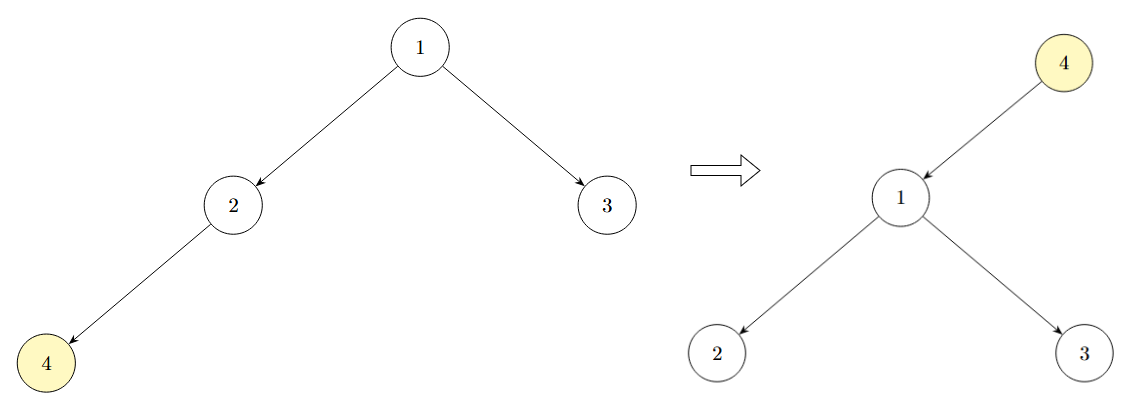
Input: root = [1,null,2,3,null,4], p = 1, q = 4
Output: [4,null,1,null,2,3]
Explanation: This example follows case 1 because node q is in the sub-tree of node p. Disconnect 4 with its parent and move node 1 with its sub-tree and make it as node 4's child.
Constraints:
- The total number of nodes is between
[2, 1000]. - Each node has a unique value.
p != nullq != nullpandqare two different nodes (i.e.p != q).
Solutions
Solution 1
Thinking
We must move the subtree rooted at \(p\) so that \(p\) becomes a child of \(q\). Rewiring pointers without regard to ancestry breaks the tree when \(q\) lies inside \(p\)'s subtree: detaching \(p\) also disconnects \(q\) from the rest of the tree.
Locate \(p\), \(q\), and their parents, and test the ancestor relation. If \(q\) is under \(p\), first attach \(q\) to \(p\)'s original parent, then attach \(p\) under \(q\); otherwise detach \(p\) from its parent and hang it under \(q\). The tree is small enough that a couple of traversals suffice to find the nodes and rewrite the links.
1 | |
1 | |
1 | |
1 | |