1503. Last Moment Before All Ants Fall Out of a Plank



Description
We have a wooden plank of the length n units. Some ants are walking on the plank, each ant moves with a speed of 1 unit per second. Some of the ants move to the left, the other move to the right.
When two ants moving in two different directions meet at some point, they change their directions and continue moving again. Assume changing directions does not take any additional time.
When an ant reaches one end of the plank at a time t, it falls out of the plank immediately.
Given an integer n and two integer arrays left and right, the positions of the ants moving to the left and the right, return the moment when the last ant(s) fall out of the plank.
Example 1:
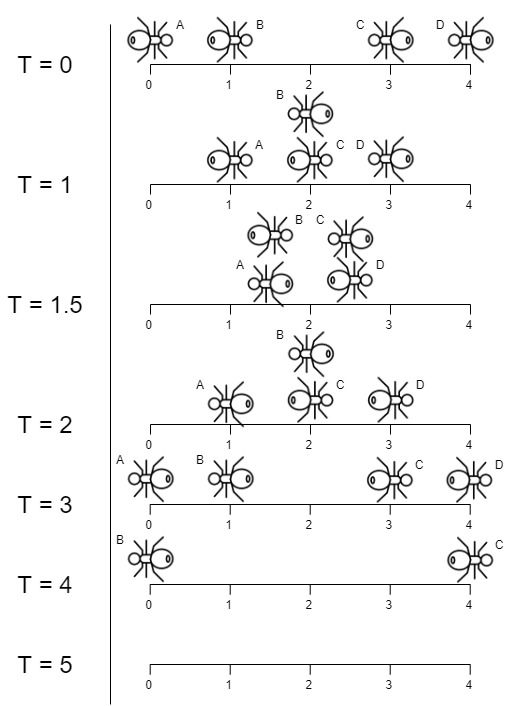
Input: n = 4, left = [4,3], right = [0,1]
Output: 4
Explanation: In the image above:
-The ant at index 0 is named A and going to the right.
-The ant at index 1 is named B and going to the right.
-The ant at index 3 is named C and going to the left.
-The ant at index 4 is named D and going to the left.
The last moment when an ant was on the plank is t = 4 seconds. After that, it falls immediately out of the plank. (i.e., We can say that at t = 4.0000000001, there are no ants on the plank).
Example 2:

Input: n = 7, left = [], right = [0,1,2,3,4,5,6,7]
Output: 7
Explanation: All ants are going to the right, the ant at index 0 needs 7 seconds to fall.
Example 3:

Input: n = 7, left = [0,1,2,3,4,5,6,7], right = []
Output: 7
Explanation: All ants are going to the left, the ant at index 7 needs 7 seconds to fall.
Constraints:
1 <= n <= 1040 <= left.length <= n + 10 <= left[i] <= n0 <= right.length <= n + 10 <= right[i] <= n1 <= left.length + right.length <= n + 1- All values of
leftandrightare unique, and each value can appear only in one of the two arrays.
Solutions
Solution 1: Brain Teaser
Thinking
Simulating every second and reversing on collisions costs time proportional to the plank length times the number of ants. That can pass for \(n\le 10^4\), yet it is clumsy and unnecessary.
When two ants meet and turn around, their later positions coincide with the paths they would take if they passed through each other. Collisions can therefore be ignored, and the answer is the maximum time for a left-going ant to reach \(0\) or a right-going ant to reach \(n\).
The key point of the problem is that when two ants meet and then turn around, it is equivalent to the two ants continuing to move in their original directions. Therefore, we only need to find the maximum distance moved by any ant.
Note that the lengths of the \(\textit{left}\) and \(\textit{right}\) arrays may be \(0\).
The time complexity is \(O(n)\), where \(n\) is the length of the plank. The space complexity is \(O(1)\).
1 2 3 4 5 6 7 8 | |
1 2 3 4 5 6 7 8 9 10 11 12 | |
1 2 3 4 5 6 7 8 9 10 11 12 13 | |
1 2 3 4 5 6 7 8 9 | |
1 2 3 4 5 6 7 8 9 10 | |