1474. Delete N Nodes After M Nodes of a Linked List 🔒

Description
You are given the head of a linked list and two integers m and n.
Traverse the linked list and remove some nodes in the following way:
- Start with the head as the current node.
- Keep the first
mnodes starting with the current node. - Remove the next
nnodes - Keep repeating steps 2 and 3 until you reach the end of the list.
Return the head of the modified list after removing the mentioned nodes.
Example 1:

Input: head = [1,2,3,4,5,6,7,8,9,10,11,12,13], m = 2, n = 3
Output: [1,2,6,7,11,12]
Explanation: Keep the first (m = 2) nodes starting from the head of the linked List  (1 ->2) show in black nodes.
Delete the next (n = 3) nodes (3 -> 4 -> 5) show in read nodes.
Continue with the same procedure until reaching the tail of the Linked List.
Head of the linked list after removing nodes is returned.
Example 2:
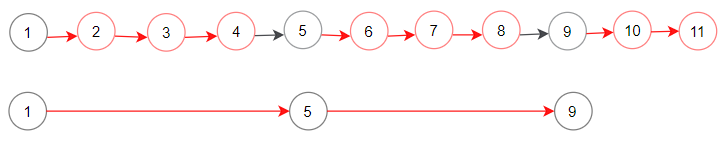
Input: head = [1,2,3,4,5,6,7,8,9,10,11], m = 1, n = 3
Output: [1,5,9]
Explanation: Head of linked list after removing nodes is returned.
Constraints:
- The number of nodes in the list is in the range
[1, 104]. 1 <= Node.val <= 1061 <= m, n <= 1000
Follow up: Could you solve this problem by modifying the list in-place?
Solutions
Solution 1: Simulation
Thinking
Repeatedly keep \(m\) nodes and drop \(n\). Advance \(\textit{pre}\) over the kept segment, skip \(n\) nodes with \(\textit{cur}\), then relink \(\textit{pre.next}\). Stop early if the list runs out.
We can simulate the entire deletion process. First, use a pointer \(\textit{pre}\) to point to the head of the linked list, then traverse the linked list, moving \(m - 1\) steps. If \(\textit{pre}\) is null, it means the number of nodes from the current node is less than \(m\), so we directly return the head. Otherwise, use a pointer \(\textit{cur}\) to point to \(\textit{pre}\), then move \(n\) steps. If \(\textit{cur}\) is null, it means the number of nodes from \(\textit{pre}\) is less than \(m + n\), so we directly set the \(\textit{next}\) of \(\textit{pre}\) to null. Otherwise, set the \(\textit{next}\) of \(\textit{pre}\) to the \(\textit{next}\) of \(\textit{cur}\), then move \(\textit{pre}\) to its \(\textit{next}\). Continue traversing the linked list until \(\textit{pre}\) is null, then return the head.
The time complexity is \(O(n)\), where \(n\) is the number of nodes in the linked list. The space complexity is \(O(1)\).
1 2 3 4 5 6 7 8 9 10 11 12 13 14 15 16 17 18 19 20 21 | |
1 2 3 4 5 6 7 8 9 10 11 12 13 14 15 16 17 18 19 20 21 22 23 24 25 26 27 28 29 30 | |
1 2 3 4 5 6 7 8 9 10 11 12 13 14 15 16 17 18 19 20 21 22 23 24 25 26 27 28 29 30 31 | |
1 2 3 4 5 6 7 8 9 10 11 12 13 14 15 16 17 18 19 20 21 22 23 24 25 26 27 28 | |
1 2 3 4 5 6 7 8 9 10 11 12 13 14 15 16 17 18 19 20 21 22 23 24 25 26 27 28 29 30 | |