Alice is throwing n darts on a very large wall. You are given an array darts where darts[i] = [xi, yi] is the position of the ith dart that Alice threw on the wall.
Bob knows the positions of the n darts on the wall. He wants to place a dartboard of radius r on the wall so that the maximum number of darts that Alice throws lie on the dartboard.
Given the integer r, return the maximum number of darts that can lie on the dartboard.
Example 1:
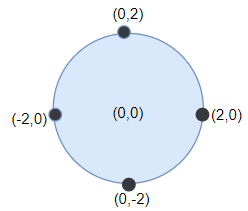
Input: darts = [[-2,0],[2,0],[0,2],[0,-2]], r = 2
Output: 4
Explanation: Circle dartboard with center in (0,0) and radius = 2 contain all points.
Example 2:
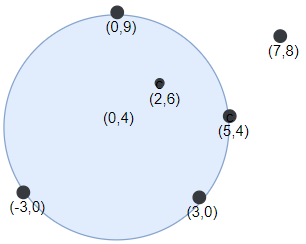
Input: darts = [[-3,0],[3,0],[2,6],[5,4],[0,9],[7,8]], r = 5
Output: 5
Explanation: Circle dartboard with center in (0,4) and radius = 5 contain all points except the point (7,8).
Constraints:
1 <= darts.length <= 100
darts[i].length == 2
-104 <= xi, yi <= 104
All the darts are unique
1 <= r <= 5000
Solutions
Solution 1
Thinking
\(n\le 100\). A maximum covering disk of radius \(r\) can be assumed to pass through two points. For each pair at distance \(\le 2r\), compute the two candidate centers and count covered darts.
A single dart already gives \(1\). Compare distances against \(r\) with a small epsilon so boundary points are kept.