1401. Circle and Rectangle Overlapping



Description
You are given a circle represented as (radius, xCenter, yCenter) and an axis-aligned rectangle represented as (x1, y1, x2, y2), where (x1, y1) are the coordinates of the bottom-left corner, and (x2, y2) are the coordinates of the top-right corner of the rectangle.
Return true if the circle and rectangle are overlapped otherwise return false. In other words, check if there is any point (xi, yi) that belongs to the circle and the rectangle at the same time.
Example 1:
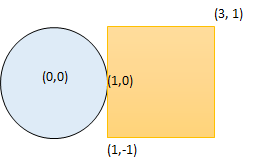
Input: radius = 1, xCenter = 0, yCenter = 0, x1 = 1, y1 = -1, x2 = 3, y2 = 1
Output: true
Explanation: Circle and rectangle share the point (1,0).
Example 2:
Input: radius = 1, xCenter = 1, yCenter = 1, x1 = 1, y1 = -3, x2 = 2, y2 = -1
Output: false
Example 3:
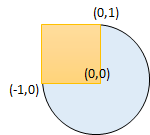
Input: radius = 1, xCenter = 0, yCenter = 0, x1 = -1, y1 = 0, x2 = 0, y2 = 1
Output: true
Constraints:
1 <= radius <= 2000-104 <= xCenter, yCenter <= 104-104 <= x1 < x2 <= 104-104 <= y1 < y2 <= 104
Solutions
Solution 1: Mathematics
Thinking
Sampling grid points or checking only the four corners misses edge and interior intersections. Coordinates go to \(10^4\), so we need an exact geometric test.
The circle meets the rectangle iff the closest point of the rectangle to the center lies inside the circle. That point's \(x\) and \(y\) can be clamped independently to \([x_1,x_2]\) and \([y_1,y_2]\).
A coordinate that already lies in its interval contributes distance \(0\); otherwise we take the nearer endpoint. Compare the sum of squared distances with \(radius^2\).
For a point \((x, y)\), its shortest distance to the center of the circle \((xCenter, yCenter)\) is \(\sqrt{(x - xCenter)^2 + (y - yCenter)^2}\). If this distance is less than or equal to the radius \(radius\), then this point is within the circle (including the boundary).
For points within the rectangle (including the boundary), their x-coordinates \(x\) satisfy \(x_1 \leq x \leq x_2\), and their y-coordinates \(y\) satisfy \(y_1 \leq y \leq y_2\). To determine whether the circle and rectangle overlap, we need to find a point \((x, y)\) within the rectangle such that \(a = |x - xCenter|\) and \(b = |y - yCenter|\) are minimized. If \(a^2 + b^2 \leq radius^2\), then the circle and rectangle overlap.
Therefore, the problem is transformed into finding the minimum value of \(a = |x - xCenter|\) when \(x \in [x_1, x_2]\), and the minimum value of \(b = |y - yCenter|\) when \(y \in [y_1, y_2]\).
For \(x \in [x_1, x_2]\):
- If \(x_1 \leq xCenter \leq x_2\), then the minimum value of \(|x - xCenter|\) is \(0\);
- If \(xCenter < x_1\), then the minimum value of \(|x - xCenter|\) is \(x_1 - xCenter\);
- If \(xCenter > x_2\), then the minimum value of \(|x - xCenter|\) is \(xCenter - x_2\).
Similarly, we can find the minimum value of \(|y - yCenter|\) when \(y \in [y_1, y_2]\). We can use a function \(f(i, j, k)\) to handle the above situations.
That is, \(a = f(x_1, x_2, xCenter)\), \(b = f(y_1, y_2, yCenter)\). If \(a^2 + b^2 \leq radius^2\), then the circle and rectangle overlap.
1 2 3 4 5 6 7 8 9 10 11 12 13 14 15 16 17 18 19 | |
1 2 3 4 5 6 7 8 9 10 11 12 13 14 15 | |
1 2 3 4 5 6 7 8 9 10 11 12 13 14 | |
1 2 3 4 5 6 7 8 9 10 11 12 13 14 | |
1 2 3 4 5 6 7 8 9 10 11 12 13 14 15 16 17 18 19 | |