A ZigZag path for a binary tree is defined as follow:
Choose any node in the binary tree and a direction (right or left).
If the current direction is right, move to the right child of the current node; otherwise, move to the left child.
Change the direction from right to left or from left to right.
Repeat the second and third steps until you can't move in the tree.
Zigzag length is defined as the number of nodes visited - 1. (A single node has a length of 0).
Return the longest ZigZag path contained in that tree.
Example 1:
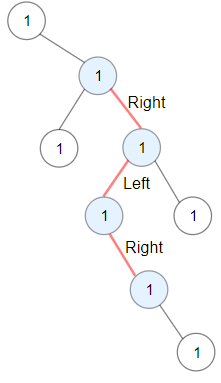
Input: root = [1,null,1,1,1,null,null,1,1,null,1,null,null,null,1]
Output: 3
Explanation: Longest ZigZag path in blue nodes (right -> left -> right).
Example 2:
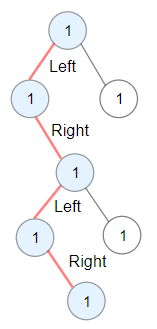
Input: root = [1,1,1,null,1,null,null,1,1,null,1]
Output: 4
Explanation: Longest ZigZag path in blue nodes (left -> right -> left -> right).
Example 3:
Input: root = [1]
Output: 0
Constraints:
The number of nodes in the tree is in the range [1, 5 * 104].
1 <= Node.val <= 100
Solutions
Solution 1
Thinking
A zigzag must alternate left and right while descending. Restarting from every node and direction repeats subtrees. DFS carries the length already obtained if the last step was left (\(l\)) or right (\(r\)). The left child continues with \(r+1\) and resets the right length; the right child is symmetric. A global maximum is kept.
1 2 3 4 5 6 7 8 910111213141516171819
# Definition for a binary tree node.# class TreeNode:# def __init__(self, val=0, left=None, right=None):# self.val = val# self.left = left# self.right = rightclassSolution:deflongestZigZag(self,root:TreeNode)->int:defdfs(root,l,r):ifrootisNone:returnnonlocalansans=max(ans,l,r)dfs(root.left,r+1,0)dfs(root.right,0,l+1)ans=0dfs(root,0,0)returnans
/** * Definition for a binary tree node. * type TreeNode struct { * Val int * Left *TreeNode * Right *TreeNode * } */funclongestZigZag(root*TreeNode)int{ans:=0vardfsfunc(root*TreeNode,l,rint)dfs=func(root*TreeNode,l,rint){ifroot==nil{return}ans=max(ans,max(l,r))dfs(root.Left,r+1,0)dfs(root.Right,0,l+1)}dfs(root,0,0)returnans}