Skip to content

1335. Minimum Difficulty of a Job Schedule

Description

You want to schedule a list of jobs in d days. Jobs are dependent (i.e To work on the ith job, you have to finish all the jobs j where 0 <= j < i).

You have to finish at least one task every day. The difficulty of a job schedule is the sum of difficulties of each day of the d days. The difficulty of a day is the maximum difficulty of a job done on that day.

You are given an integer array jobDifficulty and an integer d. The difficulty of the ith job is jobDifficulty[i].

Return the minimum difficulty of a job schedule. If you cannot find a schedule for the jobs return -1.


Example 1:
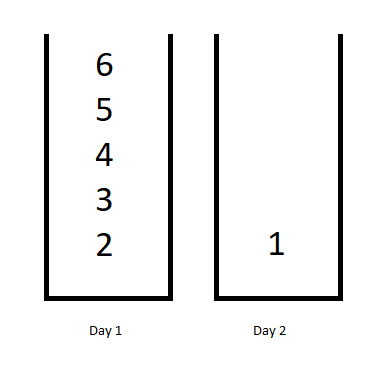
Input: jobDifficulty = [6,5,4,3,2,1], d = 2
Output: 7
Explanation: First day you can finish the first 5 jobs, total difficulty = 6.
Second day you can finish the last job, total difficulty = 1.
The difficulty of the schedule = 6 + 1 = 7 

Example 2:

Input: jobDifficulty = [9,9,9], d = 4
Output: -1
Explanation: If you finish a job per day you will still have a free day. you cannot find a schedule for the given jobs.

Example 3:

Input: jobDifficulty = [1,1,1], d = 3
Output: 3
Explanation: The schedule is one job per day. total difficulty will be 3.


Constraints:

  • 1 <= jobDifficulty.length <= 300
  • 0 <= jobDifficulty[i] <= 1000
  • 1 <= d <= 10

Solutions

Solution 1: Dynamic Programming

Thinking

Split the job sequence into \(d\) contiguous days; a day's difficulty is its max job, and the total should be minimal. Jobs stay in order. \(n \le 300\), \(d \le 10\) still forbids enumerating all cuts. The best way to finish \(i\) jobs in \(j\) days depends only on the last day covering \([k..i]\).

\(f[i][j]\) stores that optimum. Enumerating \(k\) backward maintains the segment max and transitions from \(f[k-1][j-1]\). Fewer jobs than days is impossible.

We define \(f[i][j]\) as the minimum difficulty to finish the first \(i\) jobs within \(j\) days. Initially \(f[0][0] = 0\), and all other \(f[i][j]\) are \(\infty\).

For the \(j\)-th day, we can choose to finish jobs \([k,..i]\) on this day. Therefore, we have the following state transition equation:

\[ f[i][j] = \min_{k \in [1,i]} \{f[k-1][j-1] + \max_{k \leq t \leq i} \{jobDifficulty[t]\}\} \]

The final answer is \(f[n][d]\).

The time complexity is \(O(n^2 \times d)\), and the space complexity is \(O(n \times d)\). Here \(n\) and \(d\) are the number of jobs and the number of days respectively.

 1
 2
 3
 4
 5
 6
 7
 8
 9
10
11
12
class Solution:
    def minDifficulty(self, jobDifficulty: List[int], d: int) -> int:
        n = len(jobDifficulty)
        f = [[inf] * (d + 1) for _ in range(n + 1)]
        f[0][0] = 0
        for i in range(1, n + 1):
            for j in range(1, min(d + 1, i + 1)):
                mx = 0
                for k in range(i, 0, -1):
                    mx = max(mx, jobDifficulty[k - 1])
                    f[i][j] = min(f[i][j], f[k - 1][j - 1] + mx)
        return -1 if f[n][d] >= inf else f[n][d]
 1
 2
 3
 4
 5
 6
 7
 8
 9
10
11
12
13
14
15
16
17
18
19
20
21
class Solution {
    public int minDifficulty(int[] jobDifficulty, int d) {
        final int inf = 1 << 30;
        int n = jobDifficulty.length;
        int[][] f = new int[n + 1][d + 1];
        for (var g : f) {
            Arrays.fill(g, inf);
        }
        f[0][0] = 0;
        for (int i = 1; i <= n; ++i) {
            for (int j = 1; j <= Math.min(d, i); ++j) {
                int mx = 0;
                for (int k = i; k > 0; --k) {
                    mx = Math.max(mx, jobDifficulty[k - 1]);
                    f[i][j] = Math.min(f[i][j], f[k - 1][j - 1] + mx);
                }
            }
        }
        return f[n][d] >= inf ? -1 : f[n][d];
    }
}
 1
 2
 3
 4
 5
 6
 7
 8
 9
10
11
12
13
14
15
16
17
18
19
class Solution {
public:
    int minDifficulty(vector<int>& jobDifficulty, int d) {
        int n = jobDifficulty.size();
        int f[n + 1][d + 1];
        memset(f, 0x3f, sizeof(f));
        f[0][0] = 0;
        for (int i = 1; i <= n; ++i) {
            for (int j = 1; j <= min(d, i); ++j) {
                int mx = 0;
                for (int k = i; k; --k) {
                    mx = max(mx, jobDifficulty[k - 1]);
                    f[i][j] = min(f[i][j], f[k - 1][j - 1] + mx);
                }
            }
        }
        return f[n][d] == 0x3f3f3f3f ? -1 : f[n][d];
    }
};
 1
 2
 3
 4
 5
 6
 7
 8
 9
10
11
12
13
14
15
16
17
18
19
20
21
22
23
24
25
func minDifficulty(jobDifficulty []int, d int) int {
    n := len(jobDifficulty)
    f := make([][]int, n+1)
    const inf = 1 << 30
    for i := range f {
        f[i] = make([]int, d+1)
        for j := range f[i] {
            f[i][j] = inf
        }
    }
    f[0][0] = 0
    for i := 1; i <= n; i++ {
        for j := 1; j <= min(d, i); j++ {
            mx := 0
            for k := i; k > 0; k-- {
                mx = max(mx, jobDifficulty[k-1])
                f[i][j] = min(f[i][j], f[k-1][j-1]+mx)
            }
        }
    }
    if f[n][d] == inf {
        return -1
    }
    return f[n][d]
}
 1
 2
 3
 4
 5
 6
 7
 8
 9
10
11
12
13
14
15
16
function minDifficulty(jobDifficulty: number[], d: number): number {
    const n = jobDifficulty.length;
    const inf = 1 << 30;
    const f: number[][] = new Array(n + 1).fill(0).map(() => new Array(d + 1).fill(inf));
    f[0][0] = 0;
    for (let i = 1; i <= n; ++i) {
        for (let j = 1; j <= Math.min(d, i); ++j) {
            let mx = 0;
            for (let k = i; k > 0; --k) {
                mx = Math.max(mx, jobDifficulty[k - 1]);
                f[i][j] = Math.min(f[i][j], f[k - 1][j - 1] + mx);
            }
        }
    }
    return f[n][d] < inf ? f[n][d] : -1;
}

Comments